The Red Virgin: Motherhood and Power Dynamics

“I shall do as you request, and tell you everything about myself […] You may like me, but I am not alive.” –Hildegarte, played by Ivana Baquero in The Red Virgin

“I will do as you ask and tell you everything about myself. My name is Aurora Rodriguez and you will not like me. I killed my daughter…”  –Aurora, played by Maribel Verdú in The Red Virgin

TRV_BOCETOS

The Red Virgin – La virgen roja (dir. Sheila Pye, 2012)

In 1933, Aurora Rodriguez Carballeira murdered her 18-year old daughter Hildegart Rodriguez (1914-1933) in their Madrid residence. The senseless assassination sparked outrage and scandal within the intellectual community, as the young Hildegart had become a prominent public figure in Spain and a vocal advocate of modern sexual reform in Western Europe. Aurora had “created” Hildegart as a eugenic experiment, and she exerted extreme control over her daughter’s education and public persona. It is said that Hildegart could read and write by the age of 3; she could speak several languages by the time she was 6 years old; and she became a lawyer by the age of 17. Moreover, despite her youth, Hildegart communicated with some of the most well-known doctors, researchers, and intellectuals of her era, engaging with a variety of topics pertaining to sexual reform and human sexuality. Spain’s Dr. Gregorio Marañon, Britain’s Havelock Ellis, and the US’s Margaret Sanger were among the internationally respected figures with whom Hildegart corresponded.  The short film, The Red Virgin (dir. Sheila Pye, 2012), depicts the tragic, Frankensteinian tale of this ill-fated mother-daughter pair, imbuing the narrative with symbolic and suggestive imagery.
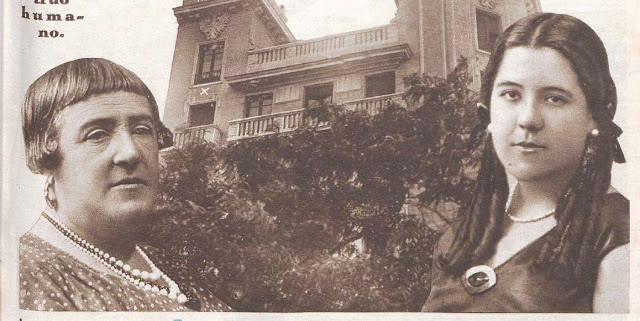
Aurora (mother) and Hildegart (daughter) Rodriguez – photo 1920-1930

Last fall I wrote a short post about this film and the documentary-style Spanish podcast (from the Radio Nacional Española) that details the biography of the Aurora as well as the historical context of Hildegart’s life and death. The English title of the podcast is “Aurora Rodríguez y su hija Hildegarte: The assassination of the modern woman”. I planned to incorporate both The Red Virgin and the podcast into my literature seminar this semester and, now that I have done so, I wanted to share my teaching experience and my students’ projects. This will be the third in my series of posts detailing the materials, resources, and lesson plans I created for use in a 300-level Spanish literature seminar. At the end of this post are the necessary links and documents (Word files) for adapting this particular topic to a course-plan or lesson of your own.

Overall, my students reacted quite positively to both the film and podcast. They had a bit of difficulty with the podcast, which I had anticipated, but they were able to grasp the most important details with the guide I had provided. Even though a few may have struggled with comprehension, I definitely think it was a worthwhile exercise as it required them to listen to a rather fast-paced Spanish program that contained advanced grammar structures and academic vocabulary.  Regarding the film, one of the scenes that generated the most discussion was that in which Aurora (the mother) is dressed as a bullfighter (matador; torero), while Hildegart (her daughter) functions as a stand-in for the victimized bull. Several students discussed the symbolism of this scene in their final essays.

Aurora as the bullfighter (matador) - The Red Virgin

Aurora as the bullfighter (matador/torero) – The Red Virgin

Hildegart as a bull (toro) - The Red Virgin

Hildegart as a bull (toro) – The Red Virgin

For the essay on this film, I required my class to first analyze the film’s presentation of either maternity/motherhood or female sexuality (2/3 of the paper), and to then provide their critical reaction or evaluation (1/3 of the paper). I made it clear that they should not merely discuss whether or not they liked/disliked the film, but that they should provide a thoughtful critical commentary.  I suggested they compare the message or themes within the film to those they observed in other texts from the course, or perhaps discuss the film’s success (or failure) in communicating a particular message. Below are a few of the titles of my students’ essays and – just as I did with my assignment on Carmen de Burgos’s La rampa – I required them to select an image to accompany their work:

“El poder de la madre en The Red Virgin [The Power of the Mother  / The Mother’s Power in The Red Virgin] – This paper proposes that the film represents motherhood as a role that affords women an enormous amount of power and influence over their children and, by extension, the future of their society and/or nation. The thesis is supported through analyses of the parallel scenes at the beginning and end of the film, the wardrobe, and carefully selected close-up shots.
El poder de la madre

El poder de la madre


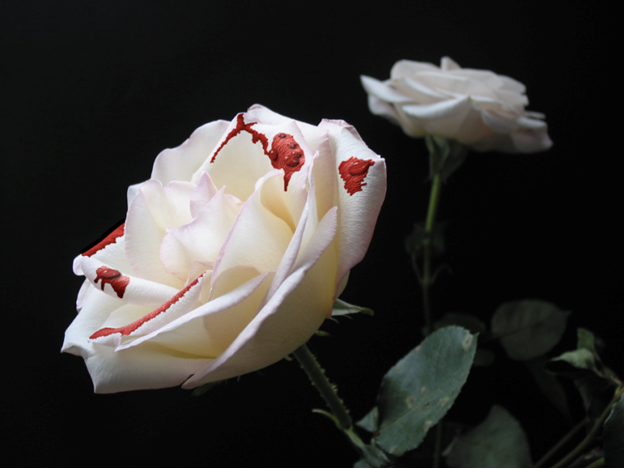
“La mancha de la maternidad” [The Stain of Motherhood/Maternity] – This essay discusses the absence of maternal love and devotion that characterized Aurora’s relationship with her daughter, Hildegart.  The paper proposes that the calculating, controlling, and cold nature of Aurora’s maternal philosophy essentially stains the idyllic image of motherhood that Spanish culture strove to maintain. The thesis is supported by noting the irony in the first scene titled “Amor” (a scene in which little maternal love is demonstrated), and by analyzing the changes in color and lighting in the parallel first and last scenes.
"La mancha de la maternidad"

“La mancha de la maternidad”


“La maternidad: Un analisis sobre la esclavitud [Motherhood/Maternity: An analysis of slavery] – This essay argues that Aurora’s controlling motherhood is presented first as the ownership of property, and later as an oppressive relationship that mirrors the master-slave dynamic. Upon examining this dynamic and the obsession with controlling one’s property, the paper suggests that such a mother-child power-play can lead to a specifically feminine (maternal) illness.

Mother and Child (Madonna) - Egon Schiele

Mother and Child (Egon Schiele, 1908). Image via: http://www.wikiart.org


“La sexualidad femenina: no todo es blanco o negro” [Feminine Sexuality: Not Everything is Black or White] – This paper analyzes the ambiguous sexual undertones of the film in order to argue that Spanish society’s negative view of sexually active women contributes to a dangerous identity conflict that causes the repression of female sexuality. This enforced repression becomes dangerous for both individual women and for society in general. The essay discusses how The Red Virgin presents sexuality through interpretations of the symbolic colors of the wardrobe and analyses of the various shifts between close-, medium-, and long-shots.

Two Tahitian Women by Paul Gauguin (1899)


“Su madre, su dueño” [Her Mother, Her Owner] – This essay focuses on the way in which motherhood has been historically valued as a virtuous service (“oficio santo”) to the family, community, and nation. It proposes, however, that The Red Virgin critiques the power dynamic and subsequent abuse of power that may result in mother-child relationships. The thesis is supported with analyses of the camera angles, the position of the characters within different scenes/shots, and the symbolism of the caged canary.

Su madre su dueño

Su madre su dueño


How have you incorporated free online materials into your classes? Have students reacted favorably to listening to a podcast or watching an online film rather than reading traditional articles or books? What open source, online resources have you found to be the most useful and user-friendly?

Resources:
(1) Film: The Red Virgin (dir. Sheila Pye, 2012): http://vimeo.com/62044318
(2) Podcast: “Aurora Rodríguez y su hija Hildegarte: el asesinato de la mujer moderna.” from la Radio Nacional Española: Documentos RNE
(3) Homework and class discussion questions for the podcast and the film: Asesinato de la mujer moderna_tarea
(4) Essay topic – Analysis of and critical reaction to the film: Essay_La virgen roja
(5) Syllabus (Spring 2014, Grinnell College) – “Refashioning the Self: Hispanic Women’s Literature of the 20th Century” SPN 295_Syllabus_SP14_ReFashioning the Self

 

Posted in Feminism, First-wave spanish feminism, History, Pedagogy, Science and Medicine, Spain, Women | Tagged , , , , , , , , , , , , , , , , , , , , | 7 Comments

Picasso on Maternity and Motherhood

A few weeks ago, students in my Hispanic Women’s Literature course turned in their first paper on Carmen de Burgos’ La rampa. Part of their assignment was to include an image with their essay. One student selected the following painting, a 1905 portrait by Picasso:

“Maternidad”, Picasso, 1905. Rose Period.

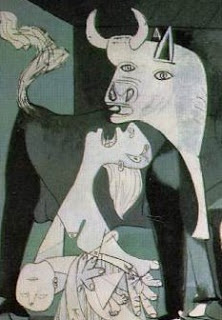
Since I was not familiar with the context of this particular painting, despite the fact that my research on women’s literary representations of motherhood and maternity in early 20th century Spain is related both historically and thematically, I decided to do a bit of investigating. As I began searching for information, I discovered that Picasso had in fact created numerous paintings entitled “Maternidad” – a quick Google-image search was all I needed!  In addition to various renditions of “Maternidad” (Maternity or Motherhood, in English), Picasso also created a number of paintings that depict mothers with their children, several of which are titled “Madre e hijo” (Mother and Child). While I had seen many of these before, I had not considered how they might relate to my research on early 20th century Spanish literature, and I now find myself more closely examining Picasso’s appropriation and depiction of maternal themes. I had already studied the mother-child relationship that appears in, and is in fact thematically central to, one of his most famous pieces, Guernica, created just after the onset of the Spanish Civil War. Unlike some of his more classic and tender renditions of maternity, the mother-child relationship in Guernica is fraught with agony, suffering, and death. It thus serves not merely to demonstrate, but to amplify and critique the extreme horrors and senselessness that war brings to an innocent populace:

“Guernica”, detail (madre e hijo / mother and child), Picasso, 1937.

This maternal representation in Guernica is the result of numerous studies, and some art historians have interpreted the mother figure metaphorically as representative of certain political and national powers in times of war. The stylistic discrepancy between Picasso’s 1905 and 1937 portrayal of maternal devotion is fascinating from both personal and historical perspectives. Yet a contrast between these two samples alone does not adequately characterize Picasso’s treatment of maternal themes in the early 20th century, and in fact runs contrary to the more general trajectory identified by some scholars. Below are some examples of the treatment of maternity and motherhood in Picasso’s oeuvre. This is by no means a comprehensive analysis, but rather a “springboard” of sorts from which I have just begun to investigate the possible parallels between the literary themes I study and their appearance in contemporary artwork.

In his 2005 article – “La representación de lo materno en Pablo Picasso y Soledad Puértolas” – Pablo Pintado-Casas argues that Picasso’s treatment of maternal themes in his paintings is marked by a strong autobiographical impulse that singularly affects the manner of representation. That is, earlier paintings depict a mother figure that reflects sadness, melancholy, and poverty, similar to the other subjects that appear in his “Blue Period” (Época o periodo azul), 1900-1904 (p. 112). Such portrayals also hark back to Emile Zola and Naturalist impulses of the late nineteenth century. In the Blue Period, maternity and motherhood are in fact frequent subjects, and the life-giving mother figure is paradoxically placed in a dark, blue-gray context that evokes death, illness, and suffering. The accessible introductory text, Essential Picasso, identifies Picasso’s series of “Madonnas” during this time as a prime example of his penchant for combining themes of religion and poverty: “The almost monochromatic use of blue in this period, and its traditional association with the Madonna, are superbly combined to produce a set of haunting, almost ghostly images” (p. 26). Below are a few samples:

Picasso_maternidad_blue period_madre e hijo-1901

“Maternidad” (Mother and Child), Picasso, 1901.

Picasso_maternidad_blue period_madre e hijo-1903-wikipedia

“Maternidad, madre e hijo” (Maternity, mother and child), Picasso, 1903. Image via Wikipedia

23b66-7-picassomaternidad

“Madre e hijo” (Mother and child), Picasso, 1905.

After seeing these variations on the maternal experience, I think they would serve as evocative complements to Carmen de Burgos’ La rampa in one of my future literature courses, as the novel deals extensively with the harsh realities of maternity for a poor, working-class woman in urban Madrid. Returning to Picasso, this dark “Blue Period” was immediately followed by the “Rose Period” (Época o periodo rosa) from 1904-1906, during which time the artist completed the painting that I included at the top of this post (“Maternidad,” 1905). The Rose period is marked by brighter shades of orange and pink, as well as by subtle lines of expressionism. Picasso’s tendency to render marginalized individuals or social outcasts as worthy artistic subjects is evident by the ubiquitous appearances of circus performers, individuals who were dedicated to their art (performance), yet were frequently mocked by society. The first image of this post, the image my student chose for her paper, was produced during the Rose Period. Below are a few more examples of mothers and their children in this aesthetic:

Picasso_maternidad_madre e hijo saltimbanquis-1905

“Madre e hijo saltimbanquis” (Mother and Child Acrobats), Picasso, 1905.

Picasso_maternidad_Familia de acrobatas con mono

“Familia de acróbats con mono” (Family of acrobats with monkey), Picasso, 1905. Image via WahooArt.

Returning to the aforementioned article, Pintado-Casas points to 1919-1921 as years that mark a transition in the trajectory of maternal themes in Picasso’s work. He attributes this shift not only to the fact that Picasso traveled throughout Italy and Greece studying neoclassicism and the Italian Renaissance, but that he also became a father (p. 111). The experience of fatherhood especially prompted him to contemplate and approach maternity and motherhood from a new vantage point (p. 113).  Picasso’s later depictions of mothers and children reveal a more intimate perspective that admires and glorifies maternity and motherhood. The Art Institute of Chicago agrees with Pintado-Casas’ observations, and also notes that, unlike those frail and anguished figures of the Blue Period, these classical-period figures are “majestic in proportion and feeling“. Picasso produced at least 12 works on the Mother-Child subject between 1921-23:

picasso_maternidad_Madre e hijo_mar

“Madre e hijo al borde del mar” (Mother and Child on the Seashore), Picasso, 1921. [Art Institute of Chicago]. Image via 20minutos.

picasso_maternidad_Madre e hijo_1921-artnet

“Madre e hijo” (Mother and Child), Picasso, 1921. Image via Artnet


Picasso_maternidad_Mother and child_1922

“Mother and Child”, Picasso (1922)

While the Pintado-Casas’ article and the observations of The Chicago Art Institute provide neatly organized, easily-identifiable categories, there are in fact several works that do not quite fit within these timelines. Here are a few more samples of Picasso’s paintings on “Maternidad” that defy, to some extent, that useful, but perhaps over-simplified, trajectory of the evolution of this theme his work.

Picasso_maternidad en el campo_1901

“Maternity en el campo” (Mother and Child in the countryside),  Picasso, 1901.

As part of the early 1900s’ Blue Period, the above painting evokes the imagery of the “Madonna and Child” with the darker, blue and gray hues and the rural landscape. Yet the contrasting colors of the bucolic background – complete with greens, oranges, and pinks – gives the painting a brighter overall appearance. This bright contrast distances the piece from the melancholic, pessimistic depictions of poverty prevalent in the Blue Period (1900-04) and approaches the lighter tones and optimism expressed in the later Rose Period (1904-06). Below are a few examples of later, more abstract mid- and late-20th century models:

Picasso_maternidad_1963

“Maternidad”, Picasso, 1963. Image via Tlaxcala.org

Picasso_maternidad con manzana_1971

“Maternidad con manzana” (Motherhood with apple), Picasso, 1971. Image via Necesitodetodos.org

What are your favorite pieces of art depicting motherhood, maternity, and/or mothers and their children?  What other versions of Picasso’s numerous takes on the subject do you prefer?

Resources and works cited:
Payne, Laura. Essential Picasso. Introduction by Dr. Julia Kelly. Bath, UK: Dempsey Parr; Parragon, 2000.

Pintado-Casas, Pablo. “La representación de lo materno en Pablo Picasso y Soledad Puértolas.” Letras Femeninas 31.1 (2005): 107-115. [JSTOR: http://www.jstor.org/stable/23021520].

Wischnitzer, Rachel. “Picasso’s ‘Guernica’. A Matter of Metaphor.” Artibus et Historiae 6.12 (1985): 153-72.
[JSTOR:  http://www.jstor.org/stable/1483241].

Save

Posted in Art, Spain, Women | Tagged , , , , , , , , , , , , , | 9 Comments

Pretty Women Use Birth Control – my guest post at Nursing Clio

I’m very excited to have written a guest post for one of my favorite blogs, Nursing Clio. For this piece, I re-visited my very first blog post in which I critiqued, with a sort of “literary analysis” approach, the function of the “silent woman” in a short, Disney-produced 1968 Family Planning film.  For the historians at Nursing Clio, I expanded on the historical context of the creation and production of this film, and I also elaborated on how and why I made connections between a 1960s American production and 1920s medical and (pseudo)scientific research in Spain.

family planningPRETTY WOMEN USE BIRTH CONTROL

I recently came across this amazing vintage video, “Family Planning,” produced by Disney in 1968. Do yourself a favor and take 10 minutes to watch it. In addition to the frivolous use of Donald Duck and the caricature of a “simple” heterosexual couple who appear clueless as to how babies are made, this short film provides us with a wealth of information regarding attitudes towards reproduction in the U.S., and abroad, during the late 1960s. After doing a bit of research, for example, I found out… [read the full post over at Nursing Clio].

Posted in History, Science and Medicine, Spain, Women | Tagged , , , , , , , , , , , , , | 1 Comment

The Dalí Triangle: A Surrealist’s Take on the Catalonian Landscape

Lately I’ve been writing recommendation letters and filling out language evaluation forms for many of my students who are planning to study abroad during the upcoming academic year. Costa Rica… Ecuador… Argentina… Spain… with each request I find myself wishing I were an undergraduate again so that I could spend an entire semester abroad. Somehow it has been 10 years since my semester in Spain (how does time go so fast?!?) and, while I doubt I’ll have the opportunity to spend an extended period of time abroad studying or working in the near future, I will finally have the opportunity to return to Spain this summer for a conference in Santiago de Compostela. The Asociación Hispánica de Humanidades VII Congreso Internacional will take place at the Universidad de Santiago de Compostela, Facultad de Filología, June 26-28, and I am hoping to spend an extra week in Madrid prior to the conference.  In any case, both my jealously of my students’ travel opportunities and my upcoming summer plans in Spain are making me quite nostalgic for my own study abroad experience. So this week I am going to “re-live” it by sharing one of my study abroad highlights: the research I conducted for my undergraduate thesis, “Teaching Language through Culture: A Thematic Unit on Salvador Dalí.”

fullsizeoutput_15b7

Not Spain… but this picture would have gotten me sooooo many likes on Instagram, if it existed in 2004. Photo credit: random stranger in Rome.

First, I will preface this post by emphasizing that this was undergraduate research,” and my understanding of what constitutes research has certainly transformed over the past decade (grad school tends to have that effect, even on an over-achieving undergrad!). For my project, rather than poring over archives or writing away in the library, most of my research time was spent traveling to different towns and museums, taking pictures with my brand new, super-high-tech 3.2 megapixel digital camera, and collecting books, pamphlets, and other realia that might inspire a lesson plan or classroom activity. I was studying for degrees in Spanish and Secondary Education at the time, so my goal was to create an original thematic unit (envisioned as a mini-textbook chapter) that would teach Spanish vocabulary and grammar through a single cultural element: Salvador Dalí. I chose Dalí, my favorite artist at the time, because I thought building creative lessons around his surrealist art and connections to the avant-garde cultural scene of pre-Civil War Spain would capture the attention of even the most apathetic of Spanish language students. I knew that my future high school language classrooms would certainly contain a few disinterested teenagers studying Spanish out of obligation or requirement. To the credit of my 22-year-old self, I have since found this “hypothesis” about how to capture student interest to be correct, both at high school and university levels: Incorporating Dalí’s paintings into my language or literature courses has generated quite dynamic class discussions that include even the shyest, or least enthusiastic, of my students.  One of my most popular blog posts is on my experience bringing Salvador Dalí’s Spanish Civil War paintings and double-images into my course on Textual Analysis, so I thought adding another Dalí piece to my blogging repertoire would be worthwhile.

Teatro-Museo Dali, Figueras

Teatro-Museo Dali, located in the artist’s hometown of Figueras, Spain. Dali designed this building to be the “most surreal object in the world,” and he chose to be buried in the museum’s crypt.

During my semester in Spain back in 2004, I visited what tourist guides refer to as the “Triángulo de Dalí” in Cataluña (the northeast region of Spain, surrounding Barcelona and bordering France).  Over five days, I set out from Barcelona to visit three small towns within about 2 hours of the city, each of which contains a former residence of, or museum dedicated to, Salvador Dalí:  Figueras, Cadaqués (Portlligat), and Púbol. If you ever travel to Spain and have the opportunity to visit any of these towns, I highly recommend each and every one. While I thoroughly enjoy the Teatro-Museo Dalí in the artist’s hometown of Figueras (above), having visited the museum on two separate occasions, my favorite location from this “triangle” is the town of Cadaqués, a small fishing village located on the Costa Brava. Portlligat, just a short walk up the coast from the town, is where you can visit Dalí’s former residence and studio. It has since been converted into a museum, the Casa-Museo Dalí (below), and today you can wander through the labyrinthine passageways viewing the artist’s former studio and living quarters. For more information about this museum, and each of the museums in Figueras and Púbol, you can skim through the official website of the Fundación Gala-Salvador Dalí, in Spanish, English, or Catalan.

Casa-museo Dali, Cadaques

Casa-museo Dali, Cadaques

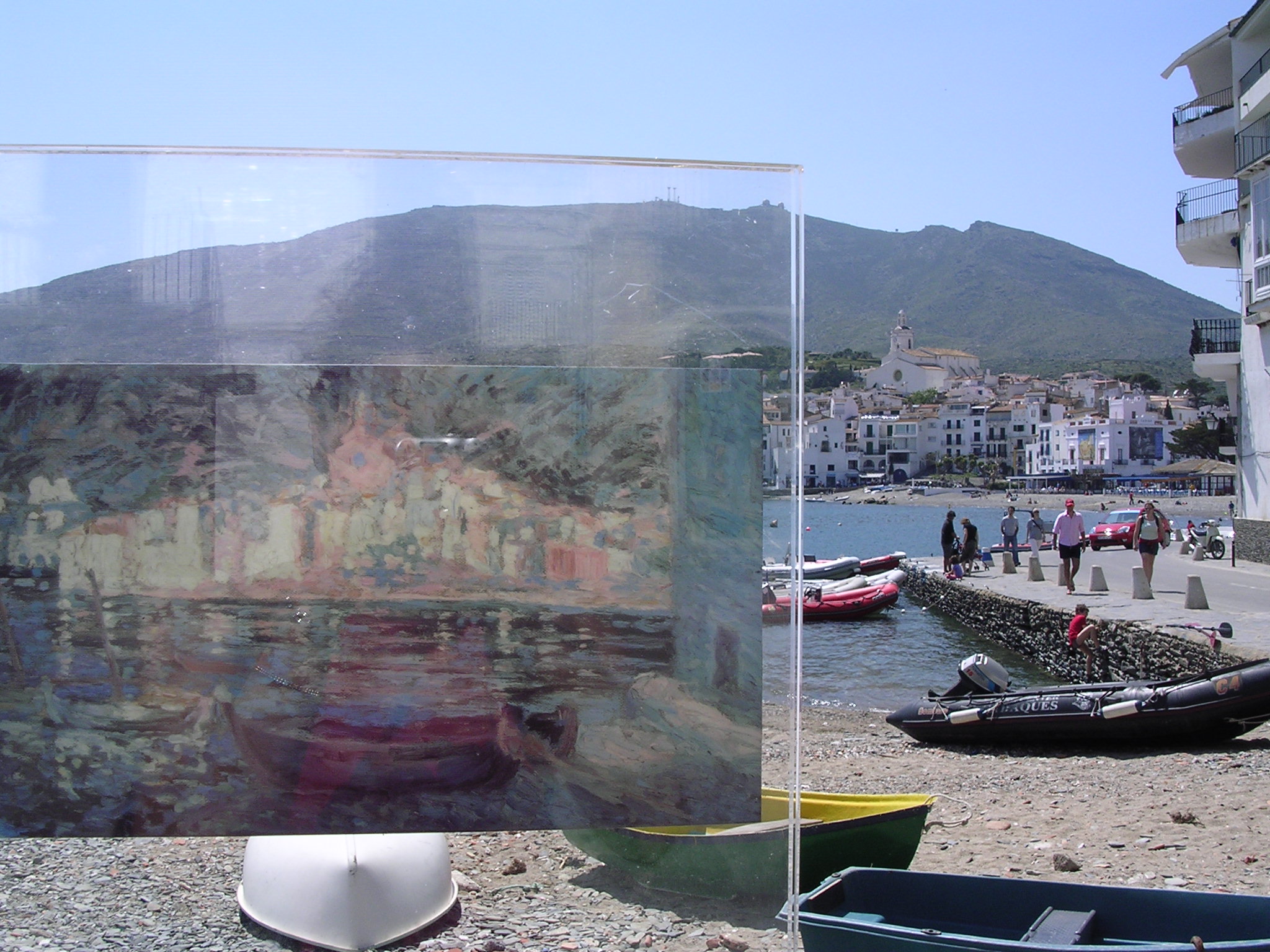
One of the things I enjoyed the most in Cadaqués (in addition to the actual museum-residence) was the veritable “camino de Dalí” created by both the town and the Fundación Gala-Salvador Dalí. Similar to a nature hike in a state or national park, sporadically placed signposts dot the coastal pathways, and each contains a reproduction of one of Dalí’s paintings. These displays are located precisely at the location that appears in, or inspired, each piece. Below are photographs I took of three of these artistic signposts that dot the village. The first displays one of Dalí’s earlier, more abstract surrealist paintings; the pebbled beach of Cadaqués and the rocky Costa Brava make up the background. In this painting, you can also see the triangular rock jutting through the surface of the water (more on this geographical feature below). This signpost, posted on the beach facing the water, allows the viewer to compare the actual view of the beach and sea with the portrayal of this same landscape in this particular painting.

Beach, cadaques, Dali

The second example below displays an impressionist-style painting of the picturesque village, the bay, and several fishing boats. If you look on the right-hand side of both the painting and my photograph, you can see the tall white building in the foreground of both images. This makes it apparent the way in which great care has been taken to display these pieces of art in the precise locations that inspired Dalí.

Cadaques, Spain - Dali

Finally, the third example below is yet another scene of the whitewashed village. This time, however, the town and mountains are far in the background and the bay and fishing boats occupy the central focus of the painting.

Cadaques, Spain - Dali

If you enjoy photography, art, and/or travel, I highly recommend checking out this book, one of my favorites purchased in Spain: Dalí: El triángulo de l’empordà. Even if you cannot read Spanish, it will be worth your time to skim through the fantastic photography and archival materials that trace the influence of these three Catalonian towns – the three “vertices” of the “Triángulo de Dalí” – on Salvador Dalí’s artistic production, life, and relationships. The book demonstrates how the Catalonian countryside and the Costa Brava impacted Dalí’s work, and there are several side-by-side juxtapositions of the spaces and natural geographic features that have been immortalized in his paintings. Below is an example from my copy of the book:

painting cadaques

Sample pages from the book “Dalí: El triángulo de l’emporda”. On the left is a photograph of Cadaques taken around 2000; to the right is a painting of this same portion of the village painted by Dali prior to 1920.

After reading this text, I began to pay especially close attention to the landscapes of my favorite paintings by Dalí.  Below are a few of my photographs from Cadaqués and Portlligat, taken in 2004, alongside some of Dalí’s paintings that contain the same locations, buildings, landscapes, or other geographical features. I have divided the paintings below into two sets. The first are those that contain a depiction of the rock formation “Cucurucuc,” which is visible from any point of the beach in Cadaqués. The second grouping contains paintings with backgrounds that exhibit the contrasting coastal landscape – the calm, smooth waters of the bay against the rugged, rocky coastline at Portlligat.

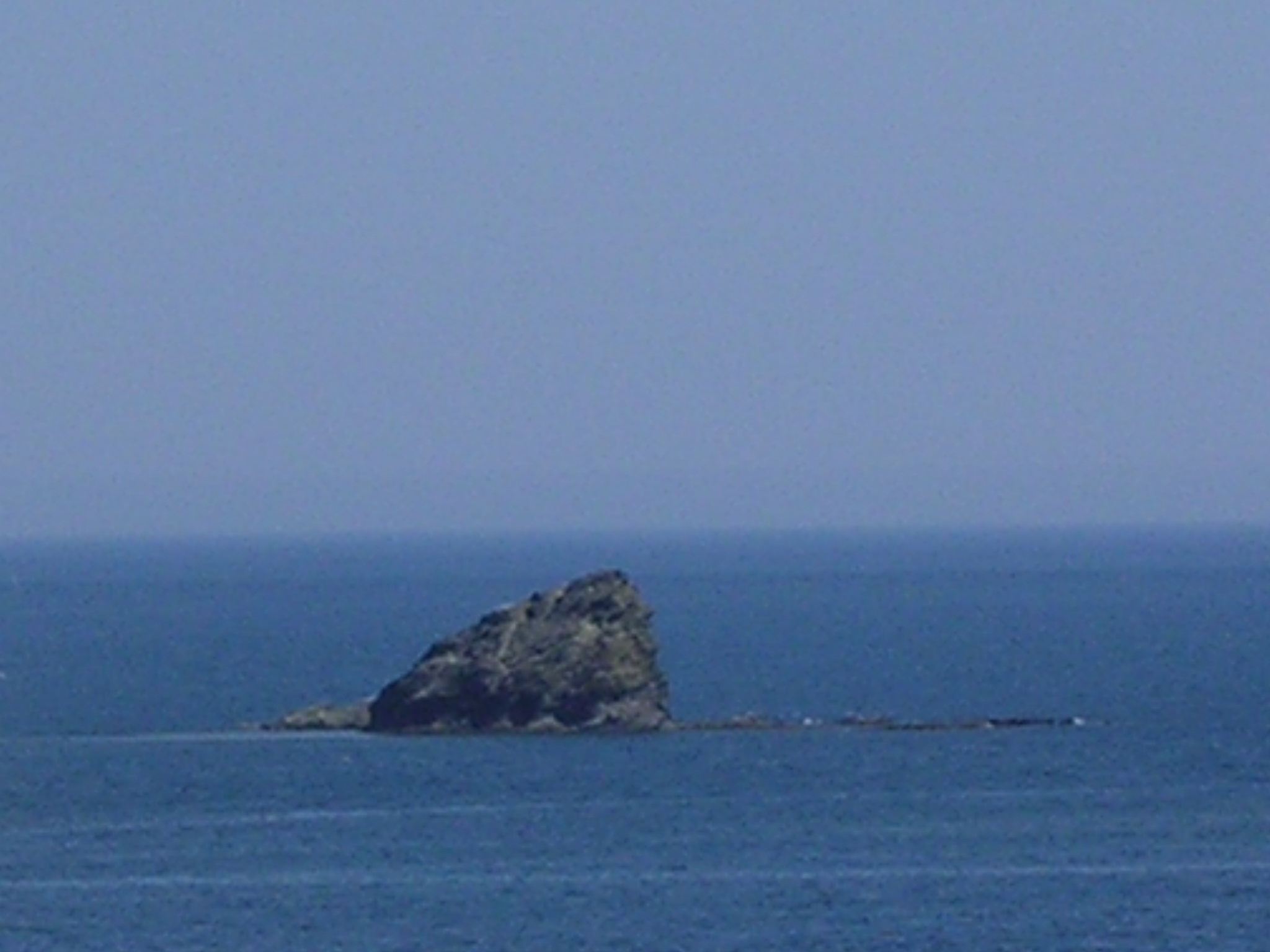
The rock formation “Cucurucu”

Cadaques, rock, Dali

View of “Cucurucu” from the central beach of Cadaques

View from a hilll in Cadaques

A more distant view of “Cucurucu” from a hill within the village

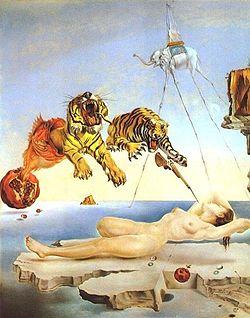
In Dalí: El triángulo de l’empordà, Sebastian Roig describes the “islote Cucurucu” as one of the most magnetic of the Bay of Cadaqués, similar to a rhinoceros’s horn rising out of the water; In his paintings, Dalí converted this rock formation into an energetic symbol of the Mediterranean (Roig 118). This geographic feature is apparent in the background of several Dalí paintings, including my own personal favorite, “Dream caused by the Flight of a Bee around a Pomegranate One Second Before Awakening.”

Dream Caused by the Flight of a Bumblebee around a Pomegranate a Second Before Awakening.jpg

Sueño causado por el vuelo de una abeja alrededor de una granada un segundo antes de despertar [Dream Caused by the Flight of a Bee around a Pomegranate One Second before Awakening] (1944). Image via wikipedia.

Figura rinocerontica del ilisos de fidias [Figure Of Phidias Ilissus Rhino] (1954)

El asno putrefacto [The Rotten Ass] (1928)

La armonía de las esferas [Harmony of Spheres] (1978)

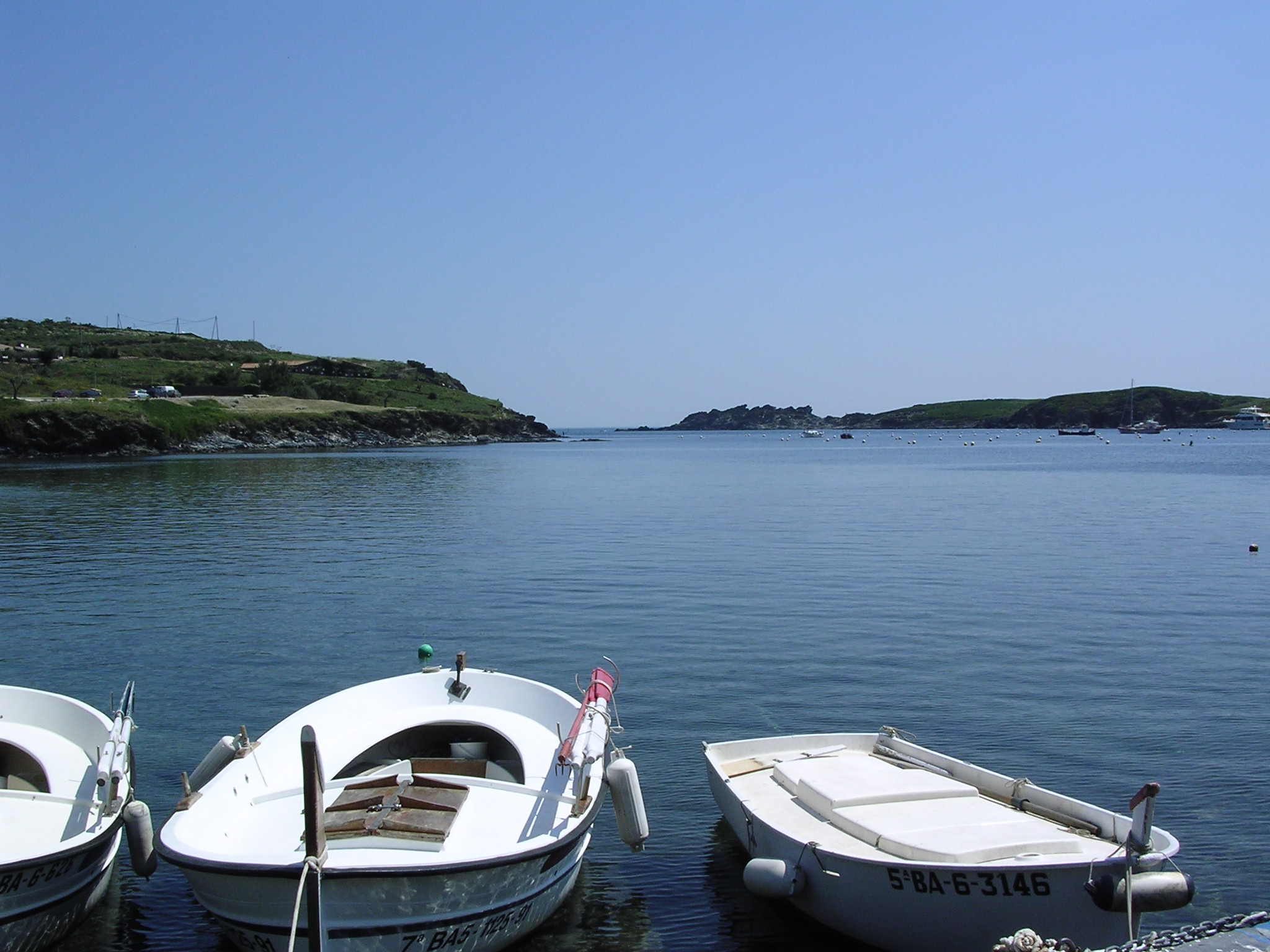
The Bay and Costa Brava

The tell-tale characteristic of the coastline at Cadaqués and Portlligat is the stark contrast between the smooth lines of the calm Mediterranean waters and the jagged outline of the rocky coast. Below are two photographs I took when I visited the Casa-Museo Dalí – the first was taken just outside the entrance of the museum, the second from the hill behind the home as I walked back to Cadaqués.

Port Lligat - bahia

View of the bay from Dali’s studio and former residence, today the Casa-Museo Dali.

Dali house, museum

My photograph of the Casa-Museo Dali, Port Lligat, Cadaques

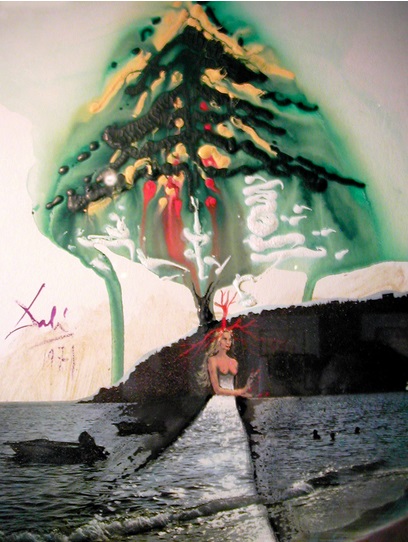
“The Persistence of Memory” (below) is arguably Dali’s most famous surrealist painting, and it also provides an excellent example of how the painter incorporated this particular coastal landscape into both realistic and abstract (surrealist) paintings. It also appears in the ghostly Christmas Cards Dalí designed in 1971. Below are several more paintings that exhibit this typical “Dalinian landscape”.

Salvador Dalí. The Persistence of Memory. 1931

La persistencia de la memoria [The Persistence of Memory] (1931)

The Madonna of Port Lligat.jpg

La Madonna de Port Lligat [The Madonna of Port Lligat] (1950). Image via wikipedia.

San Juan de la Cruz [St. John of the Cross] (1951)

Swans reflecting elephants.jpg

Cisnes que reflejan elefantes [Swans Reflecting Elephants] (1937). Image via wikipedia.

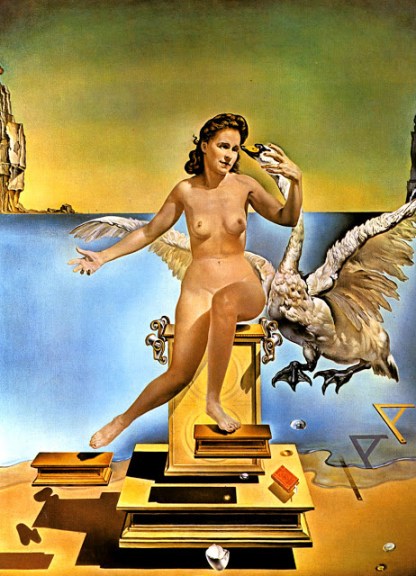
Leda atómica [Atomic Leda] (1949)

Overall, visiting the spaces, buildings, and towns that appear in the works of art I most enjoy – whether they are paintings, literary texts, or film – and then incorporating these elements into my lesson plans are two of my favorite things about being a Spanish Professor. In the future, I am hoping to design a short-term study abroad experience around Spanish painters, writers, and architects, and this “Triángulo de Dalí” will definitely appear on my itinerary!

Have you taken students to any of Dalí’s museums in Spain (or to The Dali Musuem in St. Petersburg, FL)What have been your favorite research- or teaching-related trips?


Posted in Art, Spain | Tagged , , , , , , , , , , , , , , , | 10 Comments

Exploring Female Identities in Carmen de Burgos’ “La rampa”

One of the first novels to spark my interest in early twentieth-century Spanish women’s literature was Carmen de Burgos’ La rampa (1917). As an urban novel, the narrative explores the effects of modernity not only on the residents of and spaces within Madrid as a metropolitan city, but on the individual women who attempted to navigate – and indeed survive – in this stifling, yet transformative atmosphere. In her novelistic portrayal of life in Madrid, Burgos delves into many themes that were also explored by male authors at this time: the possibilities and challenges of modern spaces; the novelty of places and things we now take for granted; the overwhelming sensation of life moving at an increasingly rapid pace; and the paradoxical new psychology in which the individual feels anonymous and lonely amongst an ever-increasing population of strangers. As an independent woman living and working in Madrid, Burgos paid much more attention to the implications of gender in the city than did her male contemporaries. She specifically dedicated La rampa, for example, to the numerous struggling women who hoped to establish independent, modern lifestyles of their own:

A toda esa multitud de mujeres desvalidas y desorientadas, que han venido a mí, preguntándome qué camino podrían tomar, y me han hecho sentir su tragedia.

To the multitude of defenseless and disoriented women who have come to me, asking me what path they should take, and have made me feel [sorry for] their tragedy.

Originally published in 1917, La rampa contains over 200 pages; you can access the full text as a PDF through Cervantes Virtual. I recently discovered that an abridged version was also published in 1921 – a short 30-page “novela” appearing in the popular literary magazine Los Contemporáneos. I tracked it down and requested a copy via Inter-Library Loan, and I was ecstatic to see that all chapters on Madrid’s Maternity Ward had been included in this second printing. I say “ecstatic” because this is the theme on which I centered my own article, “Maternity Ward Horrors,” (2012) and because literary representations of maternity and motherhood form the bases of my current projects.  I’m looking forward to working on an article in the coming weeks that deals specifically with these two different versions of the same novel – especially now that I have worked with my students at length on the shorter novela. It is quite telling to examine which elements of the text were  included or discarded in this second addition. Additionally, the contrasting covers suggest on the one hand that the novels may have been marketed to distinct readerships and, on the other hand – if one were to judge a book by its cover – we might surmise (incorrectly) that the subject matter or narrative trajectory would be different:

According to the newest edition of

According to the newest edition of “La rampa” (Stockcero 2006), this cover graced the earliest editions of the novel.

La rampa-Los contemporaneos. 1921

Cover of “La rampa” published in 1921 for the popular literary magazine “Los contemporaneos”. The short length of this version, as well as the affordable price, likely made it quite popular with upper- or even middle-class women.

In my current seminar on 20th century Spanish and Latin American women’s literature,  this shorter version of La rampa was the first piece of fiction the class read after having studied various “paradigms of womanhood” that informed female identity in the Hispanic world (the longer version would have taken too long to read at this level). I was quite excited to gain new insights into this novel by discussing it with eighteen young minds that would certainly bring their own unique, often surprising, interpretations and reactions. I have to say – I was not disappointed!  I dedicated three class sessions to the novel, and I created reading guides and discussion questions that students prepared prior to each class. I also assigned the class’s first long essay of 700-900 words, or about 3 pages, on this text. This final assignment is what I plan to share in this post (I will also include PDFs of my assignments at the end, just as I did in my previous post on teaching La perfecta casada. 

My assignment for the paper was the following (condensed and translated from Spanish):

  • Examine the way in which the novel represents different institutions and social expectations targeting modern women. Consider our discussions of traditional paradigms of Spanish womanhood and decide if La rampa re-imagines, criticizes, or reinforces these traditional feminine identities. Are alternative female identities (im)possible?
  • This paper must be based on a close literary or textual analysis, not on external research. The thesis should clearly state both the message (criticism) you perceive and the way in which it was successfully (or unsuccessfully) transmitted to readers. I suggest you limit your focus by concentrating on only one theme, such as female labor, motherhood, or marriage.

One additional component of the assignment was to include an image or photograph that students felt represented an aspect of either their paper (thesis) or of the novel or time period in general. I wanted them to be creative with this, as I believe images are extremely powerful in both conveying and affecting our personal interpretations. I always try to incorporate art, or some visual element, into my literature classes. During our final class period working with La rampa, for example, I showed students the two different covers (above) and they offered their thoughts on what each portada might have communicated. Now, as the professor grading all of their papers, I must say I am thoroughly enjoying the creative titles and accompanying images. Somehow, this simple visual addition makes the grading process almost enjoyable. I similarly like to imagine my students eagerly and enthusiastically embarking on the refreshingly “fun,” non-labor intensive task of finding a unique yet pertinent image for the essay they just dedicated so much time to carefully writing and revising (ha!?)… or spending 30 seconds typing their title into “google images”. In any case, this is the first semester I have decided to make the inclusion of an image a requirement on essays (all four of them), and so far I’m happy with the results.

Below are a few of my favorite titles and images – all of them were great, ranging from images of Carmen de Burgos, to different physical “ramps” and staircases representing the metaphorical title, to depictions of stressed-out “modern” women during various decades of the 20th and 21st centuries. If any of you have read La rampa,  you will likely appreciate my class’s selections as much as I do – feel free to share your thoughts. If you have not read the text, I’m sure you will still enjoy these title-image juxtapositions… mini works-of-art in and of themselves… Enjoy the “gallery.”

Condenada a sufrir, La rampa

Condenada a sufrir, La rampa (Condemned to suffer)

Dos esferas de genero o un mundo de opresion

¿Dos esferas de género o un mundo de opresión? (Two gendered spheres or a world of oppression?)

El doble-rasero

El doble rasero: la perpetuación del maltratamiento de las mujeres en el siglo XX – La rampa (The Double-Standard: The Perpetuation of the Mistreatment of Women in the 20th Century)

El poder de la maternidad en La rampa

El poder de la maternidad en La rampa (The power of maternity [motherhood] in La rampa)

El rechazo de la mujer domestica

El rechazo de la mujer doméstica – La rampa (The Rejection of the Domestic Woman)

La maternidad y sus realidades como advertendcia

El tema de la maternidad y sus realidades como advertencia a las mujeres (The Theme of Maternity and Its Realities as a Warning to Women)

Los variables de la felicidad

Los variables de la felicidad en La rampa (Variables of Happiness)

La caida de Isabel en La rampa
La caída de Isabel en La rampa (The Fall of Isabel)

The above is a 1901 painting by Picasso. Somehow in my research on maternity and motherhood during this time period, I had never come across this painting (and if I did, I had never paid it much attention!). So I’m grateful to this student for sharing it. I was curious about this portrait so I did a bit of research googling; I found it on a great site dedicated to images of mothers and breastfeeding in art – Such representations were frequent during the late nineteenth and early twentieth centuries as a means of enticing women to both become mothers and to breastfeed their own children.
[UPDATE: See my more recent post on Picasso’s diverse representations of mothers throughout his career: Picasso on Maternity and Motherhood]

The next images are two of my favorites, simply because they both relate to their titles in relevant ways, and they also really made me smile! And based on these students’ likely search terms… I’m not sure I even want to imagine the resulting “google image” pages.

La maternidad y la sexualidad

La mujer: Abarcando la maternidad y la sexualidad en La rampa (Woman: Taking on Maternity [motherhood] and Sexuality in La rampa)

La maternidad y el ciclo de la desigualdad

La maternidad y el ciclo de la desigualdad en La rampa (Maternity [motherhood] and the Cycle of Inequality in La rampa)

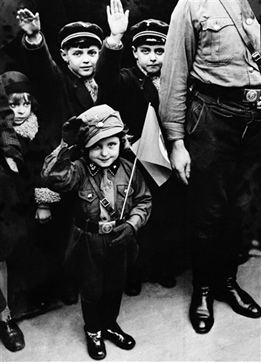
This last image may initially appear out of place for such a novel, but this student chose to focus on (1)  how children are indoctrinated from a very young age to behave a certain way, and thus imitate what they see, and (2) how mothers have power to influence the behavior of these future adults. A very thoughtful selection… (although admittedly when I saw “Hitler” in the URL attached to the paper I may have freaked out just a little bit…).
So now that I have read through the essays and written a “fun” blog post about them – time to get to work on grading! 😦

What “fun” or creative assignment have you given your students? And did they share your sentiments regarding the enjoyable nature of this task?

Resources: Below are PDFs of the assignments I created for “La rampa” – all are in Spanish. The first document contains discussion questions and homework for three, 75-minute classes; The second contains the essay topic and instructions; The third is the print-out with the two different book covers that we used in class.
Homework: La rampa_todas las tareas
Essay: La rampa_Ensayo 1
Cover art: La rampa_covers

Save

Posted in Feminism, First-wave spanish feminism, History, Literature, Modernity, Pedagogy, Spain, Women | Tagged , , , , , , , , , , , , , , , , , , , , , , , | 16 Comments

Sunday Morning Medicine

If you’re interested in the history of gender and medicine, check out the Nursing Clio blog. Written by several historians, the excellent articles tie historical scholarship to present-day political, social, and cultural issues surrounding gender and medicine (per mission statement). Here’s today’s post, “Sunday Morning Medicine,” which is a weekly round-up of gender, medicine, and history in the news. Enjoy!

Posted in History, Science and Medicine, Women | Tagged , | 2 Comments

The Perfect Wife in the 21st century: “La perfecta casada” en el siglo XXI

Now that February is suddenly here, the Spring 2014 semester is officially underway and I am finally organized (well, for the most part!). For me, the most exciting part about this new semester is that I’m teaching a course I designed, based largely on my main areas of expertise and research: representations of marriage and motherhood in 20th century Spanish literature (Refashioning the Self: Hispanic Women’s Literature in the 20th Century). As this course is Transatlantic in nature, I am using it as an opportunity to expand my research and establish more explicit connections between Spanish, Latin American, and Latino narratives and films. Since we’re now in the third week of the semester and my students have been completing their readings, actively participating in class discussions, and coming to class with excellent questions and observations that make me reconsider some of my own previous interpretations, I thought It would be fun to share some of my lesson plans and student reactions on my blog. I hope this will be the first of a series of posts in which I will briefly outline the class readings, include a few brilliant (anonymous) student comments, and provide links to materials I used or created at the end of the post.

The first two weeks of my seminar are dedicated to understanding popular cultural representations and paradigms of womanhood in the Hispanic world. The first readings were selections of Fray Luis de León’s conduct manual, La perfecta casada (The perfect wife). Written in Spain in 1583 for his recently engaged cousin, León penned this “instructional” manual for newly-wed or recently-engaged women based on the Biblical depiction of the perfect wife in Proverbs 31 (Proverbios 31). By starting with this text, my goals were for students to recognize the ways in which this seemingly antiquated rhetoric did in fact contain a positive evaluation, and even a celebration, of women’s domestic roles as wives and mothers – especially in 1583 Spain.  León praised married women for their abilities to balance diverse responsibilities to their husbands, their children, their home, and to God. In this context, he also emphasized a woman’s position as “la compañera del hombre” and criticized men who behaved as “leones” (lions), treating their wives as if they were slaves. For the time period, this was a clear defense of women’s supposedly subordinate roles. Moreover, León’s hyperbolic celebration of the “perfect wife” (and the corresponding condemnation of “la mala”(!)) strengthened the appeal of this domestic model of womanhood for centuries, and his text even enjoyed a resurgence in late 19th- and early 20th-century Spain and Latin America. Below, for example, is an advertisement from 1930s Spain promoting La perfecta casada as an exquisite gift for the 20th century newlywed, or recently engaged young woman (“novia”):

La perfecta casada in the twentieth century

La perfecta casada in the twentieth century

But the prevalence of the manual’s guiding tenets throughout the twentieth-century, and even into the present-day, begins to create problems for women in the context of equal rights, economic freedom, and individual agency in modern societies.  Rather than read the entire, rather verbose text, my class read the prologue and a few select chapters that I took some time to edit (you can view the PDF I created at the end of this post). We concentrated on three main points that León repeatedly emphasized:

(1) a “perfect wife” should remain silent and refrain from discussing business matters,
(2) a “perfect wife”should stay in the home and avoid going out in public, and
(3) a “perfect wife” will not only give birth to, breastfeed, raise, and educate her children (she will never employ a wet-nurse or otherwise “outsource” this labor).

The images and comparisons he uses to illustrate these points are… descriptive, to say the least. He compares a woman out of the home to a fish out of water; Women who speak up about business matters are tigers, lions, or scorpions; A woman who employs a wet-nurse commits an “ugly” sort of adultery against her husband. The section on the use of wet-nurses is especially revealing, particularly for the way in which class divisions and prejudices become apparent (Wet-nurses were often servants, employed by upper-class women; León categorizes them as untrustworthy, conniving, and even drunkards who pose potential threats to the children they help raise). One of my students observed that this chapter on childcare portrays a woman’s body as belonging to everyone else – her husband, her children, and by extension, God. Her body is used to fulfill her “duties,” not as a means of self-realization; there is no indication that these “maternal duties” might be voluntary – she is destined to give birth to children and likewise destined to feed, raise, and educate them. Anything less renders her “imperfect” and even a threat to her family.

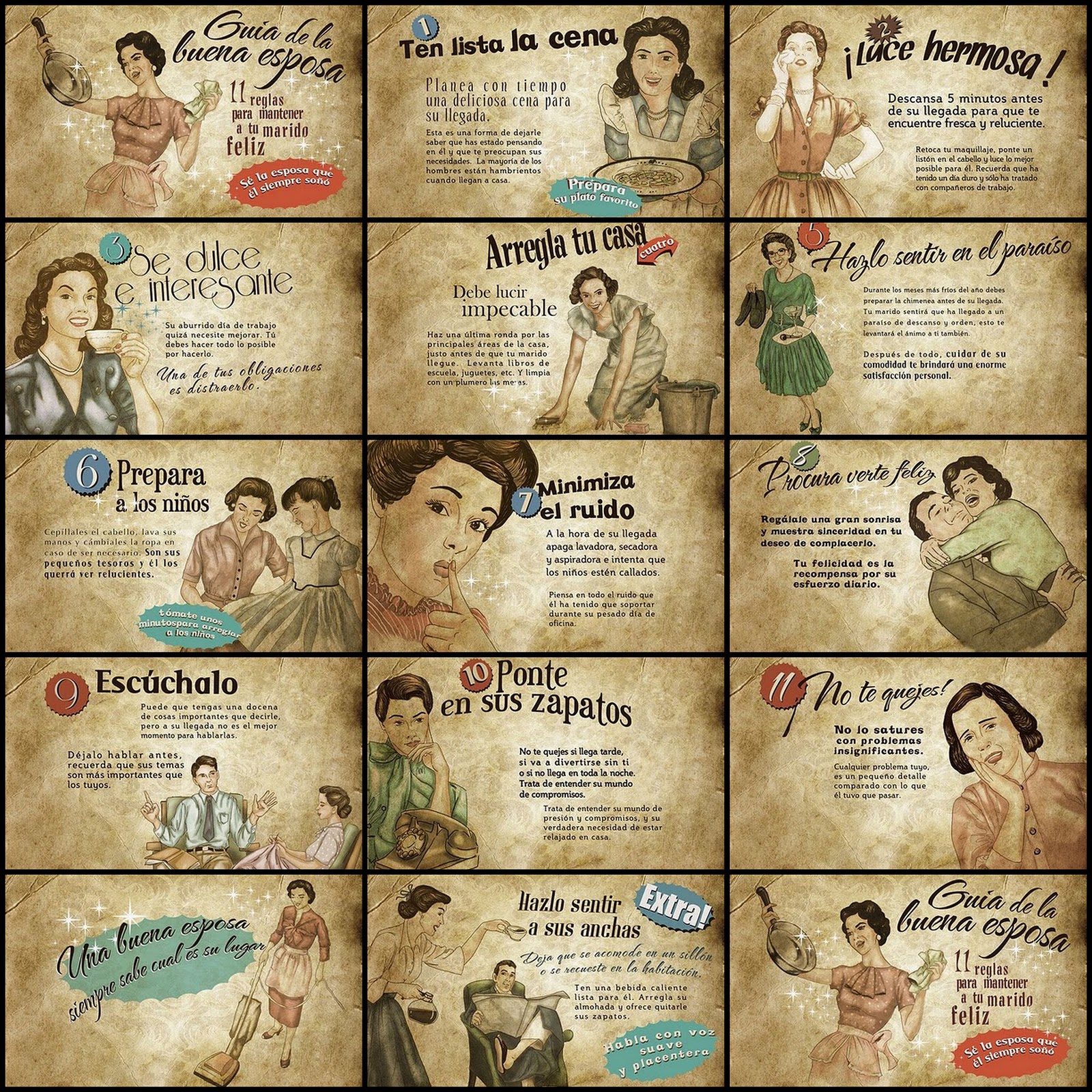
After discussing these points, I provided the class with the illustrated “Guide of the Good Wife / Guía de la buena esposa,” a Spanish text produced in 1953 during the Franco dictatorship.  The subtitle reads, “11 reglas para mantener a tu marido feliz,” or “11 rules to keep your husband happy.” What is most fascinating about these illustrations and captions, at least from a modern-day perspective, is the fact that these 11 rules were created by a woman – Pilar Primo de Rivera – for the Sección Femenina.  As the Falange’s women’s organization, the Sección Femenina’s goals revolved around instructing women in Francoist patriotic, religious (Catholic), and social values. Women were to remain subordinate to men, concerning themselves only with marriage, children and housework. While I’m not certain that this particular illustrated text came directly from Rivera (who, it’s worth noting, never married!), it certainly demonstrates the Sección Femenina’s propaganda. While the instructions in the guide are not explicitly based on León’s text, many of the same key elements appear – this time in the form of short commands accompanied by pictures of contented wives happily performing their domestic chores (well, orders):

Guia de la buena esposa, Spain, 20th century

Guia de la buena esposa, Spain, 20th century

One of my students intelligently pointed out that the command forms make the text appear to be a “Woman’s Ten Commandments” (well, eleven!). She was right to note the appeal of this “narrative” structure, as much for communicating orders to the subordinate subject as for affirming the authority of the “higher” power (God/husband). This leads to one of the differences my students noted between the 1583 celebration of the “perfect wife” and the 1953 guide. In the sixteenth century, Fray Luis encouraged women to perform their domestic duties in order to obtain and ensure the love and respect of GOD, their husbands, and their children. There were rewards awaiting women who performed their duties well. In the modern version, however, the goals not only revolve almost exclusively around pleasing the husband, but there is absolutely no implication that the wife will be rewarded or appreciated for her labors. Is this husband lavishing praise on his wife while he reads the paper? When he stays out all night? Are the children adoring their mother while she mends their clothing? It doesn’t appear so…. In fact, this version appears even more oppressive to women than the sixteenth century text – here, they defer to their husbands; ignore their own needs; and acknowledge the triviality of their own lives.

… but I REALLY REALLY want to know more about “La guia de la buena esposa!”

Ok, ok… For my readers who don’t speak Spanish, below is an English summary of the 11 rules from La guia de la buena esposa.  This was quite the exercise, and it reminded me why I didn’t choose a career in translation! It’s also worth noting that the first image in the last row explains, “A good wife always knows her place.”

(1) Have dinner ready – Take time to prepare a delicious dinner for his return. This is a way of letting him know you have been thinking of him and that you worry about his needs. The majority of men are hungry when they return home.
(2) Appear beautiful (make yourself beautiful) – Rest for five minutes before his arrival so that he finds you fresh and gleaming. Re-touch your make-up, put a ribbon in your hair and look your best for him. Remember that he has had a difficult day and has only dealt with men at work.
(3) Be sweet and interesting – His boring day of work might need to improve. You should do everything possible to improve it – one of your obligations is to distract him.
(4) Tidy your home – It should appear impeccable. Make a final round around the main areas of the home just before your husband arrives home. Pick up school books, toys, etc. And dust the tables.
(5) Make him feel he’s in paradise – During the coldest months of the year you should prepare the fire before he arrives. Your husband will feel like he’s arrived in a paradise of rest and order; this will raise your spirits as well. Overall, ensuring his comfort will give you enormous personal satisfaction. [notice the martini glass she’s carrying!]
(6) Prepare the children – Brush their hair, wash their hands, and change their clothes. They are your little treasures and he will want to see them “shining.”
(7) Minimize noise – When he arrives home, turn off the washer, dryer, and vacuum and try to keep the kids quiet. Think about all the noise he has had to deal with during his long day at the office.
(8) Make sure he sees you happy – Give him a great smile and show sincerity in your desire to please him. Your happiness is the best reward for his daily efforts.
(9) Listen to him – You might have a dozen important things to tell him, but when he arrives home it is not the best moment to say them. Let him speak first; remember that his issues are more important than yours.
(10) Put yourself in his shoes – Don’t complain if he arrives late, if he goes out to have fun without you, or even if he doesn’t return home all night. Try to understand his world of obligations. Try to understand his world of stress and responsibilities and his true need to be relaxed at home.
(11) Don’t complain – Don’t overwhelm him with insignificant problems. Whatever your problem, it is a small detail compared to what he must deal with.
(Extra!) Make him feel at ease – Let him get comfortable in a chair or take refuge in the bedroom. Have a hot drink ready for him. Fluff his pillow and offer to take off his shoes.

I think #10 is my “favorite”. Of maybe the “extra-special-bonus” round in which the wife will fluff his pillow….

Sure, you may say, of course we can observe these rather antiquated ideas in the notoriously anti-feminist goals of Francoist Spain, or in the 1930s magazine ads that likely served as a subtle counter-discourse to the rhetoric of First-Wave Feminism that was finally beginning to catch on in Spain. Certainly we have moved beyond such essentialist representations of femininity…..

21st century “Perfecta casada”??

Behold! A present-day, 2013 iteration: “El manual catolico para sumisas” (The Catholic Manual for Submissive Women) – Cásate y sé sumisa (Get Married and Be Submissive). This book was written by an Italian journalist, Costanza Miriano, and published in Spain by a publishing house created by the controversial, ultra-conservative archbishop of Granada, Francisco Javier Martinez. The book is structured in the form of letters that Miriano writes to her friends in which she reflects on her experiences as a wife and mother. She bases much of her advice on Saint Paul: “You must learn to be submissive… submission is a gift” she repeats.  Just as Fray Luis de Leon cited Proverbs as his authority in 1583, so Miriano cites another book of the Bible in 2013. While the text is clearly directed at a very particular, narrow audience – Catholic housewives – I nevertheless find such modern adaptations of Early Modern texts and philosophies to be fascinating

Finally, as I pointed out to my students, attempts to entice women into lives of domesticity are not unique to Spain or Latin America. American women receive similar messages through media consumption on a daily basis. While not directly related to the texts we read, of my favorite ways to demonstrate the similarities of the underlying messages is to find examples that relate to students’ own lives and experiences. For this class, I went to some of my favorite short videos created by comedian and writer Sarah Haskins. Over the past few years, Haskins created a series of satirical videos illustrating the absurd marketing tactics aimed at women: “Target Women. A few that consistently make me laugh (cry?) include “Yogurt,” “Jewelry,” and “Birth Control” – especially Birth Control!  During the last 5 minutes of class, we watched the video that skewers cleaning commercials for portraying housework not as a chore or duty, but as a rewarding, escapist romance for working moms and housewives alike. I selected this particular video given that both La perfecta casada (1583) and La guia de la buena esposa (1953) emphasize that it is a woman’s/wife’s responsibility (not the man’s/husband’s) to clean and care for the home.

While the tone of these videos is clearly humorous, the constructs they highlight should be considered with critical thought. I encourage my students to think of present-day media – television programs, movies, advertisements, opinion pieces, news articles, and of course blog posts – as LITERATURE. They should apply the same skills of textual and critical analysis to these “texts” as they do in class with novels, poems, or short stories. As these videos point out, modern media encourages women to protect their families and take pride in a clean house – not exactly a terrible message, but does it really need to be gendered?!?!? Men are certainly as capable of cleaning a home and protecting their families, yet we rarely, if ever, see such products marketed to men – or even to both men and women. In fact, Sociological Images creates and maintains Pinterest boards dedicated to precisely these topics, and among them is a board on “Gendered Housework and Parenting“. The images posted to this board focus on the ways that “Pop Culture portrays housework and childcare as almost exclusively women’s responsibility.” Just as one of my students commented in our class that “we don’t generally see Guides for perfect husbands,” neither do we see married men performing domestic responsibilities. While this may be changing, non-gendered representations are a long way from normalization – and Target Women addressed this phenomenon in the video “Doofy Husbands.”

Overall, I think my students understood the way in which Spanish women have been historically defined by domesticity and how literature works as a powerful manifestation of cultural values. They also considered the historical and cultural contexts of these manuals in order to better evaluate and examine the implications of such long-lasting gendered ideologies. The roots of the separate spheres dichotomy so often observed in modern literature,for example, are clearly illustrated in La perfecta casada. But unlike 16th-century Spain, modern societies afford women many opportunities in the public sphere (work; wages; education; political involvement), and thus the private sphere can become restrictive. In my opinion, adequately understanding and analyzing the long history of such ideas will go a long way towards building more constructive interpretations and critiques of modern literature – and media!

Have you taught early modern texts in low-level literature courses? How do you connect those themes to students’ own lives and experiences?

Resources:

Posted in Feminism, History, Literature, Pedagogy, Spain, Women | Tagged , , , , , , , , , , , , , , , , , , , , | 10 Comments

Salvador Dalí’s Christmas Cards Are Better than Yours

Over the weekend, while attempting to get into the holiday spirit by setting up my table-top fiber-optic Christmas tree, baking cookies, and watching the snow fall in sub-zero temperatures, I discovered that one of my favorite Spanish artists, Salvador Dalí, designed 19 unique Christmas cards between 1958-1976 for the Barcelona-based company Hoechst Ibérica. While I knew that Dalí had created artwork for advertisements (Bryan’s Hosiery) and magazine covers during the mid-20th century, I had never seen his unique portrayals of Christmas. So like any good academic on winter break, I put off my Spring syllabus-planning to do some frivolous investigating.

One of the earliest Dalinian images used for commercializing the holiday season was actually a sketch for a cover of Vogue magazine in 1946. This image (below) exhibits  tell-tale characteristics of Dalí’s surrealist style, including the barren, expansive landscape and the incorporation of double-images (which also characterize his depiction of the Spanish Civil War). In this particular piece, the architectural elements supporting the symmetrical Christmas trees exhibit feminine facial features, a tactic that adds a fitting flare to the cover of a fashion magazine. This more popular image is still re-printed and available as a specialty Christmas card today.

Noel, 1948 - Study for a cover of VOGUE

Noel, 1948 – Study for a cover of VOGUE

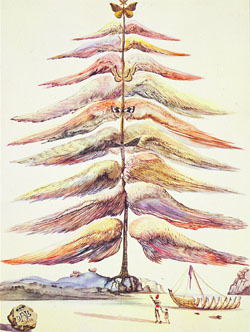
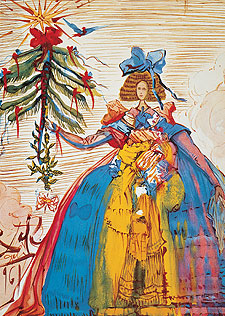
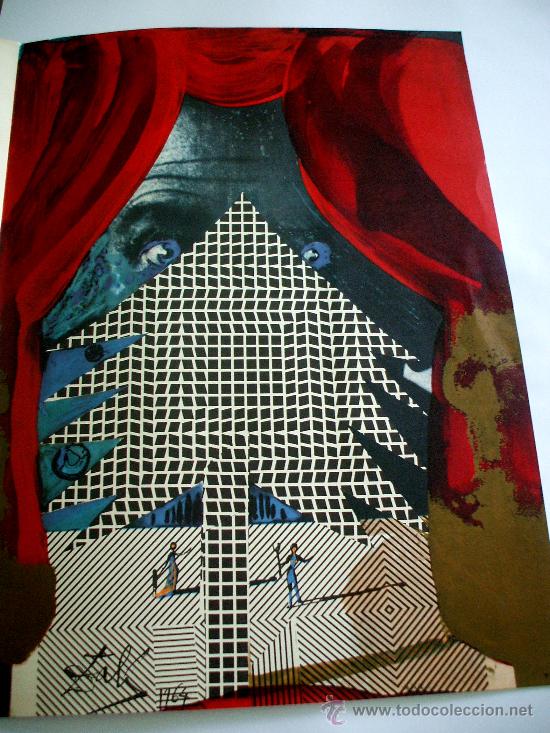
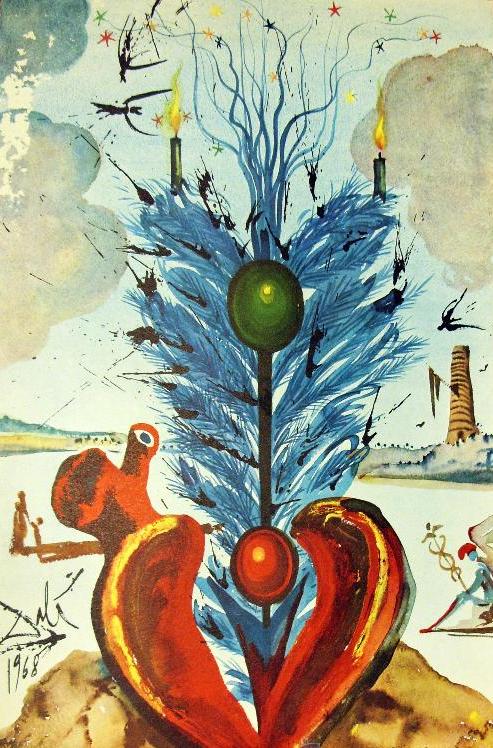
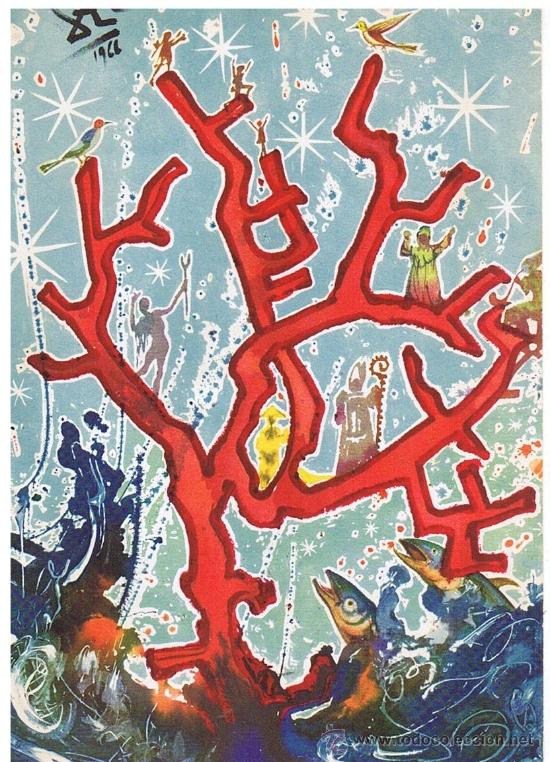
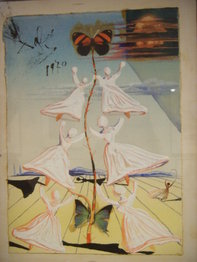
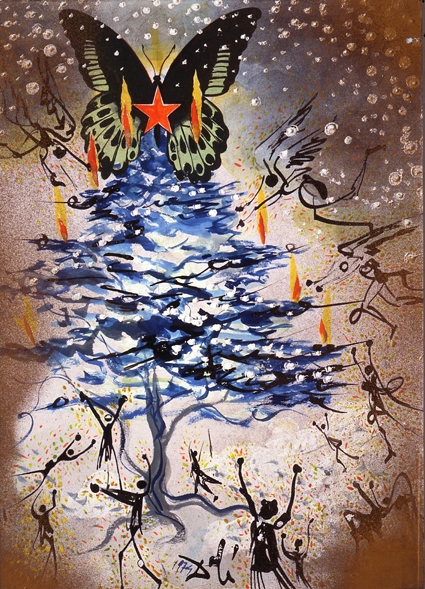
This early 1948 rendition of a “Christmas” landscape, however, is but one of Dalí’s efforts to illustrate the holiday season. In 1958 he created the first of his eventual 19 greeting cards for Hoeschts, and the publishing company would annually send these artsy holiday cards to doctors and pharmacists throughout Spain. Importantly, Dalí’s renditions did not incorporate traditional Mediterranean, Catholic Christmas imagery such as the Nativity scene or the Reyes magos (Wise men), but rather they appropriated more American and Central European elements, such as the Christmas Tree. The “árbol santo” is in fact a constant element in these 19 illustrations, and Dalí occasionally converted the Christmas Tree into an allegorical depiction of the years events or infused it with distinctive elements of Spanish culture. Below is the first card in the series:

Felicitacion de Navidad - 1958

Felicitacion de Navidad – 1958

In 1960 and 1961, the Christmas Tree is at once unconventional and also decidedly Spanish. Both of these cards invoke classic masterpieces of Spanish art and literature. In 1960, the trunk and upper branches of the Christmas tree form the outline of Cervantes’ famous caballero andante, Don Quijote de la Mancha (as Dalí imagined him)…

Felicitación de Navidad, 1960 (con Don Quijote de la Mancha)

Felicitación de Navidad, 1960 (con Don Quijote de la Mancha)

… and in 1961 Dalí pays homage to Diego Velázquez’s 1656 masterpiece, Las meninas:

Felicitación de Navidad, 1961 (con la infanta Margarita de "Las meninas")

Felicitación de Navidad, 1961 (con la infanta Margarita de “Las meninas”)

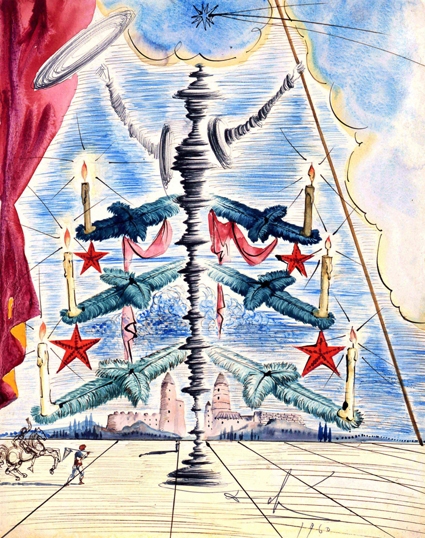
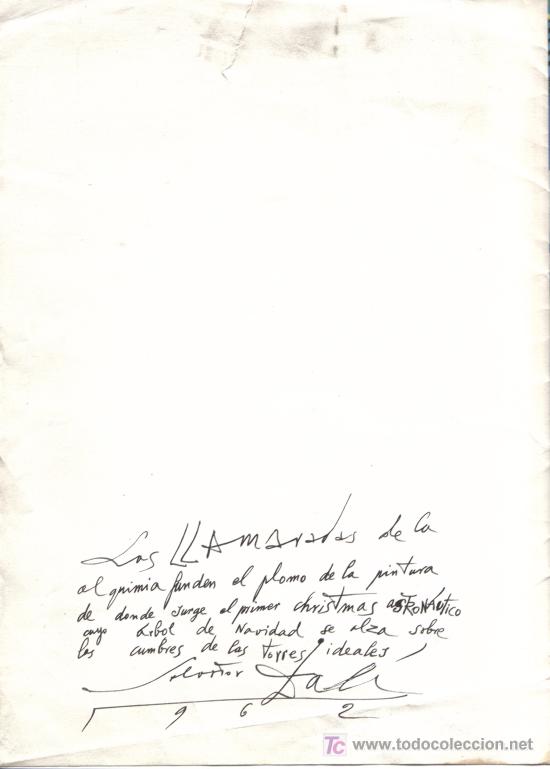
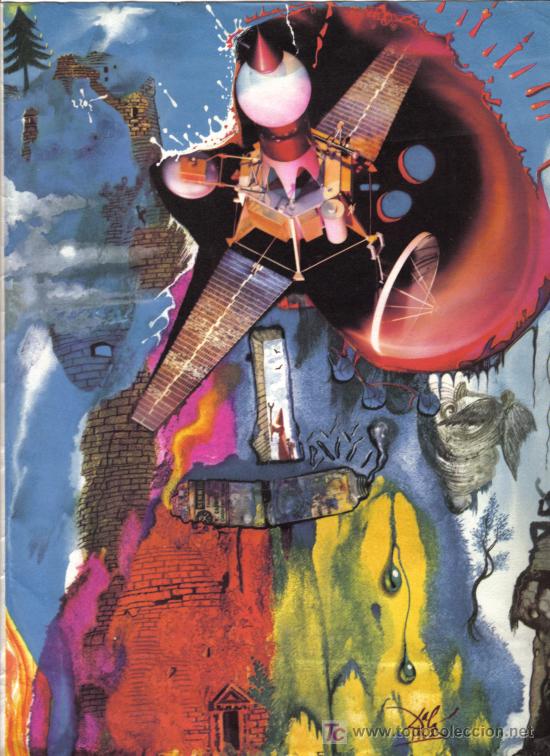
The majority of Dalí’s cards contain a short, hand-written greeting or description penned by the surrealist painter himself (though these are difficult to find online). On the 1962 card below, for example, Dalí celebrates space exploration and scientific advances by labeling his portrayal “el primer Christmas astronáutico“. The holiday, it seems, was not the main focus of this year’s card, and the tree is barely visible at first glance.

Felicitación de Navidad, 1962 (...el primer Christmas astronautico)

Felicitación de Navidad, 1962 (…el primer Christmas astronautico)

While Dalí’s holiday artwork may have found an audience in Spain, his designs were met with much less enthusiasm in the United States. Despite the relative success of his Vogue covers and hosiery advertisements in the 1940s, Dalí could not entirely win over America’s largest greeting card company, Hallmark, or the 1950s public who supported it. By the early 1950s, Hallmark had become such a culturally relevant force in the US that it was an attractive creative partner for many high-profile artists, even actors (See Patrick Regan’s Hallmark: A Century of Caring). Norman Rockwell was (is) undoubtedly among the most well-known of mid-century American artists, and the iconic illustrator created 32 traditional Christmas designs for Hallmark between 1948 and 1957. Even today, many of his designs are widely recognized and still reproduced, as they represent a classic portrayal of Christmas as a jolly, magical, and quintessentially “American” holiday.

Rockwell’s recognizable Christmas illustrations still appear on greeting cards today, over 60 years after their debut.

But Salvador Dalí also lent his talents to Hallmark in 1958.  Yet unlike Rockwell’s wholesome, familiar americana illustrations, Dalí’s “surrealist take on Christmas proved a bit too avant garde for the average greeting card buyer” (Regan 97). You can read a short newspaper article about “The Dali Christmas Story” and Hallmark’s tepid reaction in a 1981 issue of the St. Petersburg Evening Independent.  Below, for example, is Dalí’s depiction of the Nativity scene, created specifically for Hallmark:

Nativity Scene by Dali (1959 - Hallmark)

Nativity Scene by Dali (1959 – Hallmark)

While I can’t say that the rejection of Dalí’s surrealist, abstract take on Christmas in 1950s America is entirely surprising, I am disappointed that I haven’t seen these images before. They seem to be part of special exhibitions, appearing in Barcelona’s CaixaForum in 2006, and in Dalí’s Teatro-Museo in Figueres in 2008, but I’m not sure where they are displayed or housed today. I spent a considerable amount of time lost in the depths of the internet trying to amass a collection of these designs, and below are some of my favorites (well, pretty much the only images I could find via a few hours with GoogleImages…).

Enjoy!

Navidad, Dali, 1964

Felicitación de Navidad, Dali, 1964

Navidad, Dali, 1968

Felicitación de Navidad, Dali, 1968

Felicitación de Navidad, Dali, 1968

Navidad, Dali, 1971

Felicitación de Navidad, Dali, 1971 (high quality image at Flickr, http://www.flickriver.com/photos/dou_ble_you/230261710/#large)

Navidad, Dali, 1970

Felicitación de Navidad, Dali, 1970 — The note accompanying this image appears below. I can make out the English phrase “Flower Power” in quotation marks, and I believe the first words are “Las campanas,” or “The bells.” Anyone with better eyes want to help with the rest?

navidad_1962_dali_felicitacion de navidad-text

Navidad, Dali, 1974

Felicitación de Navidad, Dali, 1974

If it weren’t for digital cameras, photo editing software, and one-hour made-to-order holiday photo cards allowing us to brag about our own lives and accomplishments in the name of reconnecting with friends and relatives, perhaps we might exchange more artistic renditions of the Holiday Season today. When exactly did the holiday “greeting card tradition” transform into the creation of “personal photo montages”?

What Christmas/Holiday/New Year’s designs or artwork are your personal favorites? And what popular artists or actors would make intriguing Holiday Card Designers today? (actually, that’s a scary thought!)

Resources:

Dali: The Paintings:  This excellent book on Dalí by Robert Descharnes and  Gilles Néret contains ALL of the artist’s paintings – It’s my favorite volume, and I”ve linked to it in all my posts on Salvador Dalí.

Posted in Art, Spain, Surrealism | Tagged , , , , , , , , , , | 36 Comments

The Roaring Twenties, Metropolitan Citizens, and… LOUD NOISES!

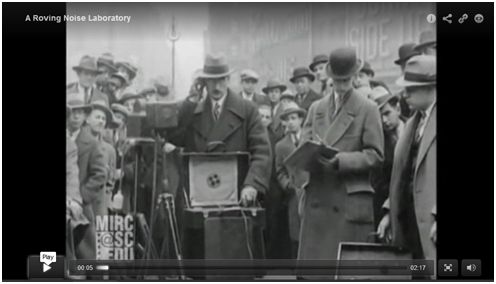
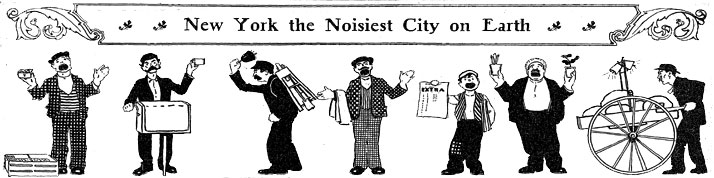
As early twentieth-century cities were experiencing rapid modernization, many intellectuals dedicated space in their writing to praising or critiquing not only these urban landscapes, but also the new mentality and behavior that they required of inhabitants. These themes were especially visible in the work of Avant-Garde artists and writers in 1900-30s Spain.  Ramon Gomez de la Serna, for example, was known for his playful skepticism and often ambivalent attitude towards Spain’s embrace of the modern (I wrote a short article in Spanish on the manifestation of this concept in his novela “La hiperestésica”). Given that this protean atmosphere informs the cultural background of much of my current research, a short video of 1920s New York City that I found via a recent New York Times article, “Listening to the Roar of 1920s New York,” immediately caught my attention. The film that accompanies the article is especially unique, since it was created to capture the noises and sounds of the street, rather than the visual splendor of new City sights. The article also explains the impetus behind the Noise Abatement Committee of New York’s decision to record city sounds by attaching microphones to a roving truck: They were concerned over how the high noise-levels might affect residents’ health(Click the image below to open a new window and watch listen to the 2-minute video):

Video - Noise in NYC 1920s

Video – Noise in NYC 1920s

This same article led me to “The Roaring Twenties” project created by Professor Emily Thompson, historian of sound, technology, and cultures of listening at Princeton University. This fantastic online resource epitomizes the creative and far-reaching possibilities of Digital Humanities scholarship and offers a wealth of unique material for teachers and scholars of history, literature, and a variety of disciplines that welcome interdisciplinary approaches to research. As Thompson points out, concerns with noise levels and distracting sounds were certainly not unique to the twenties… nor to New York City or American Culture.

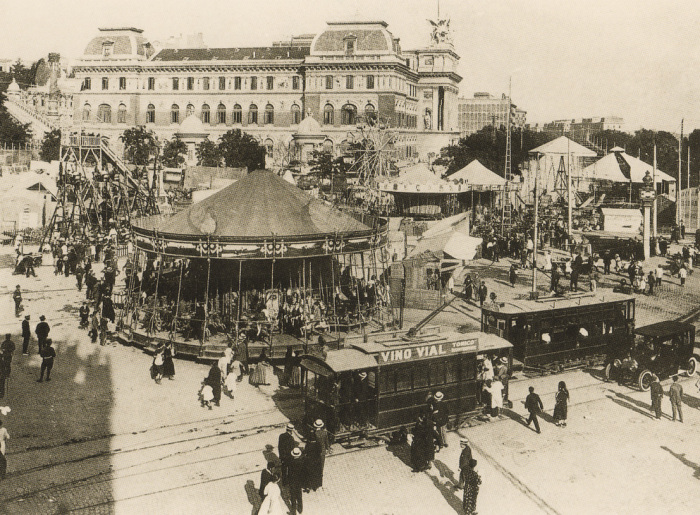
Thompson asserts in her Introduction that studying aural history is not merely about sound, but about our becoming attuned to “sonic culture” by developing a mode of listening that requires an adjustment of “our modern ears to the pitch of the past.” Yet what I find fascinating is the fact that individual imaginations will nevertheless create a unique “soundtrack” for a given image. Moreover, the inability to incorporate authentic sounds from our (present) lived experiences into our imagination of a past era makes it difficult to identify the aural milieu with precision. Take, for example, the following gorgeous images of 1920s Madrid: What noises would we hear in a 1920s carnival or amusement park that we would never hear today (and vice-versa)? How does the technology used for rides, games, and attractions not only create unique visual experiences, but distinctive sounds? No loudspeakers… no computerized music or voices…

Carnival - Glorieta Atocha, Madrid, 1920s

Carnival – Glorieta Atocha, Madrid, 1920s

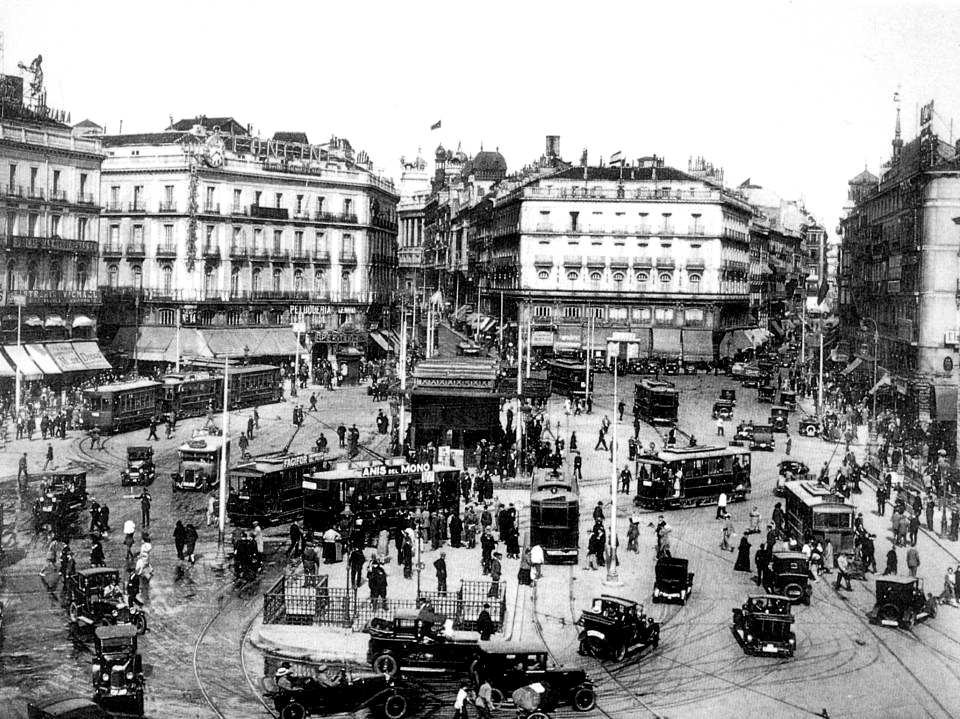
And in the Puerta del sol of the 1930s, what exactly does a Model-T driving on an un-paved or semi-paved road sound like?  What noises are present when the flow of street traffic lacks the direction of stoplights and the organization of painted lanes or traffic circles? There are certainly fewer automobiles, yet there are many more trolley cars and cables… pedestrians seem to amble about among the traffic rather than keeping to the sidewalks or “crosswalks”…

Puerta del sol - Madrid, 1930

Puerta del sol – Madrid, 1930

In general, our ability to produce an authentic sense of this past atmosphere is essentially impossible without the added use of film or recordings. Vintage photographs are noteworthy for the way in which they challenge our modern-day visual perceptions, but we rarely consider the sounds and noises that would also be present if we were actually witnessing such an event. How might we imagine the sounds, smells, and sensations that would form part of the experience in its entirety? The “Roaring 20s Project” invites us to consider these often overlooked aspects of history.

Returning to the state of urban residents’ mental health and how it might be affected by the rapid pace of modern city life, I could not help but think of  Georg Simmel’s well-known essay, “The Metropolis and Mental Life” (1903), which I read several times in graduate classes. Simmell described what he called the blasé attitude adopted by metropolitan citizens in response to the increasing number of external stimuli in modern life. He argues that such an attitude is absent in those residing in “more peaceful and more stable” rural environments; thus the blasé individual is the by-product of modern, urban life. Simmell identifies the essence of this “psychic phenomenon” of the city as:

…an indifference toward the distinctions between things. Not in the sense that they are not perceived, as is the case of mental dullness, but rather that the meaning and the value of the distinctions […] are experienced as meaningless. They appear to the blasé person in a homogeneous, flat and grey colour with no one of them worthy of being preferred to another (14).

Of course, like any good academic, I immediately related these century-old, rather profound philosophical observations to… Anchorman:

Poor Brick Tamland just cannot adapt… He lacks the ability to behave indifferently, and thus his constant attention to the distinctions between noises, arguments, and other external stimuli surrounding him provokes his mental torment. He’d be much calmer – yet much less interesting! (an important consequence of this modern phenomenon) – if he were able to adopt a blasé attitude in the workplace. And who among us today has not tried to shield ourselves from the stressful, incessant, often overwhelming sights and sounds in our own 21st century lives? I would argue that our modern day blasé attitude now consists of smart phones, iPhones, and headphones. In fact, we tend to be so caught up in our own personal (often self-created) worlds that we rarely interact with others in public, whether at coffee shops, on public transportation, or even waiting in line at the store. Thus I found the New York Time’s article and Thompson’s aural history project to be unique for their celebration of a century’s worth of LOUD NOISES and their contribution to and affects on cultural and social progress.

What are some modern-day sounds, sights, or interactions that “affect your health”? How to you adopt a modern-day blasé attitude to compensate for these disturbances?

Resources:

Simmel, Georg. “The Metropolis and Mental Life.” PDF via Blackwell Publishing

Thompson, Emily. The Roaring Twenties – an interactive exploration of the historical soundscape of New York.

Posted in History, Modernity | Tagged , , , , , , , , , , , , | 2 Comments

What People Think about Women: A Bilingual Edition

Translation update – Oct. 28, 2013Thanks to the careful attention and comment of one of my readers (Lu Cero), I learned about the “terrible mysoginic message” in the search results “Las mujeres necesitan soluciones, lo hombres también pero al revés”. When I initially wrote this post, I focused mainly on the fact that different results could be obtained simply by searching in different languages; I thought that long phrase was a bit odd, but didn’t really investigate it further. Lu Cero tells me: “It’s a known pun: ‘Soluciones’ backwards [“al reves”] is ‘senoiculos’, or in other words “seno y culos” which means boob and asses.”  Thank you for making this non-native speaker aware of this “awful” play on words!

—————————————–

This recent post, “What People Really Think about Men, Women, and Feminists,” from one of my favorite blogs, Sociological Images, caught my eye for a number or reasons. To start, it was the first I had heard of the United Nations’ campaign to raise awareness for women’s rights. These UN ads creatively incorporate Google searches and the accompanying auto-complete (based on the most popular search phrases) to draw attention to the need for empowering women worldwide. Here is a sample ad:

Secondly, I particularly appreciated Prof. Lisa Wade’s efforts to provide and compare equivalent searches for men. What I found most fascinating about these side-by-side examples was the fact that, in general, the searches for what women “need…, should…, should not…, or cannot” do were very clearly disempowering: women should not work, preach, leave the home, etc.  And while some similar results turned up for men (apparently neither women nor men “can be trusted”!), the male results did not exhibit the same condescending sentiment towards masculinity or men in general. On the contrary, these searches about men further displayed an anti-feminine, even anti-woman, tendency: men should not wear shorts; wear make-up; get married, etc. Thus, the anti-woman sentiment is visible within both search results. Below are Wade’s results for “Women/Men shouldn’t.”

Screenshot_1

Screenshot_9

Finally, I was struck by the fact that these were all English-language searches. As a professor of Spanish language and literature at an American institution (and also a native speaker of English), I pay close attention to the vocabulary used by both Spanish and English writers, journalists, and public speakers. Language is one of the most powerful manifestations of cultural values, ideas, and biases. Given that Spanish is the most spoken non-English language in the United States – that is, the second most-used language – and given that the number of Spanish speakers in the US will continue to increase in future decades, it is crucial that we recognize the power of linguistic diversity. This is especially true for educators and scholars who teach at institutions with diverse student populations. Dr. Wade, for example, teaches at Occidental College, a Hispanic-serving institution where about 36% of the surrounding Los Angeles area also speaks Spanish (the percentage is likely higher if we consider heritage speakers and those individuals who understand Spanish, but might not speak it fluently).

Thus, I wondered what a Spanish-language search might reveal about the attitudes towards men and women (and subsequently masculinity and femininity) in different cultural contexts. So I performed the same search in Spanish, at www.google.es“women/men should; should not; cannot; need…” These results, like Wade’s English results for men, both fascinated and disturbed me. Here is what I found:

Women/Men should…      Las mujeres/Los hombres deben…

Women should: be submissive / shave their pubic hair / use-wear a veil / preach

Women should: be submissive / shave their pubic hair / use-wear a veil / preach

Men should: Take folic acid / pee sitting-down / remove hair / remove pubic hair

Men should: Take folic acid / urinate sitting-down / remove hair / remove pubic hair

Women/Men should NOT…      Las mujeres/Los hombres no deben…

Women should not: drive / be enlightened or educated in any form / preach / work

Women should not: drive / be enlightened or educated in any form / preach / work

Men should not: cry / cry Pedro Fernandez / cry lyrics / cry Alejandro Fernandez -- apparently the idea of men holding back tears has been immortalized in several popular songs, skewing these search results *just a bit*!

Men should not: cry / cry Pedro Fernandez / cry lyrics / cry Alejandro Fernandez — apparently the idea of men holding back tears has been immortalized in several popular songs, skewing these search results *just a bit*!

Women/Men can’t…      Las mujeres/Los hombres no pueden…

Women cannot: drive / be color-blind / preach / be pastors

Women cannot: drive / be color-blind / preach / be pastors

Men cannot: do two things at once / be alone / solve this / have female friends

Men cannot: do two things at once / be alone / solve this / have female friends

Women/Men need…      Las mujeres/Los hombres necesitan…

Women need: to feel desired / solutions / solutions, men also but the other way around / to sleep more

Women need: to feel desired / solutions / solutions, men also but the other way around / to sleep more

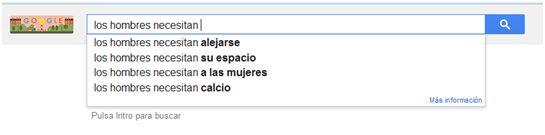
Men need: to distance themselves; move away / their space / women / calcium

Men need: to distance themselves; move away / their space / women / calcium

After performing these searches and organizing my own results, these are the things that I found most intriguing:

  1. In the Spanish language searches, the negative, disempowering, connotations in searches on women tended to appear in religious contexts (preaching; being a pastor).  Since these words appears in both the should and should not categories, we might take this as a sign that traditional gender roles within the church are being challenged or reconsidered.
  2. The anti-woman sentiment that we observe in both the “men” and “women” English searches does not appear to be quite as overt in the Spanish examples. While it is certainly still visible (“women should not drive/work/be educated”), the attitude that comes across in the Spanish searches is more consistent with machismo – the celebration of dominant, typically masculine traits associated with men as superior, and the corresponding labeling as inferior of passive, typically feminine traits associated with women. Academic studies aside, machismo is characterized by a strong sense of (often exaggerated) masculine pride. In this context, men should not cry or show too much affection, and women are expected to be quiet, submissive care-givers. While I’m certainly not suggesting that these types of results are in any way “better,” or that machismo is a justifiable, legitimate gender ideology, I do think it’s important to recognize that the Spanish-language search search results reveal assumptions about men and women that are more closely related to notions of masculinity and femininity than to men and women directly. In my estimation, the Spanish search-results might be classified as more anti-feminine than anti-woman.
  3. Concerns about health and well-being factored into these searches – calcium, folic acid, more sleep… color-blindness(?)… hair removal(?). I’m not sure what this might imply.
  4. Spanish speakers are much more concerned about the appearance and/or existence of men’s and women’s pubic hair…!!!!

So what can we take from these samples? We clearly cannot make definitive conclusions or generalizations about any population based on these fill-in-the-blank Google searches… and I’m not suggesting that we do. In fact, perhaps the entire exercise is simply a silly game of internet-chance, as many of Sociological Images’ commentators were quick to point out. We can have “fun” playing with Google’s auto-complete for all sorts of phrases – even our own names! Regardless, in this context of feminism and women’s rights, I strongly believe that it is worth contemplating the different results obtained from different language searches, especially when searching for the same concept. A one-to-one translation does not turn up the same one-to-one search results. The implications of this disparity are fascinating for what they reveal about language as a unique and powerful manifestation of diverse cultural values. Moreover, if students rely on the internet to supplement a classroom assignment, for example, bilingual students might come to class with entirely different understandings or conclusions regarding the topic at hand, since top search results clearly vary across languages.

As a final exercise, I also performed Wade’s searches for “Feminists” in Spanish. The search results for “Feminists are…” were the most depressing by far:

“Feminists are…     Las feministas son…” Feminists are: Ugly / Feminists until they're married / bitter /

Feminists are: Ugly / Feminists until they’re married / bitter / “hembristas” – think women are better than, superior to men

Clearly, there is still a need for feminism – and the need to dispel stereotypes about feminists and feminism – in both Spanish-speaking and English-speaking cultures!

What else do you notice about the Spanish search results, that I haven’t addressed? What about French, Italian, Chinese, Arabic results? What might the similarities and differences in these searches reveal about the attitudes, values, or trends towards men and women, and towards masculinity and femininity, in each of these cultures?

Posted in Language, Women | Tagged , , , , , , , , , , , | 4 Comments