Maternity and Madrid: Gendered Spaces in La rampa (1917)

I have officially decided that September is the fastest-moving, shortest month of the (academic) year. It flies by quicker than winter break. One day you are rather calmly introducing the course syllabus and getting to know new students… the next you are grading essays and the first round of chapter exams, creating midterm exam and project prompts, and counting down the days until fall break. Who assigns all this student-work anyway?!?

In addition to teaching my three classes, I had volunteered to present at one of Grinnell’s European Studies Salons this semester. This past Thursday evening was the first in a series of three “Salons” this fall hosted by Grinnell College’s European Studies Concentration. The events are intended to promote the college’s European Studies Concentration while allowing students and faculty to share and discuss their academic research projects in relaxed, non-academic settings. The promotional fliers on campus describe the Salons as “social gatherings for the informal exchange of ideas with food, drink, and good cheer.” The first salon, for example, was hosted by Professor Kelly Maynard (History), and the theme was “Sex and the City”. For a new initiative, we had an excellent turnout of more than 30 professors and students which, to be honest, was actually a larger audience than I have faced at many professional conferences! I think it was the allure of “food and drink,” combined with the enticing topic of “sex and the city”. I presented a portion of my research on the representation of specifically gendered city spaces – notably Madrid’s maternity ward – in Carmen de Burgos’ 1917 novel La rampa; Kristina Kosnick, lecturer in the Department of French and Arabic, presented on narrative strategies used by protagonists in contemporary francophone texts to relate their bodies to the urban cities that surround them; and Dana Sly, a senior Art and Art History major at Grinnell  (’15), discussed the research she conducted last semester on women in the Sherlock Holmes series.

Maternity in Madrid - Title slide

Title slide for my presentation

While La rampa and the maternity ward form a portion of the second chapter of my current book project, and I have written a relatively lengthy article on this topic, I approached that argument largely with regards to how the female protagonist and her pregnancy functioned didactically as a means of educating (warning?) women of the potential risks and pitfalls of motherhood (in general, such “negative” depictions of pregnancy and motherhood were uncommon at this time).  My women’s literature course also read an abridged version of La rampa last semester, and I discussed their projects on female identity here. But for this short, informal presentation, I re-framed my analysis to concentrate on the gendered nature of the maternity ward as an enclosed space within Urban Madrid – within this unique setting, readers encounter varied female experiences that are conspicuously absent from canonical male-authored narratives dealing with life in Madrid at the height of modernity. Isabel’s experience in La rampa does not fit within the image of Madrid as a bustling, metropolitan city full of new opportunities (like the picture above), which is often presented by male writers during the same time period. On the contrary, Burgos’ novel opens with a heartfelt, rather ominous dedication to her female readers:

“To the multitude of defenseless, disoriented women who have come to me, asking me what path they should take, and who have caused me to lament their tragedies” (1).

According to the newest edition of "La rampa" (Stockcero 2006), this cover graced the earliest editions of the novel.

According to the newest edition of “La rampa” (Stockcero 2006), this cover graced the earliest editions of the novel.

From the onset, readers can deduce that their protagonist will face challenges and setbacks in her quest to improve her lifestyle in the city. To briefly summarize La rampa, Burgos portrays the life experience of Isabel, a single, formerly middle-class woman struggling to support herself in Madrid. She works as a shopgirl in the centrally located Bazar, but when she discovers she is pregnant her life takes a dramatic turn. Due to increasing physical limitations, Isabel must give up her job and, as a result of losing her only source of income, she seeks out Madrid’s charitable maternity hospital, la Casa de Maternidad.

I limited my discussion to two main elements: (1) the geographic location of the maternity ward and (2) how experiencing pregnancy in this location affected women’s sense of self. First, the precise geographic location of the Casa de Maternidad within Madrid is especially relevant to an analysis of gendered spaces within the capital. According to the novel, along with the Hospital General, the open-air flea market El Rastro, and the Tobacco Factory, the Casa de Maternidad and the attached orphanage (the Inclusa) were strategically grouped together, just outside the increasingly modern city center. The peripheral location of the maternity ward thus obscured both the unpleasant aspects of pregnancy, as well as the consequences of what were considered immoral sexual relations. As the protagonist approaches the doors of the maternity ward, she fixes her gaze upon its looming presence:

“It seemed that they had grouped everything together in this neighborhood in order to clean the golden city center of its miseries – the same way that they cast the dead far away, in the outskirts of the city, so that the view of the Cemetery and its putrid emanations do not trouble or contaminate the city’s inhabitants” (103).

Given that the Casa de Maternidad depicted in the novel was an actual institution that existed in 1920s Madrid (near the neighborhood of what is today Lavapies), I thought a map depicting the city at this time would be useful for illustrating the citation I selected from the novel. At The 1900 Collection, I discovered several old maps and plans of Madrid from between 1899-1929 – high-resolution copies can be purchased for about 13 euros. Below is a low resolution copy of the image I selected from 1899 (the novel takes place in 1917):
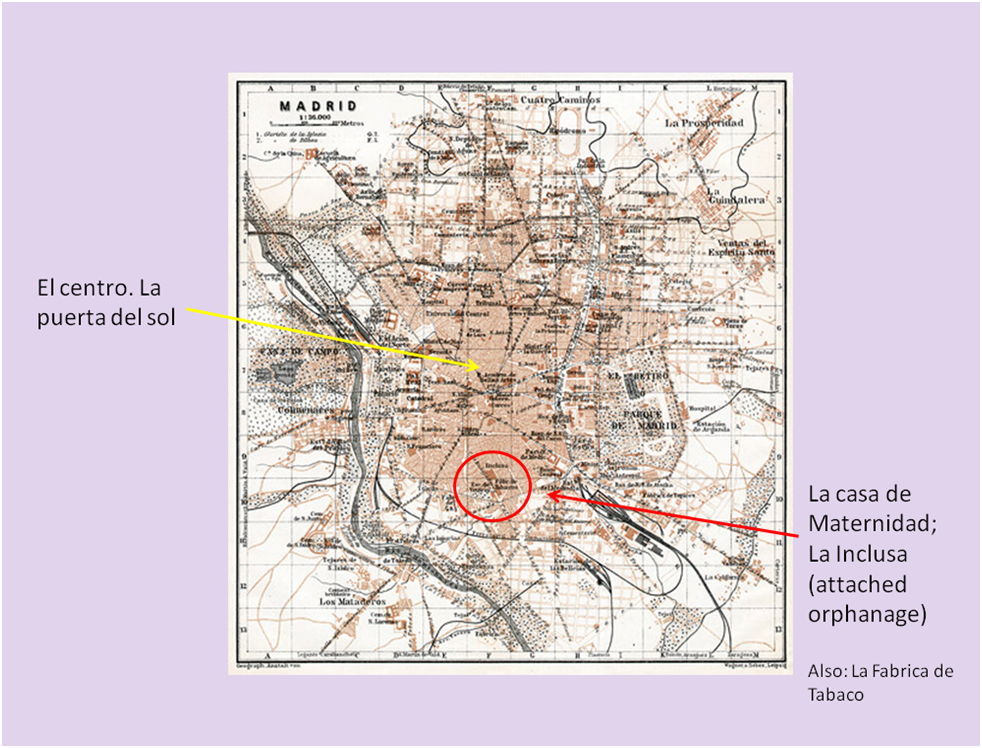
Madrid - 1899

Map of Madrid during the 1920s. You can access a larger version of the map here: http://www.discusmedia.com/catalog.php?catId=9.1.12

This map provides an important visual of the location of the Casa de Maternidad in relation to the areas of the city most frequently discussed and presented in both literary and cultural history accounts of Madrid at this time. To discuss this space, I referred to Michel Foucault’s concept of the heterotopia, though I simplified it significantly for an audience composed of undergraduate students from many different fields of study (including biology, political science, philosophy, and languages). There is a link to Foucault’s article at the end of this post, and you can view my PowerPoint presentation and paper to read my interpretation of the ward through this principle. The main point I wanted to emphasize was the way in which this city space functioned as a means of identifying and isolating a specific portion of the female population – single mothers. By way of this “heterotopic” spatial isolation, single mothers in this ward represented an immoral deviation from the traditional norm of female pre-marital chastity. Even more importantly, this was a gendered transgression, as no men occupied this institution, nor did a parallel space exist for sexually “immoral” males.

Casa de Cuna, Cadiz (Spain). I have been having difficulty locating images of Madrid’s Casa de Maternidad. This image depicts the interior of the Casa de Cuna in Cadiz, and institution run by Catholic Nuns that would take in abandoned infants and children. See the link for its fascinating history.

Of equal importance is the fact that La rampa provides a counter-discourse to official historical records. While the website of Madrid’s Hospital General Universitario refers to the “Historia del Hospital Materno Infantil,” it provides little insight into the actual experience of women in the institution at various points in history. For example, when discussing the place of the ward within the city, the website explains that in the late nineteenth-century, “the hospital’s fame and prestige had extended throughout all of Madrid.” Certainly there is truth to this statement; a hospital of this size at the turn of the century was indeed an admirable display of science, medicine, and progress. However, the details Burgos includes in her novel indicate that female patients were certainly not benefiting from nor celebrating this institution’s “fame” or “prestige”. On the contrary, they suffered greatly within the walls of the ward and were mistreated by the nuns who worked there. Below are a few examples of the way in which Burgos incorporates the medical language of progress into a decidedly non-progressive depiction of the female experience in this space.

  • As she enters the main room of the Casa de Maternidad, the narrator describes Isabel’s impressions of her new peer group: “…that group, formed of about fifty withered, haggard women who appeared tired of supporting their dropsical abdomens… Some of them were married women who, lacking proper medical care, found themselves there; but the majority were single women, the deceived, the abandoned. There were old women, repeat offenders who had already left several children there, who only saw their maternity as an unpleasant physical accident, purely mechanical, from which it was necessary to escape as if it were typhus or pneumonia, without any sort of sentimentality” (108).
  • Pregnancy is described as an illness, show to attack and disable the female body; Isabel fails to recognize herself upon catching a glimpse of her reflection prior to entering the Casa de Maternidad: “Was she really that flaccid woman, with swollen features even despite her emaciation; with a tired face, fallen; cheeks covered by a yellowish tinge that seemed to cover her eyes, giving her that peculiar expression of pregnant woman; that opaque look that appears to convert their pupils into the crystals of glasses through which they wish to see other eyes?” (104).
  • In La rampa, women are not happily awaiting the birth of a beautiful new baby, but rather suffering from an illness provoked by the “polyp, fetus, garbage, illness, stain, or tumor stirring within their wombs” (123-27). The words child, son, daughter or baby (hijo/a, niño/a, bebé) are virtually absent from the chapters dedicated to the Casa de Maternidad, effectively dehumanizing and devaluing the maternal experience within the walls of this institution.

All of the above translations are my own and, to be honest, translating the Spanish to English was quite eye-opening – I felt the force of the language even more profoundly when attempting to find English equivalents. Also, I had never used the word dropsical before, and I always appreciate “learning” English while studying Spanish!
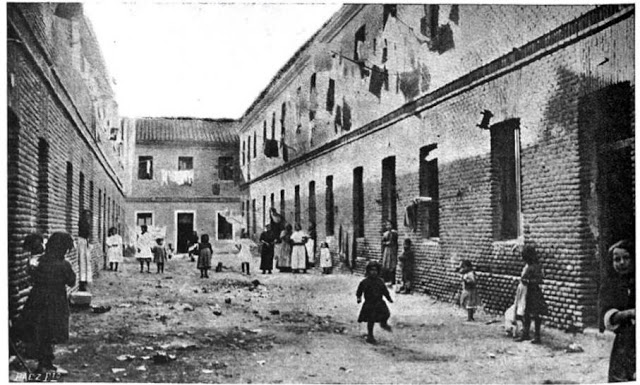
Conditions in which children lived and played in early 20th century Madrid. The Casa de Maternidad and the attached Inclusa took in abandoned children, however they discouraged women from leaving their children in the institution after giving birth due to the very little space available. (Foto: Páez, 1914; Memoria de Madrid. Taken from: http://laventanadeteresa.blogspot.com/2012/05/la-maternidad-2-parte.html)

As this post has gotten a bit long, I will not go into more detail about the second main aspect of my presentation (how experiencing pregnancy in this location affected women’s sense of self, using Julia Kristeva’s notion of the abject), but you can access my short English paper at the end of this post if you’re interested in learning more. I also want to make it clear that I am in no way attempting to endorse Burgos’ fictional narrative as an historically accurate depiction of pregnancy in Madrid at this time; I do, however, believe literature provides us with another window through which to view history, and therefore even fictional accounts contain relevant information about the past. I will end this post here with the slide I also used to wrap up my presentation – three different covers that were used to illustrate La rampa at three different moments. What you you think about these different depictions of the novel? If you have read La rampa, which do you think is most accurate? Misleading? Perhaps inappropriate? I would enjoy your comments of feedback, especially if you have used the novel in a Spanish literature course.

rampa-covers

Resources:

Bender, Rebecca M.
(paper) “Maternity in Madrid: Gendered Spaces in Carmen de Burgos’ La rampa (1917)”
(PowerPoint) “Maternity in Madrid: Gendered Spaces”

Burgos, Carmen de. La rampa, ed. Susan Larson. Buenos Aires: Stockcero, 2006. Print.

Foucault, Michel. “Of Other Spaces.” Trans. Jay Miskowiec. Diacritics 16.1 (1986): 22-27. Print. JSTOR: http://www.jstor.org/stable/464648. PDF available online here.

“Historia del Hospital Materno Infantil.” Hospital General Universitario Gregorio Marañón. Comunidad de Madrid. 2002. Web. 7 Sept. 2010. <http://www.madrid.org/cs/Satellite?cid=1142588696022&language=es&pagename=HospitalGregorioMaranon%2FPage%2FHGMA_contenidoFinal>.

Kristeva, Julia. Powers of Horror. An Essay on Abjection. Trans. Leon S. Roudiez. New York: Columbia U P, 1982. Print.

Ugarte, Michael. Madrid 1900: The Capital as Cradle of Literature and Culture. University Park: Pennsylvania State U P, 1996. Print.

Versluysen, Margaret Connor. “Midwives, medical men and ‘poor women labouring of child’: lying-in hospitals in eighteenth century London.” Women, Health and Reproduction. Ed. Helen Roberts. Boston: Routledge, 1981. 18-49. Print.

Posted in History, Literature, Modernity, Science and Medicine, Spain, Women | Tagged , , , , , , , , | 10 Comments

Santa Muerte, the Alluring and Controversial Folk Saint of Death

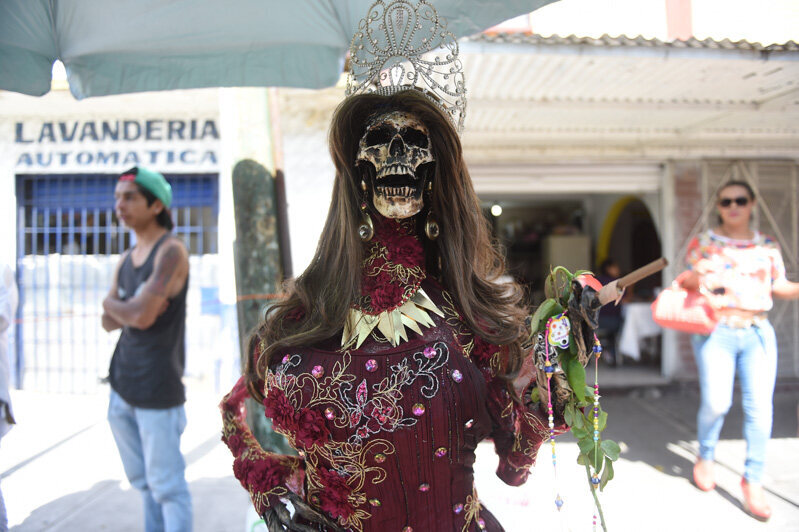
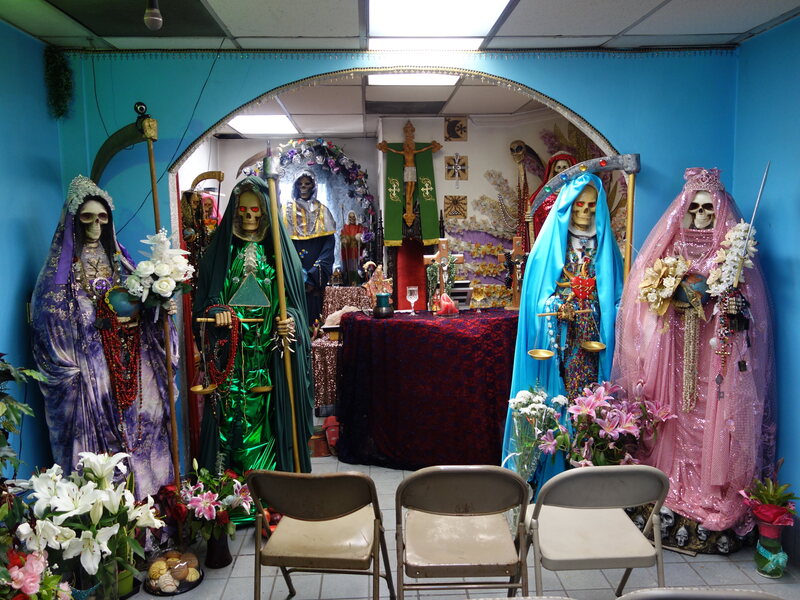
While the Virgin of Guadalupe is perhaps the most iconic and ubiquitous of Mexican Catholic imagery, Santa Muerte, or Saint Death, is quickly becoming a powerful cultural force herself. Though Santa Muerte is not an officially sanctioned saint, having been condemned by the Catholic Church, she has nevertheless become a popular folk saint in Mexico and parts of the United States. That is, her followers, their devotion, and their growing numbers have contributed to her rapidly increasing popularity and visibility within Mexican and Mexican-American cultures. As the personification of death itself (herself), Santa Muerte is a thin, skeletal figure, often depicted as a female Grim Reaper.

The Virgin of Guadalupe (La virgen de Guadalupe) and Saint Death (Santa Muerte)

The Virgin of Guadalupe (La virgen de Guadalupe) and Saint Death (Santa Muerte)

I had been drafting this post for some time, but just last week The Atlantic published a very short article on Santa Muerte, “The Rise of the Narco-Saints,” which I saw shared several times on Facebook. But the article’s lack of details and slight bias left me a bit annoyed. It was rather poorly (hastily?) researched and made no effort to provide thoughtful commentary or even additional resources. Beyond the catchy headline and intriguing image, the two-paragraph article concentrated predominantly on Santa Muerte’s association with the drug trade and other illicit activities, as well as her corresponding condemnation by traditional Catholic authorities. Despite including a short quote from Santa Muerte expert and researcher Dr. R. Andrew Chesnut (whose book I’ll discuss below), the article manages to be “remarkably content-free,” as one commentator accurately observed. Overall, it seemed to have incendiary intentions by depicting Santa Muerte as a “new” trend growing rapidly in the United States; a trend that should be feared or viewed with skepticism for its close ties to narcoculture. (Devotion to Santa Muerte is by no means “new.” Though her history is difficult to pinpoint, her following picked up in the 1960s. Plus, legends abound of her centuries-old Aztec origins, and she appears in Spanish colonial records of the late 1700s. )

In this post I wish to provide a bit more context for Santa Muerte because, unlike what The Atlantic article would lead you to believe, she is in fact a complex, multifaceted folk spirit whose appeal reaches far beyond that of narcos, criminals, and the writer, directors, and actors of Breaking Bad.

article-image

The main altar – Templo Santa Muerte, Hollywood, CA (source: http://www.atlasobscura.com/articles/visit-to-templo-santa-muerte)

In Devoted to Death: Santa Muerte, the Skeleton Saint, Professor Chesnut provides an extensive overview of “Saint Death” through interviews and anecdotes recorded during his research in Mexico. The book is composed of seven chapters, and each title is based on a different colored votive candle. These colored candles symbolize different aspects of Santa Muerte’s spiritual work – brown symbolizes enlightenment and wisdom; white is purity and protection; black, “black magic”; red, passion and love; gold, money and prosperity; purple, (supernatural) healing; and green represents the saint’s power as a nonjudgmental advocate for all her followers (p. 20-25). Devoted to Death also explains that today the seven-color jar candle is the best-selling among followers and devotees as it represents Santa Muerte’s great multitasking powers (p. 26). Thus, while her candles do includes “black (magic),” that is but one of Santa Muerte’s diverse functions.

Chesnut acknowledges the unfortunate fact that the majority of the depictions of Santa Muerte in contemporary media and film concentrate on the dark, amoral, often violent side of the cult – that which the “black” votive candle represents. This, despite the fact that the black candle is the slowest selling of the votives (p. 21): “Most American and Mexican nonbelievers, for example, have little idea that the Skinny Lady [Santa Muerte] heals sickness, finds employment, and helps alcoholics and drug addicts in their struggles for sobriety” (p. 96).  Indeed, Mexican media has portrayed Santa Muerte – considered the patron saint of the cartels and a premier symbol of narcoculture – as “religious enemy number one” (p. 102). While this might allow for a convenient, visible enemy against which legal and religious authorities might act by dismantling altars and condemning public gaterings, such a strategy ignores what Chesnut refers to as a great irony: many law enforcement officials (police, army) are themselves devotees to Santa Muerte. Rather than associate her purely with drug trafficking and narcoculture, it would be more accurate to attribute her growing popularity to the attraction she holds for all “those whose line of work gives them a sense of their own mortality” (p. 102).

article-image

A Santa Muerte display on the street in Tepito, a Mexico City neighborhood, during the Santa Muerte rosary service held on the first day of each month. The praying of the rosary is offered to both the Virgin Mary and Santa Muerte. (source: http://www.atlasobscura.com/articles/on-the-street-with-saint-death-in-tepito-mexico)

Santa Muerte is ultimately a dualistic figure, aiding both those devotees labeled “good” and “bad” by mainstream society and religion. Given that she is not an officially recognized Catholic saint, Chesnut suggests that most devotees – especially those raised Catholic – “feel far more comfortable asking the nonjudgmental folk saint to perform decidedly un-Christian miracles than the official saints” (p. 22). Likewise, individuals who are judged by or excluded from official Catholicism – often based on their “questionable” professions, private lives, or sexualities – are especially inclined to venerate this folk saint who treats everyone equally. For Santa Muerte’s followers, every human being is united by their inevitable death, regardless of their particular religious or political affiliations, criminal backgrounds, or sexualities. She offers salvation and peace to anyone living outside “official” society or religion. It is fitting, then, that Santa Muerte has recently found a number of followers within LGBT and queer communities. In reading about the Latino Queer Arts and Film Festival in Los Angeles earlier this month I found a short documentary-style video, Loving the Bony Lady, featuring Arely González, a Mexican transsexual immigrant living in New York. It’s very well done and I suggest taking the time to check it out. You can also read more about González and the popularity of the Santa Muerte cult in Queens here.

The film features interviews with González and a peek into her personal shrine. González suffered much discrimination in Mexican churches before becoming a leader in the community of Santa Muerte devotees in New York. I was struck in watching this video and in listening to González’s words by the appeal that Santa Muerte must have for queer communities. In fact, Santa Muerte herself appears to embody the figure of a queer saint – she is excluded from official Catholic rituals; her skeletal, deathly face and figure are the antithesis of the life-giving Virgin; and she makes no judgements, accepting any and all individuals who sing her praises. She categorizes no one, and therefore allows for an infinite amount of identities amongst her followers. Her cult, then, fits within the project that Eve Kosofsky Sedgwick described as nonce taxonomy: “The self-evident truth for Sedgwick that ‘people are different from each other’ in sexual, as well as in other, more or less fraught and contested ways, is difficult to theorise even though we may well ‘know’ less systematically through literature or gossip about the small, unregistered gradations of difference which require the ‘making and unmaking and remaking and redissolution of hundreds of old categorical imaginings'” (Anderson 68). Santa Muerte’s followers acknowledge and celebrate those differences that may ostracize them from other organized sects, therefore making, unmaking, remaking, and dissolving restrictive, hegemonic categorizations of identity. Now, I’m anxious to finish reading Devoted to Death, revisit queer theory readings, and do a bit of research on Santa Muerte through this lens.

Below I’ve included a short 2-minute YouTube video below that touches upon many of the reasons for which “ordinary” individuals (that is, those who are not members of drug cartels!) are drawn to Santa Muerte. It also addresses a common misconception: Santa Muerte followers consider themselves, and often are, Christians – they believe in Jesus Christ, and also in Santa Muerte. The two are not at odds, as many might surmise based on media portrayals that liken Santa Muerte’s occult image more to a satanic cult than to a variation (or extension) of the Catholic practice of praying to saints.

Finally, if you are interested in learning more, I highly recommend Chesnut’s book, Devoted to Death. But if you’d rather read some shorter, still very informative articles online, check out Most Holy Death (Skeleton Saint), a blog that explores the sanctification of death in the popular faith traditions of the Americas. It is maintained by Dr. Chesnut and researcher David Metcalfe. The blog contains beautiful and fascinating images of Santa Muerte within and outside of Mexico and the US. Some posts include: “Santa Muerte in the Philippines,” “Saint without Borders: Santa Muerte Goes Global,” and “Let the Earth Tremble! Top Santa Muerte Leader Seeks to Cleanse the Cult!“.

Please take some time to check out the following links and resources for Santa Muerte – Are you familiar with this folk saint, in the US or in Mexico? What are some of the places where you have seen her image?

La Santa Muerte (dir. Eva Aridjis, 2007) is a 90-minute documentary that examines the origins of the cult and tours the altars, jails, and neighborhoods in Mexico where the saint’s most devoted followers can be found. She is worshiped by people whose lives are filled with danger or violence – criminals, gang members, transvestites, sick people, drug addicts, and families living in rough neighborhoods. [imdb]

article-image

Secondary altar in the Templo Santa Muerte, Hollywood, CA. As Atlas Obscura points out, there are many similarities between the manner of presentation of this folk saint and traditional Catholic saints. (source: http://www.atlasobscura.com/articles/visit-to-templo-santa-muerte)

This Kickstarter campaign was successfully funded this summer; it appears the content of the final 30-minute documentary would be similar to the above 4-minute video in that it would focus on Santa Muerte’s role within the LGBT community in New York.

This short article from the Huffington Post (2013) describes Santa Muerte’s increasing popularity in the United States, but without attempting to incite angst or fear in its readers.

A visit to the Templo Santa Muerte,” posted over at Atlas Obscura includes numerous colorful images of the Templo Santa Muerte in Hollywood, CA (including two that I used to illustrate this post). The article also outlines the significance of the colored robes – green, for example, is for health; gold is for business. I highly recommend this short read.

Also on Atlas Obscura are beautiful images from the Rosary ritual in Tepito, Mexico that took place on August 1, 2014: “On the Street with Saint Death in Teptio, Mexico.”

Scholarly publications:

Anderson, Linda. “Autobiographical Travesties: The Nostalgic Self in Queer Writing.” Territories of Desire in Queer Culture: Refiguring Contemporary Boundaries. Eds. David Alderson and Linda R. Anderson. Manchester, UK: Manchester U P, 2000. p. 68-81. [Google books preview here]

Chesnut, R. Andrew. Devoted to Death: Santa Muerte, the Skeleton Saint. New York: Oxford U, 2012. [Google books preview here]
You can listen to Chesnut, a professor at Virginia Commonwealth University, discuss his book here (2.5 minute video).

Thompson, John. “Santísima Muerte: On the Origin and Development of a Mexican Occult Image.” Journal of the Southwest 40.4 (1998): 405-436. JSTOR: http://www.jstor.org/stable/40170073.

Posted in Art, History, US Southwest | Tagged , , , , , , , , , , | 8 Comments

“Fun” with Academic Publishing: Wordle, Coffee, and Pedagogy

As any professor, graduate student, or postdoc knows, publishing an article in an academic journal is not a particularly enjoyable process… and it can take months, if not years, to see your article in print once accepted and revised. Knowing this, I wanted to send something off early in the year to better my chances at a more productive 2014. Back in January, at the beginning of the Spring semester, I decided to follow the recommendations of one of the National Center for Faculty Development & Diversity‘s “Monday Motivator” emails and set aside a minimum of 60 minutes each day – first thing in the morning – for academic writing. I managed to start by 6:15 am each day, thanks to two strategies: (1) I opened the word document of the piece I was working on the night before so it would be staring right at me when I sat at my computer, and (2) I got an automatic coffee pot that I set to start brewing at 5:45 am so I also had hot coffee rewarding me for getting out of bed!

Have your coffee ready and your document open to minimize distraction and procrastination.

Have your coffee ready and your document open to minimize distraction and procrastination.

I highly recommend both of these “techniques” – and the NCFDD’s Monday Motivators. I was able to maintain this morning writing schedule until my article draft was completed and sent off, which was about 5-6 weeks. Some days I would write for an hour, others for 2-3, depending on my level of “inspiration” and the other obligations I had that particular day. During the remainder of the semester I continued to write in the morning on this schedule, but only about 1-3 times per week instead of daily.

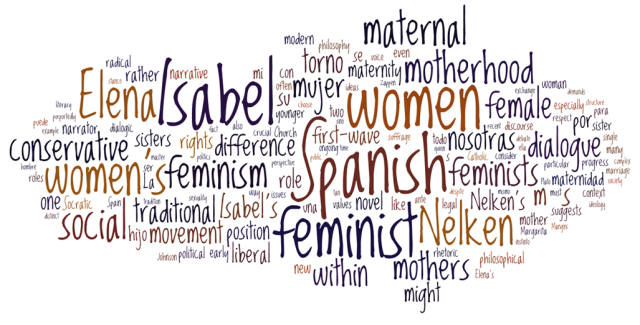
Now that I have completed the revisions the reviewers recommended for publication and have officially sent off my (hopefully) final draft, I decided to have some fun and used Wordle to make a Word Cloud of my article. At the conference I attended this summer in Santiago de Compostela, Spain, one of the presenters incorporated these clouds into her presentation and I found it a quite dynamic and visually appealing way to present her particular literary and textual analysis during a 15-minute panel presentation. She told me she had used Word It Out to create the clouds. I played around with both of these free tools and found that, for my purposes, I preferred Wordle (and I’ll explain a bit below). Below is the cloud generated from my 11,000-word article on a 1927 novel written by Spanish writer and activist Margarita Nelken, “Theorizing a Hybrid Feminism: Motherhood in Margarita Nelken’s En torno a nosotras“:

En torno a nosotras - Margarita Nelken

Word Cloud for my article, “Theorizing a Hybird Feminism: Motherhood in Margarita Nelken’s En torno a nosotras”. Made with Wordle

I found some of the benefits of using Wordle to be the following. After your cloud is generated, you can simply click on words to delete them if you so choose. For example, my paper was written in English but contained many Spanish citations; I chose to omit common Spanish prepositions and verbs like de, en, and es. I did the same in English with the, an, and to. With Wordle it is also extremely easy to manipulate the shape and color scheme of your cloud. Word It Out did not allow you to delete words in the clouds, and I found their tools for changing color to be much less user-friendly. My only complaint is that the Wordle Word Cloud is not available as an image file  – you can neither copy the image nor download it from the website. Your cloud is publicly archived online and you receive a unique url to access it (though I had some problems copying this link). To make my image file (above), I simply made a screen-shot of my Word Cloud page, cropped it in Microsoft Word, then converted it to an image file in Office Picture manager.

I am considering using Word Clouds in my Introduction to Textual Analysis course this fall. Students write 4-5 relatively short papers for this course, and the goal is for them to communicate a complex analytic thesis in a concise manner. Word Clouds would help students see if the most dominant words in their papers are indeed supportive of and relative to their theses. Given that all students will respond to the same prompt, it would be an intriguing and revealing class activity to compare Word Clouds and theses. And the visuals would also make essays more interesting for the reader (aka, ME!); last semester I really enjoyed my students’ image selections, which I required, on their papers in my Women’s Literature seminar. You can see two examples of these assignments here and here.

Finally, for my interested readers, here is the abstract for this forthcoming article: “Theorizing a Hybrid Feminism: Motherhood in Margarita Nelken’s En torno a nosotras (1927)”, explores the complex feminist philosophy that comes to the fore in an overlooked novel [En torno a nosotras] written by Margarita Nelken, one of early twentieth-century Spain’s most vocal and polemic feminists. The analysis juxtaposes the novel with Nelken’s essays, La condición social de la mujer en España (1919) and La mujer antes las cortes constituyentes (1932), in order to encourage a hybrid interpretation of first-wave feminist thought in Spain. Specifically, this essay concentrates on the incorporation of maternity and motherhood into modern female identities. It provides a thorough examination of the debate, defense, and theorization of this traditional female role within a fictional dialogic novel by considering the implications of Platonic and Socratic dialogues. The resulting analysis argues for a reevaluation of first-wave Spanish feminism that takes into account both liberal and conservative tendencies.

Have you used Word Clouds in your classroom or for academic presentations? What tools are your favorites and why?

Posted in Feminism, First-wave spanish feminism, Literature, Pedagogy, Spain, Women | Tagged , , , , , , , , , , , , , , | Leave a comment

Highlights from Spain… as summer vacation comes to an end :(

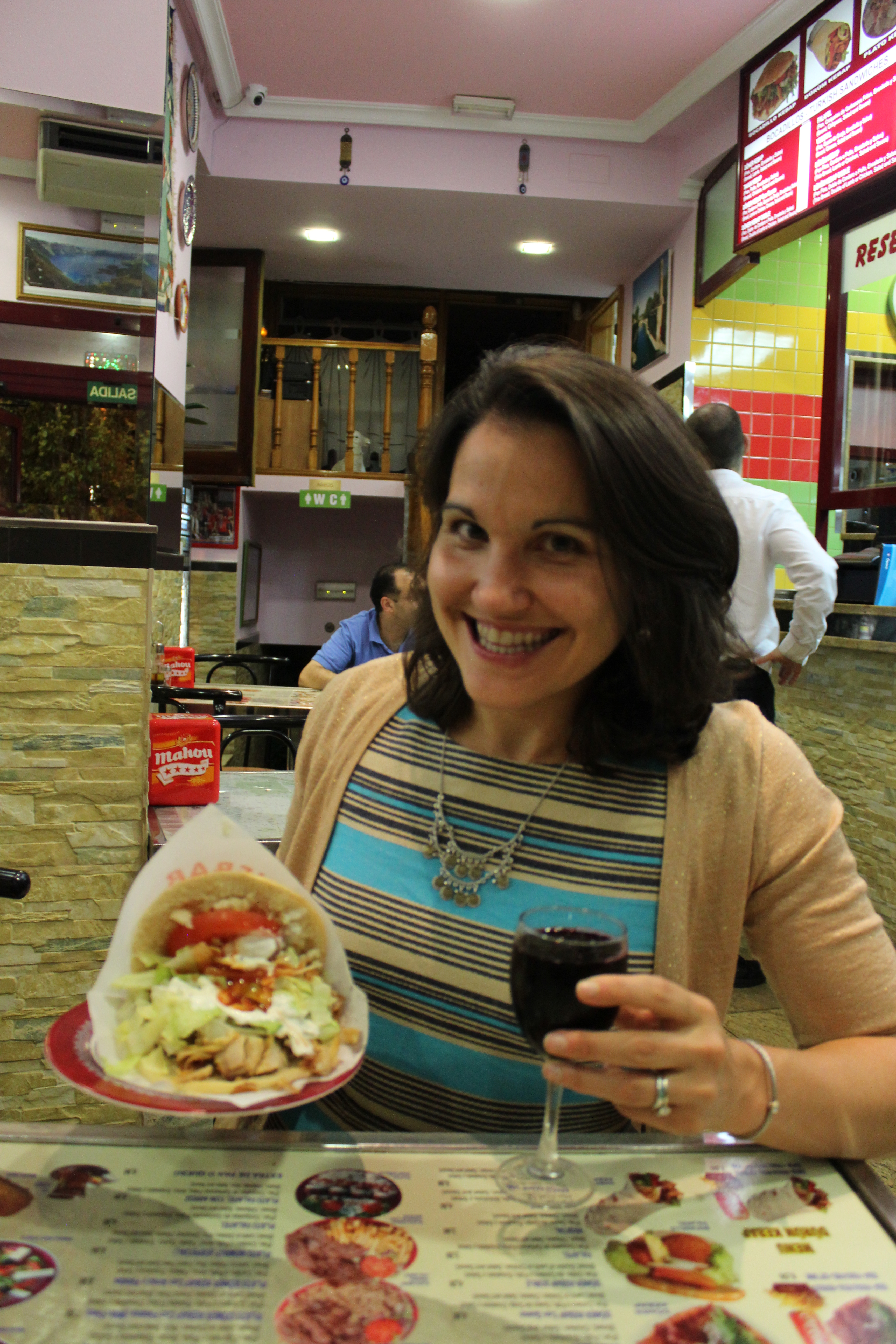
I realized I haven’t yet written a post for the month of July, and the fact that August is only days away is a bit terrifying! I must say, however, that I have had a nice balance of “work” and vacation so far this summer. So in the spirit of summer vacation, I thought I’d do a short post with some photos from my trip to Spain, which was also a mix of academic work and fun. I mentioned before how jealous excited I am for my students who are studying abroad, but in reality my month in Spain was my own version of a professor’s summer study abroad. Though likely with more libraries, museums, gourmet foods, and wines… and with much fewer discotecas, hangovers, and kebabs than and undergraduate study abroad experience (ok, ok, there was one, quite glorious kebab!).

IMG_9200

My final meal in Spain – a midnight-Madrid-Kebab.

Instead of re-capping my entire trip, I thought I’d pick a few of my favorite places and experiences that might appeal to my readers, and/or to students and travelers who might visit Spain in the near future. Below are four portions of my trip this summer that I thought my readers would find interesting or entertaining – excluding, of course, my conference presentation on Almodóvar’s La piel que habito and my discovery of surprisingly numerous breastfeeding paintings in the Prado, which I’ve already written about. Also, this post is giving me an excuse to play with photo collages – I used Fotor for the collages below and found it to be simple (and free!) for the basic compilations I wanted to create. I said I was going to work on my “graphics” this summer, and I suppose this is a start!

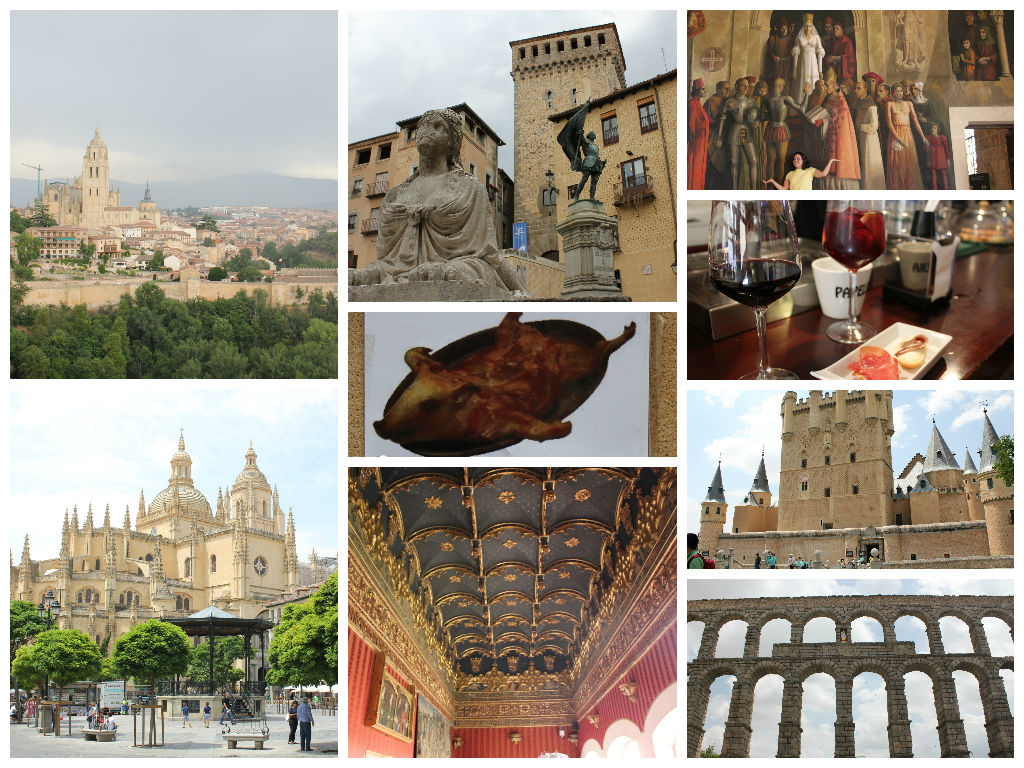
1. SEGOVIA. This small city, a UNESCO World Heritage Site, is about a 50-minute bus trip from Madrid. I had actually visited Segovia twice before, but I still wanted to return for a day-trip, as it’s such a historical – and photogenic – place. I also went with a friend who had never been there before, so we hit ALL the tourist-stops: The Alcázar de Segovia, the Aqueduct, and the Cathedral. Unfortunately, we realized there was a 3 euro charge to enter the Cathedral and, given the quantity of churches and cathedrals we had been visiting, we decided the money would be better spent on wine and Tapas prior to climbing the 150+ steps to the rooftop of the Alcázar!

segovia

Clockwise from top left: View of Segovia from the Alcázar; a rather medieval plaza; mural inside the Alcázar; tapas > cathedral entrance fee; the Alcázar; the Aqueduct; ceiling inside the Alcázar; Segovia’s Gothic Cathedral; Segovia’s famous dish, cochinillo asado… roasted suckling pig!

There is an 8 euro charge to tour the Alcázar, but it is well worth it in my opinion. The rooms are incredibly ornate, and you can climb the quite narrow, spiral staircase to the rooftop for amazing views of Segovia and the surrounding countryside. The Alcázar’s website offers high-resolution images of the interior rooms, so you can check these out to take a sort of virtual tour. The only disappointing aspect of our trip was that we waited too long to eat! All the restaurants in Segovia close by 3-4:30pm and do not re-open until dinner at 8-9pm. We had been used to Madrid where this schedule often goes unnoticed given the large quantity of restaurants and tourists. Alas, we were unable to try the cochinillo asado (roasted suckling pig)…. though I’m not sure the trip would have been better had we experienced this culinary “adventure”.

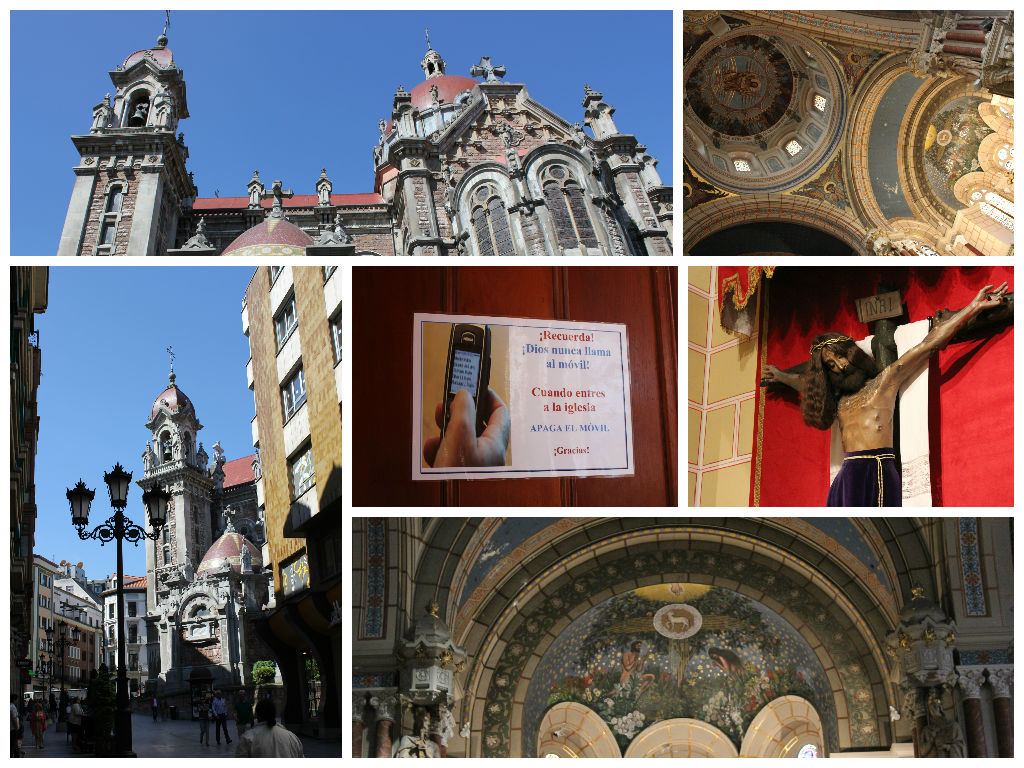
2. IGLESIA DE SAN JUAN EL REAL, OVIEDO. I was able to spend nearly four days in Oviedo visiting a friend who had attended Penn State with me a few years ago. I didn’t realize it was such a large city, so that surprised me. I think it would be the perfect place to live or spend an extended period of time – not as large or busy as Madrid or Barcelona, and not quite as small or isolated as a place like Segovia. While the main Cathedral with its lone tower is a must-see, I especially enjoyed the Iglesia de San Juan el Real in the more central part of the city. Francisco Franco was actually married in this church in 1923. In any case, in addition to its striking exterior, three things caught my attention here. First, I appreciated the humor in the sign reminding visitors to turn off their cell phones: “God never calls your cell phone” [center image below]. Secondly, the colored murals of Adam and Eve in the Garden of Eden behind/above the main altar were both beautiful and unexpected – I couldn’t remember ever having seen this particular Biblical scene depicted in a church, and especially not above the altar [below, bottom right]. And finally, the crucified Christ in the back of the Church had the most “envious” mane of hair [below, center right]. Iglesia-Oviedo

I have always found the “Cristos con pelo verdadero” (Christs with real hair) to be a bit creepy, especially those I had seen in Mexico. This one, however, was really quite impressive! I’d love to know more about where and when these depictions of Christ were popular; I’ve seen them in Mexico and Spain, but not in the US (though I likely haven’t visited as many churches here as abroad, since Cathedrals and churches in other countries are part of my “tourist” itinerary). I’d love to hear from readers if you know more about the historical significance of such realistic renderings of Christ. My google-search was unsuccessful… difficult search terms, I think.

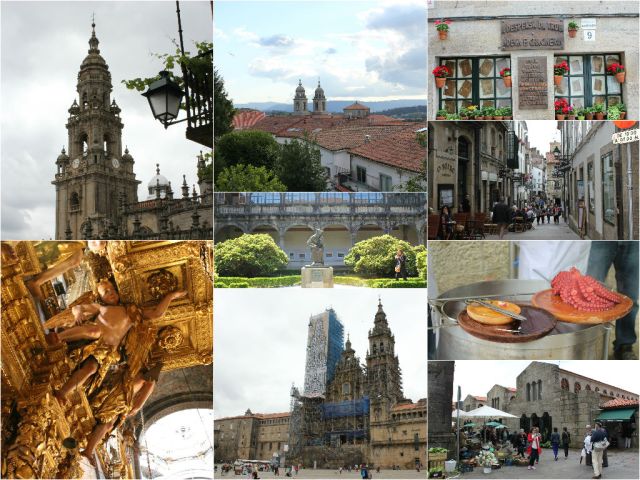
3. SANTIAGO DE COMPOSTELA, GALICIA – This was my first trip to Galicia, the northwestern region of Spain located directly north of Portugal. It proved to be a nice change from the dry, 90-degree weather I had been enjoying in Madrid – we had several cloudy days with a bit of rain, and the temperature barely rose above 60 degrees. The combination of the cool, damp weather, the lush, green landscape, the simple white or stone buildings, and the bagpipe music that filled the plaza of the Cathedral made me think I was in Ireland rather than Spain! I was pleasantly surprised at how unique this area is. Additionally, the seafood is amazing, especially the octopus (pulpo) and squid (chipirones), both served with garlic, olive oil, and homemade crusty bread. It’s even cooked up fresh outside at the Mercado de Abastos [image below, 3rd down in right column], where you can see and buy an array of fresh seafood, chicken, beef, and pork; fruits and vegetables; and bread and empanadas sold by the kilo.

Santiago

Clockwise from top left: Tower of the Cathedral, Santiago de Compostela; View from our apartment; our favorite spot for Chipirones; a street adjacent to the Cathedral; Cooking Octopus (pulpo) at the market; the Market, Mercado de Abastos; Front facade of the cathedral, which was unfortunately under construction; enormous gold angels “supporting” the ceiling inside the cathedral; and the central garden at the library (center image).

Since Santiago de Compostela is the final stop on the Pilgrimage, “El camino de Santiago”, or the “Way of St. James”, and the Cathedral houses the remains of the apostle St. James, the streets are filled with hikers and backpackers (peregrinos) who have made the journey from various starting points. Someday I’m hoping to hike a portion of the camino – if you’re interested, the 2010 movie “The Way” (dir. Emilio Estevez) does a decent job of depicting both the physical and emotional experience of trekking the camino. There are also several documentaries on YouTube.

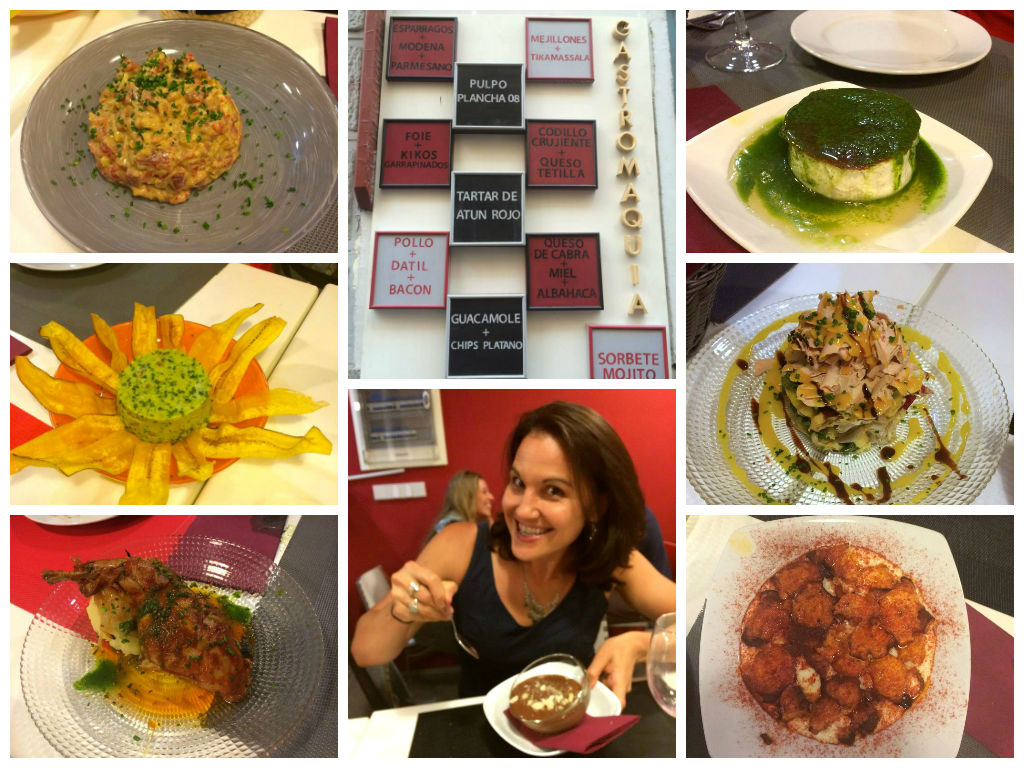
4. FOOD – TABERNA GASTROMAQUIA: I should have made this entire post about food; I ate sooo much during the month of June – especially in Galicia and Asturias! Of all the fantastic food I ate on this trip, however, I must say my favorite meal was at Taberna Gastromaquia in Madrid. This tiny restaurant is located in Chueca and seats only 24, so reservations are a must. They also don’t open for dinner until a very “Spanish” 8:00pm, so keep that in mind if you’re accustomed to an “early” American dinner hour of 5-7. Both the service and the food were fantastic – I’m certainly no food blogger, so I won’t go into detail on any of these dishes. But I will say that the warm goat cheese with honey and basil [top right image] was absolutely amazing – and I typically hate goat cheese; I think it tastes like dirt… or goat… or a barnyard? In any case, the flavor combinations of this appetizer perfectly complemented (or covered up!) the strong taste of goat cheese. Below are all the dishes we tried… our group of four also finished up two bottles of Rioja and, though we shared all the entrees and appetizers, we each ate our own dessert.

gastromaquia-Madrid

Clockwise from top right: Goat cheese with honey and basil; Foie Gras salad; Grilled Octopus over potato and cheese mousse; my dessert – a Chocolate-mousse-pudding topped with salted almonds… which is a terrible description for communicating how incredible the taste and texture were (again, not a food blogger); Rabbit leg over potatoes; fresh guacamole and plantain chips; Tuna Tartare, which was my second favorite item behind the goat cheese.

If you ever have the chance to eat a leisurely dinner in Madrid, I highly recommend making reservations at Taberna Gastromaquia (check out their Facebook page). While it’s not exactly a “cheap” option, neither is it especially expensive for the quality of the food and the overall dining experience. For our group of four, for example, including two bottles of wine, dessert for all, and a small tip, we paid about 180 euros – or about $55-60 per person. But we sampled so much of the menu and spent over 3 hours eating dinner. I think a similar meal in a US city would easily cost twice that, especially when factoring in wine (which seems practically free in Spain) and a standard 15-20% American tip. If you do visit Gastromaquia, you MUST get the Sorbete Mojito for dessert – my friend chose it and I was quite jealous as I watched the waiter pour a very “healthy” dose of Bacardi over a homemade lime-mint sorbet.

FINALLY… Though it’s technically a 5th aspect of the trip, I couldn’t help added a few pictures below of rural Asturias – only a few miles outside of Oviedo. Now, I’m from central Pennsylvania and I currently live in Iowa, so I’m no stranger to farms… or cows! What amazed me was the magnitude of the contrast between the modern city (Oviedo has a population of 250,000+) and the “pueblos” only miles away. In the states I’ve lived in, rural areas like this are not found so close to cities; only a few miles away, such an area would be a quite populated suburb! I’m especially grateful to my friend Laura and her family for welcoming me into their home – and feeding me delicious food – for my final day in Oviedo.

Beautiful Asturian countryside

Beautiful Asturian countryside only minutes from central Oviedo

Ok, now that I’ve sufficiently “re-lived” my trip and shared some of my pictures, I’ll be taking four final days off this weekend – completely computer-less (yikes!) – before returning to the reality of my office, syllabi, article revisions, more regular blogging, and general preparations for the 2014-15 academic year.

What were some of your favorite experiences – food, trips, museums, etc. – this summer? Have you been to these areas of Spain, or will you be planning a semester abroad or vacation nearby?

¡Nos vemos en agosto!

Posted in Spain | Tagged , , , , , , , , , , | 5 Comments

Pedro Almodovar’s “La piel que habito”: Science and Technology as Postmodern Mediums

I feel very lucky to have been able to spend the month of June in Spain, first in Madrid for nearly 3 weeks (with a day trip to Segovia), then in Santiago de Compostela for a few days during a conference, and now in Oviedo and other parts of Asturias where I’m visiting a friend before returning back home to my poor abandoned husband and dogs! While I have been able to use my Spanish daily, eat amazing food and drink lots of red wine, visit the incredible Prado and Reina Sofia Museums in Madrid, and blog a bit about early 20th-century eroticism and breastfeeding in classic art, I also spent a lot of time working on my paper and presentation for the Humanities conference in Santiago de Compostela (which was, in fact, the main reason for my trip!). The conference theme was Hispanic Humanism at the crossroads of print, visual, and electronic communications, and so I had to venture out of my “comfort zone” of early twentieth-century Spanish literature and culture. I decided to work with film, since I had recently seen Pedro Almodóvar’s La piel que habito (The Skin I Live In) (2011). I’d be lying if I said I wasn’t a bit nervous (terrified?) to speak of Almodóvar in Spain – yikes!

I also managed to get a researcher's card for Spain's National Library (La Biblioteca Nacional) in Madrid, which was quite an accomplishment! Photo: Madrid, June 2014.

I also managed to get a researcher’s card for Spain’s National Library (La Biblioteca Nacional) in Madrid, which was quite an accomplishment! Photo: Madrid, June 2014.

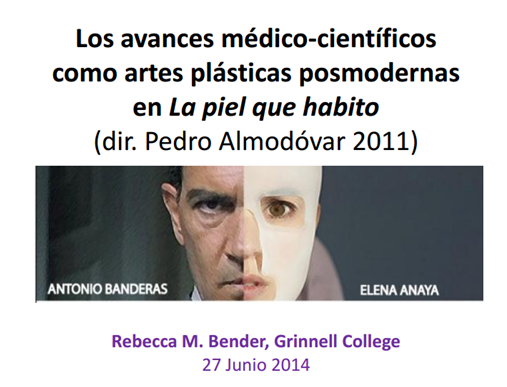
In this post you can read about what the work-portion of my trip entailed, which should be especially useful to those who think professors have the summers “off”. No complaints here, though, since I love that I am able to travel and present creative analyses of film and literature as part of my job. My conference paper (which was written in Spanish) was titled “Los avances médico-científicos como artes plásticas posmodernas en La piel que habito”, or in English, “Scientific and Medical Advances as Postmodern Plastic Arts in The Skin I Live In. In it, I adopted a postmodern interpretation of new technology as powerful and potentially dangerous artistic mediums. This movie is an extremely disturbing psychological drama, with elements of science fiction and horror films; the plot is nearly impossible to summarize in a concise way (as are the plots of most Almodóvar’s films!). In the most (over)simplified sense, Dr. Ledgard (Antonio Banderas) is a scientist/researcher/doctor who is working to create a perfect, indestructible artificial skin. The audience sees early on that he keeps “Vera” (Elena Anaya) imprisoned in his home, using her to carry out his experiments. In the process, he essentially shapes – or “(re)creates” – her in such a way that she begins to resemble his now deceased wife. As the non-lineal narrative unfolds, largely via flashbacks, viewers learn the shocking story behind Vera. I’m sure you can find a more thorough, spoiler-filled summary somewhere, if you’re interested! PielQueHabito_title slide

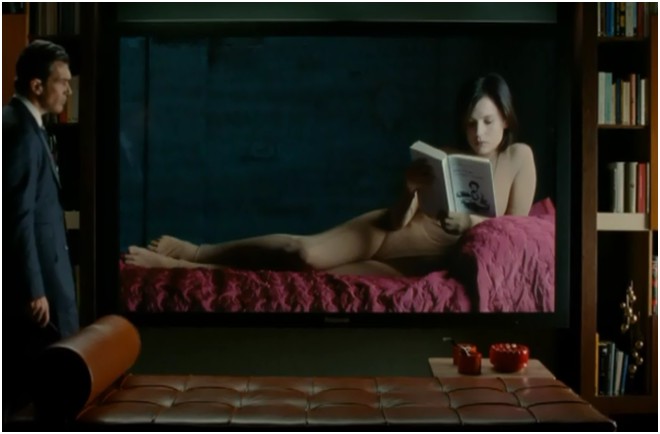
Given that the film reveals a strong interest in the arts, especially through the incorporation of sculpture, classical and modern paintings, music, dance, and even fashion, I wanted to examine Vera as yet another “piece” of artwork – the product (masterpiece) of the “artist”, Doctor Ledgard. This would allow me to look at science, medicine, and new technologies as alternative, postmodern artistic mediums that, nevertheless, found their inspiration in revered masterpieces of the past. In the film, for example, there are two large paintings of Venus by Italian Renaissance painter Titian (Tiziano) that adorn the hallway of Ledgard’s mansion: “Venus de Urbino” and “Venus recreándose con el amor y la música.” The film juxtaposes these sixteenth century representations of the goddess with subsequent images of Vera on the television screen in Ledgard’s room, where he observes her with a watchful, erotic eye. Below are Titian’s paintings, followed by two screen-shots from La piel que habito.

File:Tiziano - Venere di Urbino - Google Art Project.jpg

“Venus de Urbino” (1538), Titian

“Venus recreándose con el amor y la música” (1555) – Titian. Wikipedia.

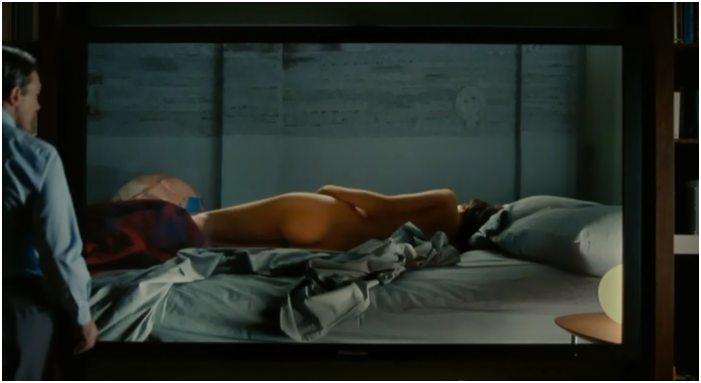
Both of these portraits find parallels in the film – first, Vera is posed in a similar way to “La Venus de Urbino.” Moreover, the “frame” of the television set causes her image – which is essentially one of surveillance – to appear as a piece of framed artwork adorning the wall of Ledgard’s room. screenshot_Vera-Venus_PielQHabito Secondly, both protagonists appear on screen in certain moments positioned such that they evoke the portrait depicting Venus, love, and music (another artistic medium). The representations in La piel que habito that echo this second painting, “Venus recreándose con el amor y la música,” were for me the most fascinating as objects of analysis, given that the imitation/evocation of this classic scene occurs on two levels: first, within the narrative [first image below]; second, in Almodóvar’s direction of the film [second image below]. screenshot_Vera-Led-VenusMusica_PielQHabito

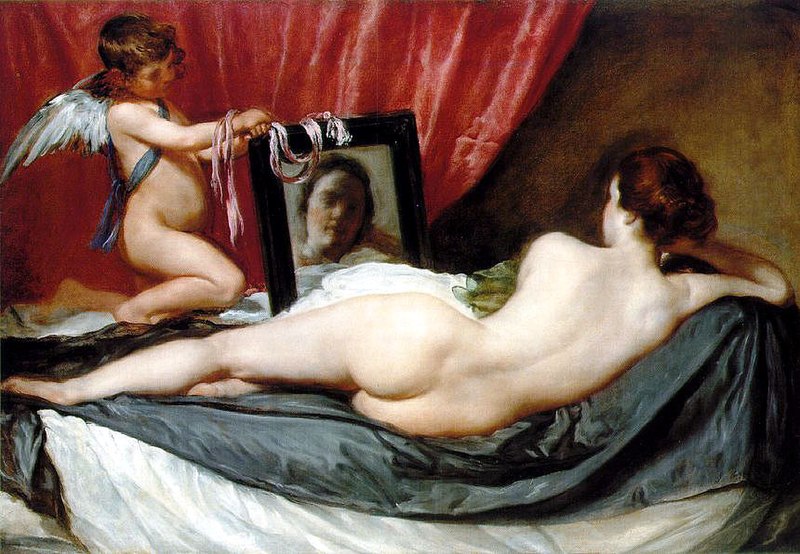
In addition to these paintings, I also discussed renowned Spanish painter Diego Velázquez’s seventeenth-century rendition of Venus, “Venus del espejo” (1599-1660). This version of the goddess was especially innovative, given that she was portrayed as a brunette, which, at the time, made it a bit more difficult to immediately identify her with the ubiquitous blonde goddess. Moreover, Velázquez incorporates a mirror into the painting, allowing viewers to see that Venus is in fact aware she is being observed (or painted, “created” as a work of art). The mirror’s reflection, however, obscures the details of her true identity and beauty. The reflected image is ambiguous, and thus we are unable to precisely pinpoint or describe this woman-goddess’s complete appearance.

File:Diego Velaquez, Venus at Her Mirror (The Rokeby Venus).jpg

“Venus del espejo” (Diego de Velázquez, 1599-1660). Wikimedia.

Velázquez’s portrait essentially challenges us to reflect on what exactly we are seeing when we observe a piece of art – how faithfully does art reflect reality, and is it even capable of doing so? In La piel que habito, we see Vera posed in a very similar position – as we can see from the following screen shot, the television monitor on the wall again makes this piece of technology resemble the classic pieces of framed art that hang in Ledgard’s hallway. screenshot_VeraEspaldas_PielQHabito In sum, by evoking or incorporating images of female beauty in classic art by way of postmodern parody – either explicitly or implicitly – I argue that Almódovar’s film both celebrates and challenges canonical artwork and the standards of beauty that it has sanctioned. According to Linda Hutcheon in The Politics of Postmodernism, postmodern parody allows us to re-visit the past (both history and art), this time contemplating its associated ideology with a mix of irony, admiration, and criticism (103-04). When viewers see these scenes of Vera in the first 20 minutes of the film, they do not know her history until they piece it together as the narrative unfolds anachronistically (I won’t include spoilers – go watch this thought-provoking, but quite disturbing, film!). Later, when the audience has constructed the back-story, these early representations of Venus – typically associated with the epitome of female beauty, eroticism, love, and the male-gaze – take on entirely new meanings. Thus, my paper suggests that, in La piel que habito Almódovar ambiguously celebrates and criticizes both canonical representations of female beauty, and the powerful capacities of science, medicine, and technology. Below is the final slide of my PowerPoint that compares Vera to the three paintings I discussed. You can view the entire presentation, and read the Spanish paper by clicking on the links under Resources, below (they will download as PDFs).

Vera (as Venus) alongside classic paintings of Venus by Titian and Velazquez.

Vera (as Venus) alongside classic paintings of Venus by Titian and Velazquez.

I’m hoping to expand on this paper by doing more research on the actual paintings (delving into some art history!), including Goya’s famed “La maja desnuda” (1795-1800) if possible. I may also consider the importance that sculpture wields within the film. In the resources below, you can read my conference paper (in Spanish) and view the PowerPoint that accompanies it. I’d love to hear your comments, suggestions, or criticism. How many of Pedro Almodóvar’s 18+ films have you seen? Which is your favorite? If you teach Spanish or film, have you used any in your classes? (My Spanish women’s literature class, for example, recently discussed Volver).

Resources:
Hutcheon, Linda. The Politics of Postmodernism. London and New York: Routledge, 1989.

Bender, Rebecca. “Los avances médico-científicos como artes plásticas posmodernas en La piel que habito.” Presented at VII Congreso Internacional de la Asociación de la Asociación Hispánica de Humanidades – El humanismo hispánico en la encrucijada universal de la comunicación: lo impreso, lo visual y lo electrónico. Santiago de Compostela, Spain: 26-28 June 2014. Paper:RMBender_LaPielQueHabito_paper PowerPoint:RMBender_PowerPoint_LaPielQHabito

Posted in Art, Science and Medicine, Spain, Women | Tagged , , , , , , , , , , , , , , , , | 4 Comments

Breastfeeding in the Prado: Religious, Mythological, and Pagan Roots

Don’t worry! This isn’t a too-much-information personal anecdote… just some observations I made regarding the very frequent and detailed depictions of breastfeeding in the artwork gracing the Prado’s walls.

Having initially visited Madrid’s Museo del Prado in 2001 for my two-week “tour” of Spain after graduating high school, then making a brief stop there while studying abroad in Spain in 2004, I was looking forward to visiting again this summer. While I had always admired the masterpieces of Goya and Velázquez (“Las meninas“, for example), I was sure I would appreciate some of the lesser-known pieces much more after spending the past 10 years studying Spanish literary and cultural history for my PhD. I was correct – now I recognized Velázquez’s portraits of Felipe IV and Conde Duque de Olivares without having to read the descriptions; I had a new appreciation for Francisco de Zurbarán’s renditions of Hercules and their curious homoeroticism (well, according to my analyses!); and I thoroughly enjoyed studying the incredibly detailed and even “futuristic” works of El Bosco with an eye towards their influence in early 20th century surrealism – it’s incredible to think that “Jardín de las delicias” [Garden of Earthly Delights] (below) was painted around 1500! Go to the Prado’s site (click here!) to explore a high-definition image that allows you to zoom in on the most intricate details of this amazing triptych.

File:El jardín de las Delicias, de El Bosco.jpg

El Bosco – “Jardín de las delicias” [Garden of Earthly Delights] (Netherlands, 1490-1500). Image via wikipedia.

But aside from these strictly “academic” observations of Spanish culture and art history that stemmed largely from my graduate studies and research, I also noticed what seemed to be an excessive quantity of artwork depicting breastfeeding. After two specific paintings caught my attention for their very detailed inclusion of long streams of breastmilk, I began to jot down all the pieces that featured this theme. I ended up with a list of 12 works – 11 paintings and a sculpture. In four days I covered about 80% of the museum – I admittedly skipped over some rooms of sculpture, so there very well could be more. But for now, I’m including these 12 works below with some very brief comments and links to the Prado’s galleries (unless otherwise stated, all images come form the Museo del Prado’s website). I think I’m going to consider this post a public-service – if you ever visit Madrid’s famed museum, you can now use my blog as your own personal guide to “breastfeeding in the Prado”!

You’re welcome.

alonso cano_prado

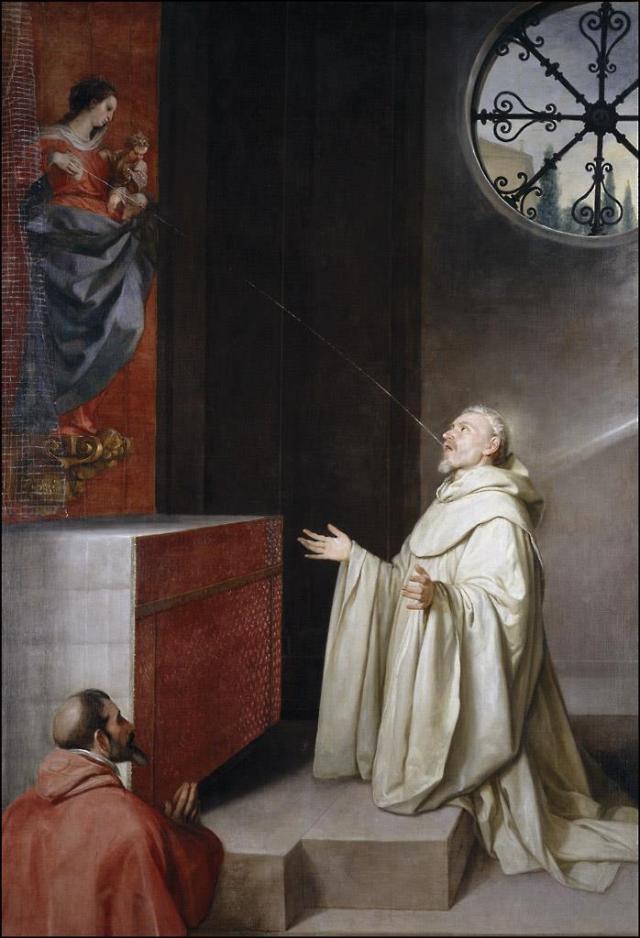
“San Bernardo y la Virgen” by Alonso Cano (1645-52). Image via Google images.

I’ll start with the first two paintings that made me stop in my tracks. One is based on a religious (Catholic) story, the other on mythology. First (above), Spanish painter Alonso Cano’s “San Bernardo y la Virgen,” was completed between 1642-52. According to the information provided by Javier Portús Pérez on the Prado’s website, Saint Bernard was known for promoting the celebration and worship of the Virgin Mary throughout his life (the cult of the Virgin). As a reward for his devotion, she shares her milk. This was a popular story in Baroque Spain that linked Catholic Marian devotion to a supernatural act. Next (below), Flemish painter Peter Paul Rubens’ “El nacimiento de la vía lactea” (“Birth of the Milky Way”), was completed in 1637. Along with other paintings by Velázquez, this large piece decorated the “Torre de la Parada,” a royal residence of the Spanish monarchy on the outskirts of Madrid. The majority of the scenes illustrated stories of the gods as they were depicted in classic works like Ovid’s poem, “Metamorphosis.” Rubens aimed to capture the moral essence of these stories, as well as the attitudes of the characters. In “Birth of the Milky Way,” Hercules – the son of Jupiter and Alcmena – is placed by his father at the breast of his sleeping wife Juno, so that her breastmilk might make his son immortal. Juno awakens, however, quite displeased, and the milk spilled when she removes the infant from her breast then formed the stars of the Milky Way.

Peter Paul Rubens - The Birth of the Milky Way, 1636-1637.jpg

El nacimiento de la vía láctea (Birth of the Milky Way) by Pedro Pablo [Peter Paul] Rubens (1636-37). Image via Wikipedia.

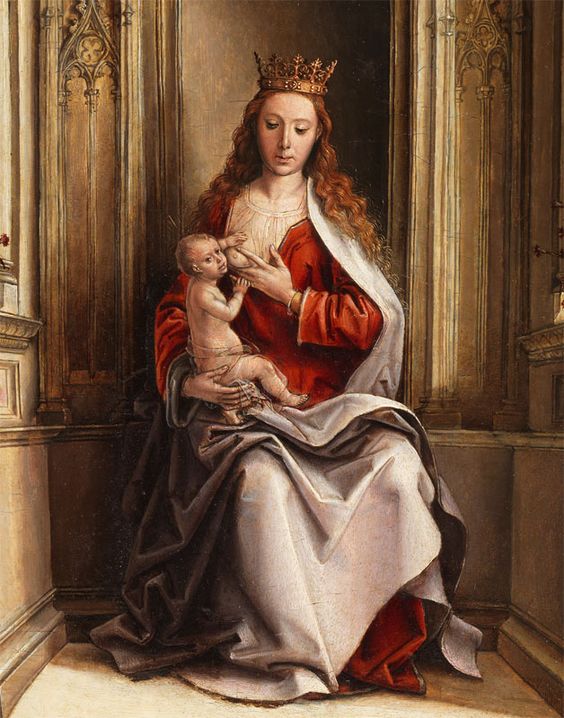
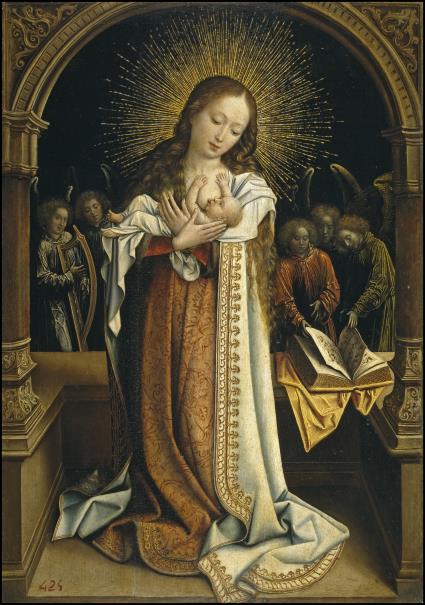
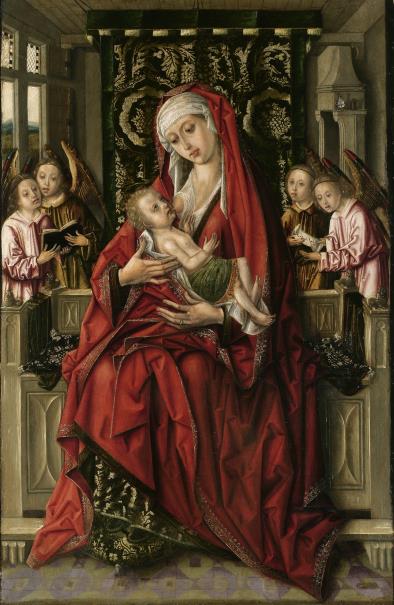
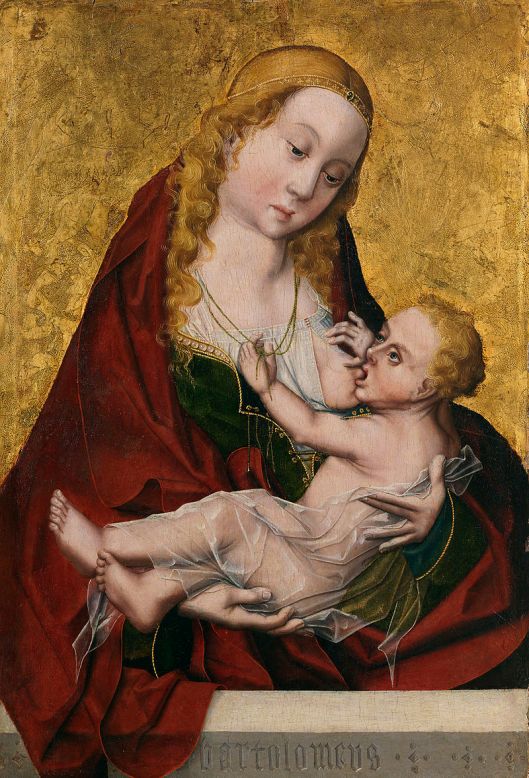
Several more paintings share the title “La virgen de la leche,” or “The Virgin of Milk.” These were all painted between the fifteenth and sixteenth centuries – 3 in Spain and one in the Netherlands.

La virgen de la leche_Pedro Berruguete-1500

“La virgen de la leche”, by Spanish painter Pedro Berruguete (1500).

bernard van orley_virgen de la leche

Dutch painter Bernard van Orley’s “La virgen de la leche” (1520).

alvaro de luna_Virgen de la leche

“La virgen de la leche,” Maestro de don Alvaro de Luna (Spain, 1490).See full-size image at the Prado Museum’s website:www.museodelprado.es/coleccion/obra-de-arte/la-virgen-de-la-leche/cadd1f37-69b5-4322-828d-20ebcf504bc6 

Maestro bartolome-virgen_de_la_leche

“La virgen de la leche,” painted by Maestro Bartolome (Spain, 1490). Image via wikipedia


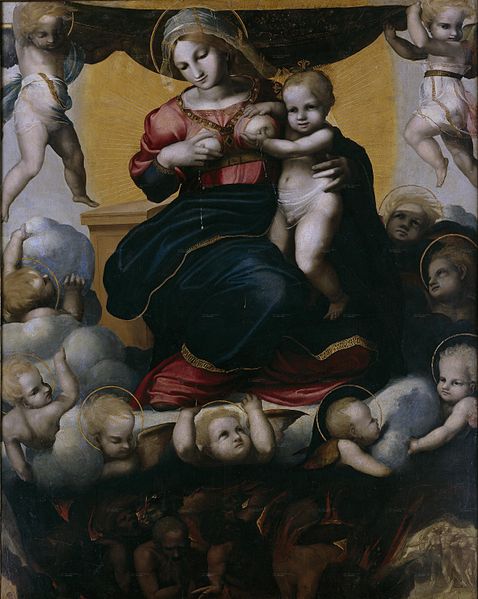
In 1517 Pedro Machuca painted “La virgen y las ánimas del Purgatorio” (“The Virgin and the Souls of Purgatory”) that actually includes TWO breasts spilling streams of milk… the milk falls onto the flames below in order to alleviate the suffering of the souls in purgatory. The Prado has a Spanish YouTube video that explains the key aspects of this painting – it would be great to use in a Spanish art history course, as it discusses Machuca’s influences, the composition, and a bit of the controversy surrounding the piece.

Machuca_virgen-prado

“La virgen y las animas del purgatorio” [The Virgin and the Souls of Purgatory], by Spanish painter Pedro Machuca (1517). Image via Wikimedia

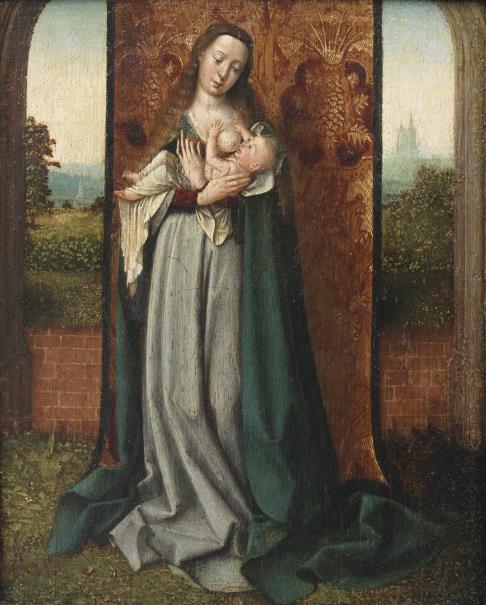
Below, the first image is Luis de Morales’ “El Nacimiento de la Virgen” (“The Birth of the Virgin”), which was completed in the 1560s. He depicts the newborn Virgin Mary being fed by her wet-nurse alongside her mother, Saint Anne. The second image below is Jan Provost’s “Virgen y el niño” (The Virgin and Child).

nacimiento de la virgen_luis de morales

“El nacimiento de la Virgen” [The Birth of the Virgin], by Luis de Morales (1590-69). Image via Museo del Prado

Virgen con el nino_Jan provost

Dutch painter Jan Provost’s “La Virgen con el nino” [The Virgin with Child], circa 1500. Image via Google images; Museo del Prado

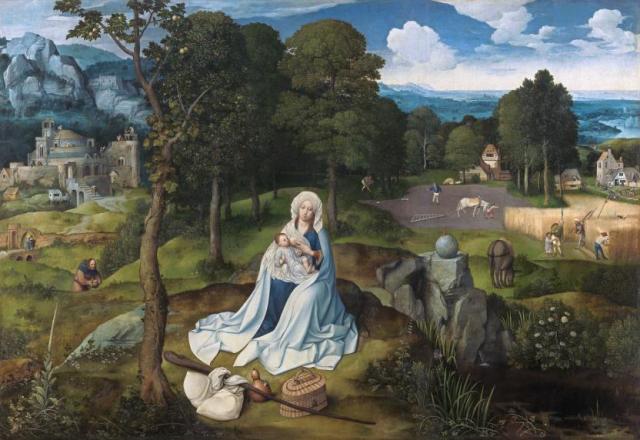
Both Gerard David and Joachim Patiner illustrated “Descanso en la huída de a Egipto” [The Rest During the Escape to Egypt] in the sixteenth century.

Descanso huida a Egipto_David Gerard

“Descanso en la huida a Egipto” [Rest on the Escape to Egypt], by Dutch painter David Gerard, 1515. Image via Google images; Museo del Prado.

Descanso huida a Egipto_Joachim Patinir

“Descanso en la huida a Egipto” by Dutch painter Joachim Patinir (1518-1520). Image via Google images; Museo del Prado.

Finally, Antonio Solá’s marble sculpture titled “La caridad romana” (“Roman Charity”) was perhaps the most fascinatingly disturbing piece I saw. The sculpture depicts the story of a young woman, Pero, who secretly breastfed her imprisoned father, Cimon, so that he would not die condemned to starvation. When her stealth act of piety is discovered, her father is released and she is celebrated for her compassion and virtue. The story is of pagan origin and had actually been depicted quite frequently in paintings and art during the 15th to 17th centuries. The  juxtaposition of eroticism, maternal care, and incest certainly caused the most gasps from my fellow museum visitors once they read the description of the father-daughter figures.

La caridad romana_antonio sola

Spanish sculptor Antonio Sola’s “La caridad romana” [Roman Charity], completed in 1851. Image via Google images; Museo del Prado.

So, there you have it. Breastfeeding has been celebrated by painters all over the world for centuries – and yet today many women are scorned, mocked, or stigmatized for feeding their babies in public. I recently read an interesting  blog post via a friend’s Facebook where a woman took a photo of herself breastfeeding her child in front of the massive Victoria’s Secret advertisement of a women showing the store’s newest bra – and a lot more breast than the mother! Perhaps that is what caused me to pay particular attention to this theme in the Prado.  I find this topic – the “controversy” of women’s breasts – both fascinating and irritating. As Iris Marion Young has stated in “Breasted Experience (PDF)” breasts are “a scandal for patriarchy because they disrupt the border between motherhood and sexuality, between love and desire”. In fact, one of my students wrote about this topic for her final paper in my women’s literature course last semester.

All in all, my experience in the Prado this summer has only strengthened my conviction that we stand to learn so much from the study of art, art history, and literature – and not just about cultures of the past, but about our own present day beliefs, values, and anxieties.

Do you know of other famous depictions of breastfeeding, either in religious, secular, or mythological contexts? Have you seen versions of Pero and Cimon’s story? What do you think of “public” breastfeeding in today’s society?


Save

Posted in Art, Spain, Women | Tagged , , , , , , , , , , , | 10 Comments

Bicycles, typewriters, and sex!?!? Cultures of the Erotic in early 20th Century Spain

Among the many articles and books I consulted for my last article on La Venus mecánica, Maite Zubiaurre’s Cultures of the Erotic in Spain, 1898-1939 (from Vanderbilt UP, 2012) was by far my favorite. Not only does Prof. Zubiaurre‘s monograph recover and examine popular Spanish erotica from the turn of the twentieth century, but it contains over 300 color illustrations – postcards, magazine covers, advertisements, photography, etc. She focuses her analysis on popular erotica and pseudoscientific essays in order to better understand how these marginalized discourses dialogue with the more sanctioned, authoritative voices of Spanish literature and culture as we understand them today. Specifically, Zubiaurre argues that the erotic cultures of 20th century Spain inevitably lead us to re-examine the works of “enshrined male figures” like philosopher Jose Ortega y Gasset and physician/essayist Gregorio Marañón (I’ve written about Marañón’s “defense” of conscious maternity here). In doing so, Zubiaurre discovers that these well-known figures also had a great deal to say regarding sexuality and eroticism, but that “their work on these topics has been largely ignored in the canonical studies of their ideas” (2). By juxtaposing canonical works on love and sexuality with popular erotic culture, Zubiaurre’s Cultures of the Erotic illustrates that, even as they struggled to react against this “vulgar” trend, many respected intellectuals could not entirely escape its influence (2-3).

Maite Zubiaurre’s investigation of popular erotica and sexual pseudoscience reveals a “Third Spain” that challenges the traditional liberal/conservative dichotomy.

The book also makes a compelling argument for the recognition of an “Other”, third Spain that “cuts a different cross section through the dualist historiographies… [that] cuts across class and gender, and bridges the divide between high and low culture” (1) . As Zubiaurre notes, it is precisely Spanish erotica that points to the breakdown of these dualist historiographies: “So-called liberal Spain was often as staunchly conservative and ‘un-European’ in its attitudes towards sexual matters as were its political opposition. Conversely, ‘conservative Spain’ showed itself to be far more sexually open and sophisticated than is usually acknowledged” (1). Thus Cultures of the Erotic points to larger themes, such as history and politics, which often informed the subtle subtexts that surfaced in visual and literary depictions of sexuality and eroticism.  She employs the Spanish word “sicalipsis” (which may suggest the erotic, burlesque, or even pornographic) to refer to the sudden proliferation of erotica and accompanying erotic liberation at the end of the 19th century. According to the Wunderkammer homepage(which I’ll discuss below), Zubiaurre draws heavily on Javier Rioyo’s interpretation of sicalipsis as an erotic invasion: “I use the term… to highlight the explosion of erotic artifacts and discourses on sexuality that infused Spanish popular culture during the Silver Age when Spain had a fully stocked erotic Wunderkammer that included a wide variety of erotic artifacts, ranging from hilarious indecency to the more somber aspects of sexuality”. You can read a few excellent academic book reviews at Literal Magazine and Taylor and Francis Online.

In reading over these reviews, I discovered the absolutely amazing companion website: “A Virtual Wunderkammer. Early Twentieth Century Erotica in Spain”.  I’ve bookmarked it; it’s phenomenal. Regardless of you research interests, discipline, or even profession, you have to check it out! There are so many fantastic free resources: a 28-page Image Gallery (much of which is NSFW) that appears to contain the majority of the images included in the printed book; samples of Spanish erotic magazines and short novels (novelettes) from the early 20th century;  nudist literature; and essays on genetics, eugenics, and sexual education published in 1920s-30s Spanish journals. The essays are open-access and may be downloaded as PDFs. I was able, for example, to obtain a copy of “Maternidad Consciente” [“Conscious Maternity”], written by the ill-fated Hildegart Rodriguez (whom I’ve written about previously in my post on the short film The Red Virgin). I’m currently torn – I have several projects to work on this summer, including a conference in just two weeks – but now I want to delve into erotic literature and eugenics essays!

https://i0.wp.com/sicalipsis.humnet.ucla.edu/files/original/11efc0a07d1d60eb631d385211440289.jpg
In my reading of the book, I especially enjoyed the chapter on technology and the machine – “machine” in this sense is not necessarily what you might think. The most popular 20th century “machines” that appeared in Spanish erotica were in fact the bicycle and the typewriter. Apparently, women on bicycles and young girls using typewriters (often typing with only one finger) were the epitome of naughty eroticism. With Freud’s writings on sexuality and masturbation fresh in the minds of many well-read Spaniards, the double-meaning inherent in such representations would not have been lost on contemporary audiences. Here are a few “scandalous” women on bicycles, followed by coy Lolitas “playing” with the “buttons” of their “typewriters” (can you follow those euphemisms?!?). Be sure to read the captions, if I’ve placed them.

https://i0.wp.com/sicalipsis.humnet.ucla.edu/files/original/ee346f4a10ab3811c34fccd8cafa242d.jpg

Image from 1903

https://i0.wp.com/sicalipsis.humnet.ucla.edu/files/original/cc19cce3e81a6185fac369170f37a0c1.jpg

“Maternity and the Bicycle” — Apparently, this couple’s bicycle became damaged and the woman goes off with the mechanic to fix it. Her partner takes a nap and awaits their return. His wife returns with the young man and is “very happy” – 9 months later, she has a child!

https://i0.wp.com/sicalipsis.humnet.ucla.edu/files/original/966cfeec674d66a3fdfe327b4613af0e.jpg

This caption uses an erotic and suggestive play on the word “conejo” (rabbit), a popular double entendre – “A difficult trip and a rabbit in trouble”

Moving on to the “typewriters”:

https://i0.wp.com/sicalipsis.humnet.ucla.edu/files/original/4d7761943403b448c40a14215ab2bfce.jpg

“Very Particular Correspondence” — “Today my machine is working very well! I will be able to answer the 13 or 14 that have solicited me!”

https://i0.wp.com/sicalipsis.humnet.ucla.edu/files/original/5657e5539c749f65a6857cc6d89c8ff5.jpg

https://i0.wp.com/sicalipsis.humnet.ucla.edu/files/original/be9b3afaf7c1c8ae4fcbcad994a0e849.jpg

“The Good Boss” – ‘What have you written today? Well… that’s enough. Later you’ll have “extraordinary hours”.

Finally, in closing, here are a few more of my favorite images. Many are the covers of Alvaro Retana‘s short novels, which are often cited as examples of early Spanish homosexual literature for their portrayals of travestism, same-sex relationships, and ambiguously gendered characters.

Cover: Alvaro Retana's erotic novelette, "Fuego de Lesbos" (1921)

Cover: Alvaro Retana’s erotic novelette, “Fuego de Lesbos” (1921)

https://i0.wp.com/sicalipsis.humnet.ucla.edu/files/original/19782dc839bf2668d71b8d3cfb9c039a.jpg

Alvaro Retana’s “pathological novel” entitled “The seeker of pleasures” (or, self-indulgences; carnal desires).

https://i0.wp.com/sicalipsis.humnet.ucla.edu/files/original/a2eedf76f2df6b4e743d0d9fb0a0ef91.jpg

“The ambiguous ones”, a 1922 novel by Alvaro Retana

This last one I love for the title, “Más hombre que cura,”  or “More Man than Priest. Page 10 of the gallery also includes a novel titled “El hijo del cura,” or “The Son of the Priest,” and throughout Zubiaurre’s book and the online Image Gallery you can see that the sexuality of priests and nuns was a quite scandalous yet recurring theme in popular erotica.

Are you familiar with early 20th century erotica in other countries – US, France, or England, for example?  Are any of the same images or representations employed? How do they compare in “subtlety” and directness?

Resources:

Zubiaurre, Maite. Cultures of the Erotic in Spain, 1898-1939. Nashville: Vanderbilt U P, 2012.

Zubiaurre, Maite. A Virtual Wunderkammer. Early Twentieth Century Erotica in Spain. Companion site with image gallery and PDFs of Spanish essays from the 1920s-30s: http://sicalipsis.humnet.ucla.edu/

Posted in Art, Literature, Modernity, Spain | Tagged , , , , , , , , , , , , , , , | 6 Comments

La Llorona: Incorporating Latino Studies into Hispanic Literature

If you grew up in the southwest United States, if you can claim Hispanic heritage, or if you’ve lived in a community with a distinct Hispanic population, you are likely quite familiar with the numerous legends of “La Llorona” (The weeping woman). If, however, you grew up in central Pennsylvania (like I did) or in more rural areas of the midwest or northeast United States (like the majority of my students here in Iowa), chances are you have never heard the eerie tales of this weeping woman – this repentant, murderous mother.

Llorona_1

(Above: La Llorona, as imagined by Harry L. Marlow III – complete with the dark river at night and the bloody hand-print of a child on her blouse)

In my transatlantic women’s literature seminar this semester, I wanted to include a sample of US Latino texts as a way of encouraging students to view Spanish as a “second” language within the US rather than a entirely “foreign” one.  Given that the course centered on paradigms of womanhood (female archetypes) like “la perfecta casada” (“the perfect wife”) and “La Malinche,” I dedicated the first class to “La Llorona.” There were three parts to my students’ first homework assignment:

  1. Students read two very abridged versions of the the Llorona legend: one that takes place in colonial Mexico and another in the 20th century US,
  2. They also read a short article on the Malinche/Llorona dichotomy that traces the evolution, and ensuing confusion and conflation of these two female figures in more recent cultural history (we had already read Octavio Paz’s “Hijos de Malinche”/”Sons-Children of Malinche” at the beginning of the semester), and
  3. Students were required to find an image of La Llorona and email it to me prior to class.
    (The texts and assignments are available at the end of this post under “Resources”).

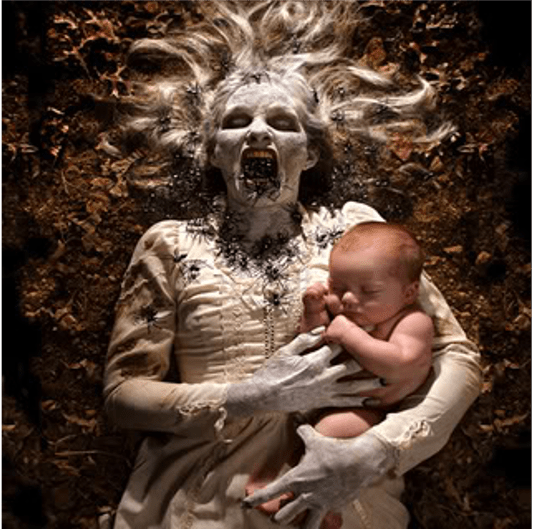
As I’ve mentioned before, I am a big fan of incorporating art and images into literature courses, and I wanted to start the class discussion by examining the diverse representations of La Llorona that exist today. This seemed like a great idea… until that morning when I received 18 versions of a dead or ghostly woman in my inbox! Just take a look at the Google Images page for “La Llorona”. Below is the most popular image that students sent me (at least 5 of the 18 selected it), followed by my “favorite” – aka – the most disturbing:

https://i0.wp.com/citedatthecrossroads.net/chst332/files/2014/02/la_llorona_by_nativecartoon-d5qd7gc.jpg

ABOVE: “La Llorona” – Several of my students selected this image after reading two different versions of the Llorona legend. BELOW: The creepiest image of La Llorona that I received in my inbox – it appears that was posed with a REAL baby, not just a doll….

Llorona2

After discussing the two different variations of the legend and images of La Llorona, we considered the power of such mythic tales. Why do they survive? What purpose do they serve? Who is the target audience? What lessons, or moralejas, do they communicate? For example, the most modern versions appear to be targeted at children, aiming to frighten them into obedience with some variation of…

“Don’t [cry / play by the river or arroyo / stay out past dark; etc. ]…
…or La Llorona will come and steal/kill you”.

To (over)simplify these narratives, in the colonial Mexican version, the woman bears the children of a white Spaniard – a man outside, and above, her own social class. When he refuses to marry her because of her Indian blood, she brutally stabs her children in a sudden moment of rage. She promptly laments her actions and roams the streets sobbing for her children, “Ayyyyy mis pobres hijos!” (Ayyyy, my poor children).  She is arrested and condemned to death, but her ghostly spirit is said to continue roaming the streets at night in search of her children.  In the modern US version, after marrying and having children, the woman becomes overwhelmed by her responsibilities at home and unhappy due to the lack of attention from her husband (who spends the majority of his time outside the home, at work, at bars, and with younger women). One day he leaves his wife, never to return. She blames the children for the failure of the marriage and her husband’s abandonment, drowning them in the Rio Grande.  Upon realizing that their death does not bring back her husband, she goes mad, wailing (Ayyyy!) and searching for her dead children, then drowns herself in the river as she attempts to “recover” them.

Modern local legends allude to sightings of a terrifying, weeping female figure in a white dress who roams the riverbed stealing children who play nearby. Throughout the 20th and 21st centuries this versatile myth has, understandably, been exploited in Mexican horror films and popular culture.

https://rebeccambender.com/wp-content/uploads/2014/05/787ee-peliculas-6541-imagen1.jpg

ABOVE: 1960s Mexican horror film / BELOW: Promo for a Halloween haunted house by Universal Studios

Llorona3

Today, “sightings” of La Llorona are occasionally reported on entertainment and “news” programs. In class we watched a brief YouTube video (in Spanish) that detailed  variations of the “Llorona” myth in other Latin American countries before delving into the main feature of the news spot: rare video footage and sound recordings of a Llorona-sighting outside of Oaxaca. Supposedly, the wail of La Llorona could be heard on this video (my class was quite skeptical!). Unfortunately, in the time since I taught the class several weeks ago, that particular video has been removed from YouTube, but below is a link to another similar one that is quite useful. It also gives a summary of the main elements of the legend, but rather than footage of a “Llorona-sighting,” it includes a documentary-style segment of a psychic examining a local property where a family had apparently felt the presence of a woman’s spirit – presumably La Llorona. It’s sort of like Ghost Hunters… in Mexico:

In any case… since my course was centered on female identities in the Hispanic World, I led the discussion away from the innocent child victims and the paranormal and towards the impact that such stories might have on women.  What do they tell us about the “bad mother” vs. the “good mother”? What norms did “La Llorona” transgress that placed her in a situation that provokes her murderous rage? How did she react in each instance? For example, both tales start with a “beautiful mestizo woman” who falls in love; both portray her subsequent filicide as a consequence of an unanticipated deceit or rejection; and both effectively punish the mother for all eternity. While the murder of one’s children indeed deserves to be castigated, the fact that male (paternal) behavior is absent or excused in these tales is revealing. The basic tenets of machismo are therefore upheld, as the man either deceives his wife or lover with no consequences, abandons her and his children in order to pursue his own desires, and/or refuses parental responsibilities – again, with no consequences. Thus the burden of responsibility falls on the woman, not merely for the well-being of her child(ren), but for ensuring the satisfaction of the male figure. Moreover, while the legend may warn young children to behave, the image of a beautiful, ultimately deceived and condemned woman serves as a warning to young women, wives, and mothers – do not aspire to marry outside your social class; do not complain if your husband does not devote as much attention to you after you have children; make sure you place the importance of your husband’s and children’s needs and desires above your own, etc. My class came up with a variety of themes that surfaced regarding woman-as-victim and the tale of La Llorona as a form of female social control – once the main “distraction” of child-murder was removed, that is.

Llorona4_virgen de guadelupe_Montoya

ABOVE: A confluence of female identities – La Llorona y La virgen de Guadalupe… Chicano artist Delilah Montoya aims to “evoke an identity” through photography that celebrates connections between Latin America and the US, which originate at the Border.

To continue this brief unit on US Latino literature and culture, during the second class we read two short stories by Sandra Cisneros – “Never Marry a Mexican” and “Woman Hollering Creek,” both taken from her 1991 collection of short stories, Woman Hollering Creek and Other Stories. In these cuentos Cisneros deliberately employs mythic and historic female archetypes as a means of both characterizing her protagonists (and other characters) and critiquing the influence that such paradigms of womanhood can have on female culture. For example, rather than following in the footsteps of the mythic “Llorona” and drowning her children in the nearby arroyo to enact vengeance on her abusive husband, Cleofilas in “Woman Hollering Creek” abandons him, saving both herself and her children by crossing the river back into Mexico. On the way, Cleofilas and Felice, the independent woman who helps her escape, laugh like powerful “Gritonas” (hollering women) rather than weeping like the “Llorona”.  And in “Never Marry a Mexican we see how the traitorous woman, “La Malinche,” is used as a subtext for the behavior and characterization of the protagonist, Clemencia.

Finally, in the third class we watched the 2002 film Real Women Have Curves, directed by Patricia Cardoso and based on the play by Josefina Lopez. We concentrated on the way in which Ana, a Mexican-American teenager, is positioned in opposition to her Mexican mother (Carmen). Each woman has a distinct idea of what constitutes a respectable, or ideal, female identity. Carmen’s traditional, conservative notions of family and femininity clash with Ana’s more rebellious sentiments regarding women’s independence and sexuality. Since this post has gotten a bit longer than I anticipated, I won’t go into much detail regarding these class preparations and discussions, but instead will include the discussion questions, assignments, and resources at the end of this post for interested readers. Feel free to leave comments, tips, or suggestions based on your experiences reading, viewing, or teaching these texts.

I’ll wrap up with a few images of the Virgin of Guadalupe that we examined during this final class. These modern, predominantly feminist renditions of La virgen de Guadalupe are a perfect way to illustrate the reinvention of female identities by way of a confluence and manipulation of the traditional and the modern. I began with the “original” representation of Our Lady of Guadalupe – the image that appeared on Juan Diego’s cloak in 1531, and which is on display today in Mexico City’s Basilica:

“Nuestra Señora de Guadalupe” (Our Lady of Guadalupe) – Mexico. This is the image that appeared on Juan Diego’s cloak in 1531; it is preserved and on display today at the Basilica in Mexico City.

I then showed them Alma Lopez’s “Our Lady” (1999), as the shape, form, and surrounding imagery share many similarities with the iconic image of La virgen de Guadalupe, yet Lopez’s (not-so)subtle refashioning is also one of the most scandalous and controversial representations to date.

Our Lady_Alma Lopez 1999

Unlike the most popular images of the Virgin of Guadalupe, Lopez’s does not hide this female icon’s body or sexuality; she actively looks out and up, rather than passively averting the spectator’s gaze; she is poised more assertively, with her hands on her hips; she wears her cloak proudly, and its fabric is imbued with allusions to her indigenous past. With this image of the Virgin in a rose “bikini,” Lopez effectively calls out the paradox of the “Virgin-Mother” – the asexual woman who is most revered for her maternal role – as an impossible standard for “ordinary” Mexican women. By bringing female sexuality and corporeality into her depiction of a woman occupying the place of the “virgin-mother,” Lopez rejects the notion that women (particularly mothers) must repress or hide their sexuality.  Along with this image, I also showed several of Yolanda Lopez’s portrayals from the 70s – specifically, this one, “Virgin Running” (1978). Lopez aimed to celebrate La virgen de Guadalupe – “the most ubiquitous female Latina” – by presenting her in ways that would connect her to real, modern women’s lives. This image is actually a self-portrait – Lopez depicts herself not as a demure, serene figure, but as a dynamic, active version of the Virgin of Guadalupe. I especially love her running shoes…

“Virgin Running” (self-portrait) by Yolanda Lopez (1978)

I was hoping that a few of my students would decide to incorporate US Latino texts into their final projects, and several actually did. One project examined the modern US and colonial Mexican versions of the legend of “La Llorona” in light of the influence of Protestantism and Catholicism respectively. Another incorporated “Never Marry a Mexican” into her discussion of how literary texts engage with and challenge the problematic dichotomies that define “appropriate” female identities (ex: good vs. bad; virgin vs. whore, etc.). And yet a third chose to discuss the mother-daughter relationships in three films that we studied during the semester: The Red Virgin (dir. Sheila Pye, 2012), Volver (dir. Pedro Almodovar, 2006), and Real Women Have Curves.

Overall, my class enjoyed reading these texts, and the majority of my students had little or no prior knowledge of the rich cultural heritage of Latinos in the US. It struck me that, even if some of them decide to become Spanish majors, they most likely will not have the opportunity take future Spanish courses that include these themes. Thus, after teaching this course and listening to my students’ positive feedback and responses on this unit, I think it’s crucial that professors of Spanish and Hispanic literature begin incorporating Latino texts into more general literature and culture courses when possible, rather than reserving them for entirely separate courses on Latino Studies or Latino or Chicano Literature. If we can place such an emphasis on Transatlantic courses (Spain and Latin America), especially given the vast cultural differences among Latin American countries, then certainly we can include US Latino literature as well. While specialized courses on Latino Studies, Literature, or Culture are of course necessary and should by no means be eliminated, they should not be the only outlet for discussion and dissemination of these very relevant works.

Phew… I’m exhausted. 🙂 For my readers who teach or have taught Latino Studies, what are some of your favorite texts to teach and discuss with students? What additional resources might work well in a Transatlantic Spanish literature course?

Resources:

Articles

  • Leal, Luis. “The Malinche-Llorona Dichotomy: The Evolution of a Myth” in Feminism, Nation, and Myth. La Malinche. Eds. Rolando Romero and Amanda Nolacea Harris. Houston, TX: Arte Publico Press, 2005. 134-38.
  • Paz, Laura.  “‘Nobody’s Mother and Nobody’s Wife’: Reconstructing Archetypes and Sexuality in Sandra Cisneros’ ‘Never Marry a Mexican'”. Human Architecture: Journal of the Sociology of Self-Knowledge 6.4 (2008):  11-27. Available at: http://scholarworks.umb.edu/humanarchitecture/vol6/iss4/3

Texts: Short stories (cuentos) and Film

Homework-discussion questions
(All are edit-able Microsoft Word documents):

Posted in Art, Feminism, Literature, Pedagogy, US Southwest, Women | Tagged , , , , , , , , , , , , , , , , , , , , , , , , | 11 Comments

The Morphing Body: Salvador Dalí’s Skulls and the Female Form

I’m currently working on an article that revolves around theories of corporeality and the body, so I’ve been reading a range of feminist interpretations of the subject: Elizabeth Grosz‘s challenge to mind/body dualism by way of the Moebius strip paradigm; Susan Bordo and the body as a “cultural plastic”; and Iris Marion Young‘s articles on distinctly female body experiences, to name a few. As far as the body in literature and art, I have found numerous articles, books, and anthologies that delve into the complexities of the female body when represented by men vs. women in various mediums. For example,  feminist critics have pointed out that, even though man does not “inhabit” the female body, he has nevertheless exerted control over its representation in cultural history. Even the most cursory investigation of canonical Western artists proves this statement true: Michaelangelo, Da Vinci, Rubens, Goya, Picasso…. Contemporary women artists must grapple with the subject-as-object paradox: “The meaning of the work relies on the paradox of woman as subject and object; viewers must at once be aware of the central figure as an object seen (of the dangerous and unpleasant objectification of woman) and as a subject who sees, a creative female agent, an artist” (Meskimmon 75).

In any case, combine this current project with the fact that my post on Salvador Dalí’s double images has been getting a lot of traffic lately and you have my newest Dalí-inspired piece: Nude Skulls and Double-Images… Spanish professor #clickbait?

Here is an example of what I’m referring to:

women-forming-a-skull_Dali

“In Voluptas Mors”(“Voluptuous/Desirable Death”) Women forming a human skull for Salvador Dali’s photo-shoot. Image via Metamythic: http://mag.metamythic.com/metamorphic-skull-illusions/

Dalí worked on this project with American photographer Philippe Halsman in 1951; the pair had collaborated on several other projects throughout the 1940s since their initial meeting in 1941. “In Voluptas Mors” (Voluptuous, or Desirable Death), the title given to this skull composed of seven nude women, apparently took over three hours to arrange. There are some fabulous articles and blog posts that discuss Dalí’s and Halsman’s “nude-skull” venture. Metamorphic Skull Illusions includes two of Dalí’s renditions of a skull made of human figures (the above photograph and a painting), as well as numerous other examples of sketches that contain double-image-skulls from different time periods all around the world. Dalí’s Skull Illusion Still Inspires details the way in which this particular visual has inspired tattoos, movie posters, magazine covers, and a variety of artistic endeavors. Finally, this site details the making of the image, including photographs like the one below that were taken from different angles as the models were positioned in their precise locations:

The making of “In Voluptas Mors” (Dali and Halsman, 1951)

Since there seems to be a wealth of information regarding the creation of this specific image available online, I was curious as to whether Dalí produced other similar projects featuring the human form morphing into a skull. I knew he had done variations with portraits and “Disappearing busts…”, but a human skull creates a markedly distinct aura. Consulting one of my favorite books, Salvador Dalí. The Paintings, which contains nearly 1700 paintings, sketches, studies, and photographs of Dalí’s vast artistic output, I found several other examples of skulls created from the female form – granted, this time they aren’t “nudes”! Two paintings in particular caught my attention for their descriptors: “For the campaign against venereal disease” (the first is the “study” and the second is the final painting):

Study, “Soldier take warning” – for the campaign against venereal disease (Salvador Dali, 1942)

Untitled - for the campaign against venereal disease - Salvador Dali

“Untitled” – for the campaign against venereal disease (Salvador Dali, 1942)

During his time in the U.S., Dalí’s work was often commissioned by different companies or organizations – I wrote about his unsuccessful Hallmark Christmas cards last year. These posters are another example. I wasn’t able to find much historically sound information regarding these images or who commissioned them online, and I’ll have to wait until the current semester ends to delve deeper into this history. I did, however, find a fascinating dissertation on Dalí’s decade-long stint in the United States during the 1940s that dedicates an entire chapter to the depiction of the human body in paintings such as these.

In her dissertation, A Spaniard in New York: Salvador Dalí and the Ruins of Modernity (1940-49), Gisela M. Carbonell-Coll argues that in Dalí’s 1940s paintings, “the partial body – its fragmentation and dismemberment – not only refers the viewer to the obvious consequences of the war but it is also used as a metaphor for its own decay as a result of venereal disease” (11). For Carbonell-Coll, the gender of these bodies is not their distinguishing characteristic –  their status as incomplete, decaying and morphing bodies takes precedence (116).  Thus, she omits feminine and masculine attributes when analyzing these images – noting that both male and female bodies appear fragmented and dismembered during this time – and opts instead to value them as “products of the socio-cultural output of the wartime years in America and the artist’s promotion as an artistic provocateur in this context” (117).  The notion that the body (male and female) is “charged with political meaning” is significant (122), yet I disagree with the proposition that gender is of little significance in these paintings on venereal disease. If we consider the title of the study – “Soldier take warning” – as well as the juxtaposition of clearly male and female subjects, the work in fact communicates important anxieties regarding sexuality in the inter- and post-war years. In fact, WW2 military propaganda aimed at young [male] soldiers emphasized the dangers of female prostitutes rather than discouraging or chastising promiscuous male behavior.

 Venereal disease propaganda posters from World War 2

WW2 Propaganda Poster – Soldiers’ “real” enemy…

WW2 Propaganda Poster – Soldiers’ “real” enemy… (via BusinessInsider.com)

WW2 Propaganda Poster – Soldiers’ “real” enemy… (via BusinessInsider.com)

In Dalí’s campaign poster, a similar visual rhetoric is deployed. A young, rather innocent looking male soldier is positioned so that he simultaneously, and paradoxically, appears vulnerable yet resolute in the face of female temptresses. While the women in the military campaign ads may or may not be traditionally attractive or overtly sexual, Dalí’s female bodies are clearly and explicitly sexual. He doesn’t need to label them “booby traps” to get the message across… Furthermore, the fact that these female forms morph into a skull – a threatening and ubiquitous symbol of death – communicates a subtle, yet extremely powerful  message regarding women’s sexuality. Such a portrayal implicitly connects women’s sexuality to degeneracy, illness, death, and even sin. And just like the posters, in Dalí’s painting the STD (the danger, the threat) is embodied by woman. As the seductive temptress, she is dangerous to the strong, respectful, honorable male members of society; her sexual prowess has the potential to corrupt or contaminate them… and by extension, the nation.  Finally, Dalí’s use of the women’s upper thighs for the skull’s “teeth” is certainly no coincidence: The image evokes the mythical vagina dentata, poised to devour or castrate any man who dares approach it.
( Caution: do not Google-Image “vagina dentata”).

Detail - Vagina Dentata: Dali's poster, campaign against venereal disease

Detail – Vagina Dentata: Dali’s poster, campaign against venereal disease

(I think I should use the summer to improve my “blog-art” skills….. )

However you wish to interpret the posters, or Dalí’s paintings, there is no denying the communicative potential of the human body as a medium — for art, advertising, or even personal expression. To wrap up this post, below I’ve included a few more Dalí creations that feature human skulls and double-images:

Dali-skulls_moontide_1941

Cafe Scene. Sketch for “Moontide” (1941). Image via imgur: imgur.com/gallery/Y7frl

The Face of War.jpg

The Face of War, Salvador Dali (1940) Source – wikipedia

Ballerina in a Death's Head - Salvador Dali

Ballerina in a Death’s Head (Salvador Dali, 1939) Source – wikipaintings

Do you know of other paintings that connect women to death by way of skulls, bones, or other corporeal imagery? How is the skull deployed aesthetically in different cultural contexts?

Resources:
Carbonell-Coll, Gisela M. A Spaniard in New York: Salvador Dalí and the Ruins of Modernity (1940-49). Dissertation. U of Illinois at Urbana-Champaign, 2009.

Descharnes, Robert and Gilles Néret. Salvador Dali: The Paintings. Köln: Taschen, 2002.

Meskimmon, Marsha. Women Making Art: History, Subjectivity, Aesthetics. London: Routledge, 2003.

Save

Posted in Art, Modernity, Spain, Surrealism, Women | Tagged , , , , , , , , , , , , , , , , | 23 Comments

Murderous Mothers and the Discourse of Infanticide

This post is admittedly a slightly odd compilation of images and ideas – It seems that over the past several months I’ve been researching or teaching about murderous mothers in literature, film, history, and popular culture: from the assassination of Hildegart, to “La Llorona” (on which I will base my next teaching-related post), to infanticidal mothers in 19th-20th century Italy, I’ve been intrigued by these texts not merely for their fascinating portrayals of twisted and manipulative maternity, but for the images they employ in order to communicate what we regard as an aberrant act.  From the symbolic and cinematic (bullfighter) to the ghostly and horrific (Halloween costume), there are numerous examples of the murderous-mother in contemporary art and popular culture.

Aurora as the bullfighter (matador) - The Red Virgin

Murderous mother, Aurora, depicted as a bullfighter (matador) about to deal the final blow to the bull – The Red Virgin (film)

La Llorona – Halloween costume in Orlando, FL (2013) Source: Azteca noticias http://www.aztecanoticias.com.mx/notas/entretenimiento/164369/la-llorona-llegara-en-halloween-a-orlando

For the article I am currently working on, I revisited a book chapter on infanticide that I had read during my first year as a PhD student nearly six years ago (before I had any clue as to what I would end up researching for my dissertation). “An Unwritable Law of Maternal Love: The Infanticide Debate” is the fifth chapter of Suzanne Stewart-Steinberg’s book The Pinocchio Effect: On Making Italians (1860-1920). Here, Stewart-Steinberg traces the history of the discourse of the infanticidal mother to determine this female figure’s impact on more general notions of Italian motherhood between the 1860s (the creation of the Italian national state) and the 1920s (the collapse of the liberal government and the rise of fascism). As a result of her research, Stewart-Steinberg asserts that infanticide came to be figured during this time as:

“the female crime par excellence and as an immensely productive model for establishing connections between subjectivity, legal responsibility, and sexuality. The power of these connections proved instrumental both in removing the discourse of infanticide from earlier theories that rendered it a crime against nature and in proving that all maternity, when left to its own devices, tended to exhibit dangerous antisocial behavior that therefore required expert intervention (185).

Thus, rather than falling within the discourses of legality and human rights, infanticide became more closely associated with defining, regulating, and criminalizing female, that is, maternal, behavior. What I find noteworthy about these observations is that they recognize the (ever increasing!) pathologizing of motherhood that not only places a great deal of pressure on women, but also makes mothers susceptible to extreme forms of control, surveillance, and scrutiny. In seventeenth and eighteenth century Italy, for example, infanticide was understood as a by-product of the rigid honor code that governed female behavior and sexuality – the infant child was the “evidence” that a woman had transgressed the boundaries that her society and culture had created for her. For Stewart-Steinberg, the infanticide debate in Italy was distinguished from that in other countries by the hegemonic role of the Catholic Church and the subsequent obsession with female honor (sexual purity) that, by extension, defined familial honor. Thus, an unmarried mother was forced to conceal her pregnancy, perhaps deposit the infant in a Church or Convent turnstile (“baby hatch“), and even rescind her maternal duties (189).

What a “baby hatch” on the side of a Church or convent might have looked like. This site, “Les enfants Troves,” provides information on the history of these devices in France: http://www.archivosgenbriand.com/chron_obliv_fr.html

As odd as it may seem to us today, Stewart-Steinberg suggests that “female honor” became the distinguishing factor in Italian infanticide debates: “Only ‘honest’ or honorable women committed infanticide, while the category of common homicide was to be reserved for dishonorable women” (197). This chapter goes on to discuss the “liberalizing” of infanticidal laws (aka, more lenient charges and punishments), infanticide in literature, Cesare Lombroso, and criminality – I highly recommend it if you are at all interested in these topics, either in an Italian or Western European context.

Coincidentally, after reading this chapter on infanticide, I found the below illustration of a murderous mother, accompanied by what appears to be an early modern rendition of the devil, by way of The British Library‘s collection of images, over 1 million of which are now available free in the Public Domain. Well, coincidentally might apply best to the fact that I found out about the free images after re-reading that chapter… then deliberately searched (a bit nervously) for “infanticide”!

A pittilesse Mother. That most unnaturally at one time murthe[red] two of her owne Children at Acton ... uppon holy thursday last 1616, the ninth of May. Beeing a gentlewoman named M. Vincent ... With her Examination, Confession and true discovery of all t[he] proceedings ... Whereunto is added Andersons Repentance w[ho] was executed ... the 18 of May 16[16].

A pittilesse Mother. That most unnaturally at one time murthe[red] two of her owne Children at Acton … uppon holy thursday last 1616, the ninth of May. Beeing a gentlewoman named M. Vincent … With her Examination, Confession and true discovery of all t[he] proceedings … Whereunto is added Andersons Repentance w[ho] was executed … the 18 of May 16[16]. [Image from: The British Library]

This illustration made me curious as to how and under what circumstances infanticide had actually been depicted in Western art since these early modern times.  Since I work with Spanish cultural history, I was especially interested in Spanish examples. I began by doing some background on one of Francisco de Goya‘s grotesque, yet perhaps most recognizable portrait of filicide, “Saturno devorando a su hijo” [“Saturn devouring his son”]. While not an example of maternal infanticide, it was the first Spanish example of child-destruction that came to mind! Below, then, are two additional examples of child-murder in art; I plan to do a bit more research on this topic in the future – especially in the Spanish context – so if you have any recommendations, please share them in the comments.

Saturno devorando a su hijo (Saturn Devouring His Son) – Francisco Goya (1819-1823), Museo del Prado

The above portrayal of infanticide is understood through the lens of mythology, and thus the viewer does not tend to judge Saturn in the same fashion as the aforementioned “pittilesse” mother of the early modern sketch.  Moreover, a father [“god”] killing his child [“son”] does not provoke the same shocking impact in [Christian] cultures that venerate maternal love as an innate, even sacred force, and accept that paternal love is all-powerful, even to the point of violence or destruction. The figures in Goya’s portrait resemble humans, certainly, but yet they remain “safely” distanced from us due to the exaggerated, distorted shapes of the bodies, as well as the dark colors that obscure the background (time and place). While Goya’s painting is at once grotesque, mythic, and macabre, I find Peter Paul Ruben‘s rendition (which some art historians believe was Goya’s inspiration) to be a bit more disturbing. Here, despite the representation of the same myth, Saturn and his son embody very human(-like) figures, and the detailed facial expressions, hair, and blood – each of which are highlighted with bright, contrasting colors – provoke visceral reactions of both repugnance and fascination.

Rubens saturn

“Saturn, Jupiter’s Father, Devours One of His Sons, Neptune” by Peter Paul Rubens (1636-38)

Though I was unable to find many “classical” renditions of infanticidal mothers in my brief search, I did learn a bit more about this portrait of Medea, poised to kill her children. Importantly, the narrative behind this image is one of vengeance. According to Euripides’ Greek tragedy Medea, this mother commits filicide as a means of avenging her husband’s betrayal.

Medea About to Kill her Children

Médée furieuse (Medea About to Kill her Children) by Eugène Ferdinand Victor Delacroix, 1862

I think this is an appropriate place to end before my next post on “La Llorona” since, like Medea, she purportedly murdered her children out of vengeance. Versions of this Mexican (Mexican-American and Latin American) legend describe a beautiful mestizo woman who drowned her children in the river (arroyo) when her lover abandoned her to marry another woman. Plus, now that I feel slightly productive after writing a short blog post, I can return to my article with (hopefully) a fresh perspective and “cured” writer’s block!

Do you know of other paintings and works of art (classical or modern) that depict maternal infanticide or filicide? What are other examples of infanticide in post-20th century literature and art?

Bibliography:
Stewart-Steinberg, Suzanne. The Pinocchio Effect: On Making Italians, 1860-1920. Chicago: U of Chicago P, 2007. [Chapter 5, “An Unwritable Law of Maternal Love: The Infanticide Debate.” p. 184-228.]

Posted in Art, History, Women | Tagged , , , , , , , , , , , , , , , , , , | 3 Comments