Research expertise and interests:
- 19th-21st-century Peninsular Literature and Culture
- 20th-21st-century Hispanic Women’s Literature
- Motherhood (Maternidad) and Feminism
- Spanish and Hispanic Avant-Garde
- Medical History
- Urban and Rural Studies
- L2 Literature Pedagogy, Teacher Training, and Digital Humanities
- Study Abroad Program Development & L2 Student Research and Language Study Abroad
Research projects and publications:
Motherhood and Feminism in 20th-21st-century Spanish Literature:
Contemporary Writing on Motherhood and Infertility: My most recent publication, “Se nos pasó el cuento, no el arroz: Non-Motherhood, (In)Fertility, and Choice in Míriam Aguilar’s ¿Y ahora qué?(2024) and Paola Andrea Ghirardi’s Diario de una bordadora (2023)” (forthcoming, 2026), examines the (in)visibility of non-motherhood by circumstance in two first-person narratives published in Spain: ¿Y ahora qué? (2024), by Míriam Aguilar, and Diario de una bordadora (2023), by Paola Andrea Ghirardi [Srta. Lylo]. While pronatalist and neoliberal discourses proclaim that motherhood is achievable through choice, persistence, and new reproductive technologies, many women encounter involuntary childlessness due to infertility, social barriers, or other circumstances. Aguilar and Ghirardi disrupt dominant narratives that frame non-motherhood as either failure (childless) or liberation (childfree), instead revealing its complexity through personal storytelling and social critique. Their narratives expand definitions of motherhood, challenge binary representations of women without children, and offer alternative models of fulfillment beyond biological reproduction.
Margarita Nelken (first-wave feminism): Related to early 20th-century narratives on feminism and women’s experiences, my article on Margarita Nelken, “Theorizing a Hybrid Feminism: Motherhood in Margarita Nelken’s En torno a nosotras (1927)”, was published in the Bulletin of Hispanic Studies in 2016. This essay explores the complex feminist philosophy that comes to the fore in Nelken’s overlooked novel. My analysis juxtaposes the novel with Nelken’s essays, La condición social de la mujer en España and La mujer antes las cortes constituyentes, in order to encourage a hybrid interpretation of first-wave feminist thought in Spain based on the incorporation of motherhood into modern female identities.
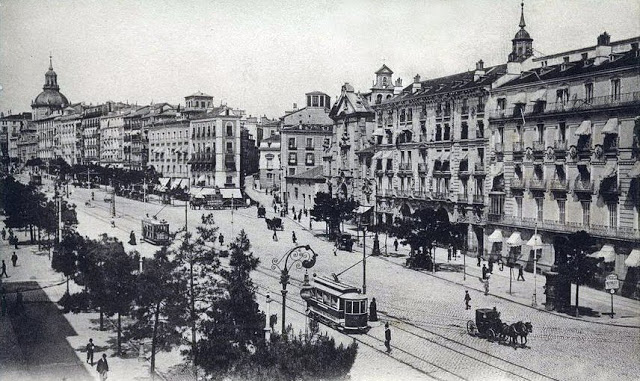
Carmen de Burgos (first-wave feminism): In early 2017 I published a chapter in the The Routledge History Handbook of Gender and the Urban Experience (ed. Deborah Simonton), “Modernity and Madrid: The Gendered Urban Geography of Carmen de Burgos’s La rampa (1917).” In this chapter I expand on earlier research pertaining to women’s experiences of pregnancy and motherhood in early 20th-century Madrid, particularly in the Maternity Ward (see “Maternity Ward Horrors” 2012), to examine additional urban spaces in the novel, which are populated almost exclusively by women (examples: the Gota de Leche (a food bank), an orphanage, and a pediatrician’s office.
I recently served as co-editor for two companion volumes on Carmen de Burgos’s Divorce in Spain – the new Spanish edition and an English translation – published by the MLA Texts & Translations Series (2025). I wrote the introduction, “From Scandal to Influencer to Activist: Carmen de Burgos, ‘Colombine,’ (1867-1932),” which appears in both volumes and is aimed at a general audience or undergraduate students of Spanish or European history. Together, both volumes capture the historic debate on divorce in early 20th-century Spain, a key moment in the country’s very early feminist movement. I linked to the volumes and included an excerpt of the introduction the blog: Divorce in Spain, by Carmen de Burgos (1904): An English Translation & New Spanish Edition
Urban and Rural Studies (20th-21st century Spanish Literature and Culture): In 2022 I published “First-Wave Fantasmas: The (In)Visible Presence of Carmen de Burgos and Maruja Mallo in María Sánchez’s Tierra de mujeres (2019),” which represents a step forward in one of my main research goals: making connections between first-wave women writers, artists, and feminists (prior to the Spanish Civil War) and contemporary women writers who often take up similar issues, but without have read or been made aware of the women who came before them. This article brings a millennial author (Sánchez) into conversation with two early 20th-century Spanish women, an author (Burgos) and a painter (Mallo). I argue that juxtaposing these women’s representation of women in rural communities may advance our understanding of the diversity of Spanish feminist thought both in the pre-Civil War era and today. This longer article was inspired by my exploration of these themes informally in a few blog posts: Farming, Gardening, and Female Labor: Carmen de Burgos’ “La mujer agricultora” (1903) and Tierra de mujeres (Land of Women) and the Myth of an “Empty Spain”.
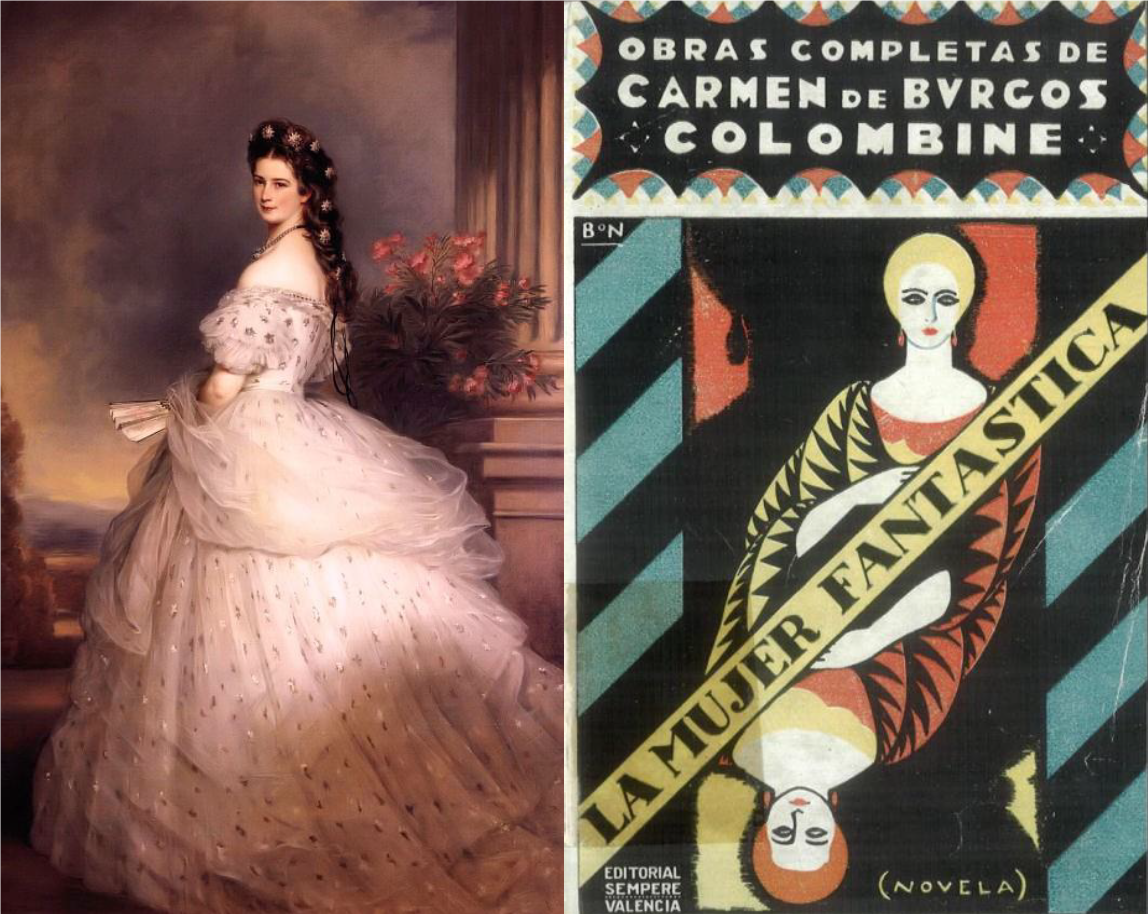
Spanish Avant-Garde: I’ve written about how the Spanish Avant-garde approaches corporeality and the female body, specifically in Ramón Gómez de la Serna’s La hiperestésica (1931) and on José Díaz Fernández’s treatment of the female body’s reproductive potential in La Venus mecánica(1929); the latter appeared in a 2016 volume focused on the body in the Spanish and Italian Avant-garde: Modernism and the Avant-garde Body in Spain and Italy (Eds. Nicolás Fernández-Medina and Maria Truglio). A thrid article on the Avant-Garde, “Fashion, Ekphrasis, and the Avant-Garde Novel: Carmen de Burgos’ La mujer fantastica(1924)” examines fashion in Burgos’s ekphrastic references to 19th-century French portraiture, arguing that her overlooked novel challenges the notion that Spanish avant-garde literature represents an abrupt break from the past. It also validates fashion and make-up as nontraditional feminine artistic mediums while establishing a cultural and historical trajectory of women’s fashion as integral to artistic production. Feministas Unidas awarded this project the 2nd place Adela Zamudio prize in 2018 for the Best Published Essay of 2017 in centered on works of literature and cinema by female authors. You can read the blog-version of the article’s argument here: Fashion and the Fine Arts in Carmen de Burgos’ Avant-garde Novel, La mujer fantástica.
L2 Literature Pedagogy & Digital Humanities: I’ve published two articles on creative ways of approaching literature in the second language classroom, both of which appeared in Hispania. The first, “Snapping the Quijote: Examining L2 Literature, Social Media, and Digital Storytelling through a Cervantine Lens,” (2020) focuses on an advanced Spanish seminar on Don Quijote de La Mancha and how I designed the course to explore traditional questions of authorship, translation and reading, metafiction, self-invention, and parody, but through the lens of contemporary pop culture, including the graphic novel and mobile applications (apps), specifically Snapchat Stories. The second, “From Snaps to Maps: Using Literature, Mobile Applications, and Mapping Software to Design Engaging L2 Curriculum” (2021), appears in a special issue dedicated to the Digital Humanities and is expansion of my earlier project. I discuss combining SnapChat with Northwestern University’s Knight Lab StoryMap to adapt L2 language skills to 21st-century modes of communication. This article was featured in the Almerian Press in 2022: “‘La rampa’ de Carmen de Burgos sirve en EE.UU. para diseñar un plan de estudios de español atractivo: de instantáneas a mapas.”
My doctoral dissertation (Penn State University, 2013) examines literary representations of the mother-role in early 20th-century women writers: Carmen de Burgos, Margarita Nelken, and Federica Montseny. In addition to their fictional narratives, I analyze their essays as a way of articulating their ideological approaches to woman- and motherhood. In the process, I reassess first-wave feminism in Spain by focusing on women’s engagement with diverse maternal issues. Many prevalent themes of first-wave Spanish feminism are echoed or visible in today’s post-modern narratives and contemporary debates; thus my research provides a new lens through which we might approach 20th- and 21st-century Spanish literature and culture. Below is the poster I designed when I was in the midst of my initial research at Penn State. The goal was to showcase this work to a general audience of all ages and backgrounds.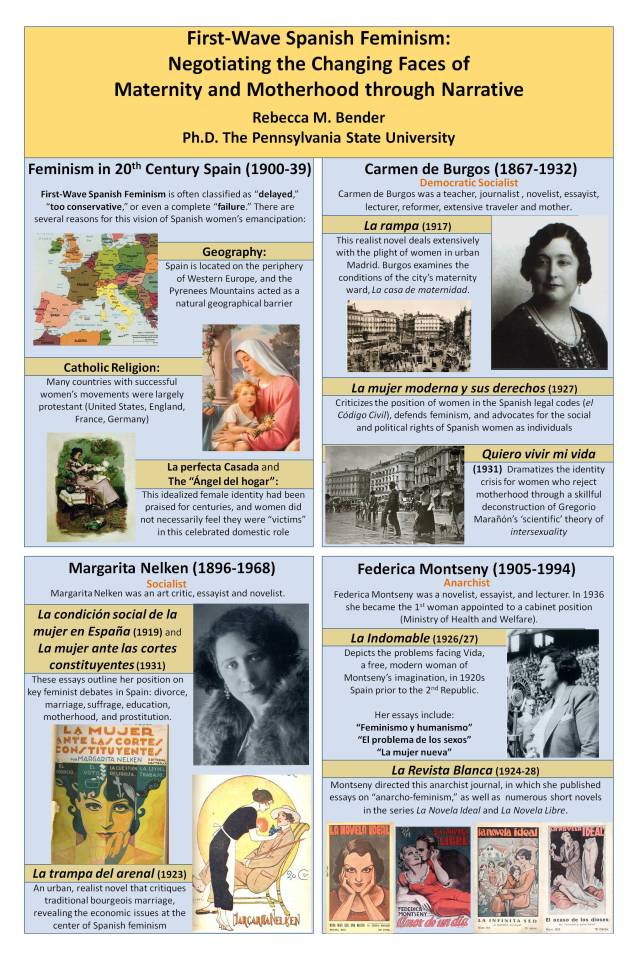


 Rebecca M. Bender, PhD
Pingback: The Silent Woman: Use Birth Control, Stay Attractive | Rebecca M. Bender, Phd
Pingback: Assassination of the Modern Woman: Hildegart and Aurora Rodríguez | Rebecca M. Bender, PhD
Pingback: Exploring Female Identities in Carmen de Burgos’ “La rampa” | Rebecca M. Bender, PhD
Pingback: Pretty Women Use Birth Control | Nursing Clio
Pingback: Picasso on Maternity and Motherhood | Rebecca M. Bender, PhD
Pingback: Murderous Mothers and the Discourse of Infanticide | Rebecca M. Bender, PhD
Pingback: Posters and Propaganda from the Spanish Civil War (1936-39) | Rebecca M. Bender, PhD
Pingback: Women of the Second Republic (Spain 1931-39) | Rebecca M. Bender, PhD