Assassination of the Modern Woman: Hildegart and Aurora Rodríguez

UPDATE: April 7, 2014 – I assigned the film and podcast in my Spanish literature seminar this semester; read about my lesson plans and student responses here.

This week I found an excellent short film on the murder of the 17-year-old Spanish prodigy Hildegart Rodríguez at the hands of her mother, Aurora, in Madrid in 1933. The Red Virgin (dir: Sheila Pye, 2012) is a 17-minute representation of Hildegart’s and Aurora’s complicated relationship. The director and the actresses do excellent jobs of capturing the obsessive nature of Aurora, the youth and intellect of Hildegart, and the tensions that surfaced in this mother-daughter relationship. At only 17 minutes, the film is visually suggestive, and at times a bit eerie. I especially appreciated the parallels between the first and last scenes – monologues by Hildegart and Aurora respectively. My only criticism of the film is that it is in English (with Spanish subtitles), even though both lead actresses are native Spanish speakers. The first and final scenes, for example, might be more powerful if the lines were spoken in Spanish, rather than in a sometimes accented-English.

http://vimeo.com/62044318

Given that I recently watched El laberinto del fauno for the fourth time since it is part of my Textual Analysis course, I found the casting of Ivana Baquero (Ofelia) as Hildegart and Maribel Verdú (Mercedes) as her mother, Aurora, to be particularly intriguing. My students had analyzed at length the parallels between Mercedes and Ofelia in the film, as well as the relationship between those two particular female characters, so I couldn’t help but think of the the mother-daughter relationship in terms of power dynamics.

In the Spain of the 1930s, many liberal reforms were welcomed by the Second Republic, thus creating an atmosphere in which intellectuals, and the educated public, became more receptive to liberal ideas regarding women’s positions in public life. Women like Margarita Nelken and Federica Montseny even held positions within the government during the 1930s prior to the onset of the Civil War. Despite her youth and the exceptional circumstances of her life and death, Hildegart voiced strong opinions regarding sexual reform and the women’s movement in Spain at this time, and her writings stand out for what appear to be quite daring, polemic titles for the traditionally conservative Spanish public: La rebeldía sexual de la juventud (1931), Profilaxis Anticoncepcional (1931), and ¿Se equivocó Marx? (1932), to name a few. 

For more information on these fascinating women, I highly recommend listening to this excellent podcast (in Spanish) from the Radio Nacional Española, from where I borrowed the title of this post: Documentos RNE – “Aurora Rodríguez y su hija Hildegarte: el asesinato de la mujer moderna.” The narrative goes beyond that of the life and murder of Hildegart and dedicates considerable time to exploring the life and formation of her mother, Aurora. I found Aurora’s eugenic philosophy towards motherhood and reproduction particularly fascinating given my work on women’s attitudes towards maternity in early 20th century Spain. This underlying eugenic discourse is also evident in anarcho-feminist writings, and I have written about Federica Montseny’s subtle incorporation of these principles in many of her fictional narratives (novellas).

Finally, Alison Sinclair’s recent book, Sex and Society in Early Twentieth-Century Spain. Hildegart Rodriguez and the World League of Sexual Reform (Cardiff: U of Wales P, 2007) examines how certain ideas regarding sex reform and eugenics were adapted in Spain during the 1930s. Rather than merely summarizing these ideas, Sinclair concentrates of their “manner of adaptation” in order to better understand those local conditions and customs that made the Spanish nation more receptive to such interests at this particular historical moment (7). She also points to both pathologies of motherhood and to eugenics in her discussion of Aurora and Hildegart, noting that Aurora’s dominance in “engineering” Hildegart’s life was evident from the child’s conception, to her education, to her death: “In both a material sense and in the psychoanalytic understanding of the term, she was the ‘object’ created by her mother” (136-38). It’s a fascinating read overall, and even includes a few reproductions of public health brochures from the 1920s – one of which is decorating the door to my office:
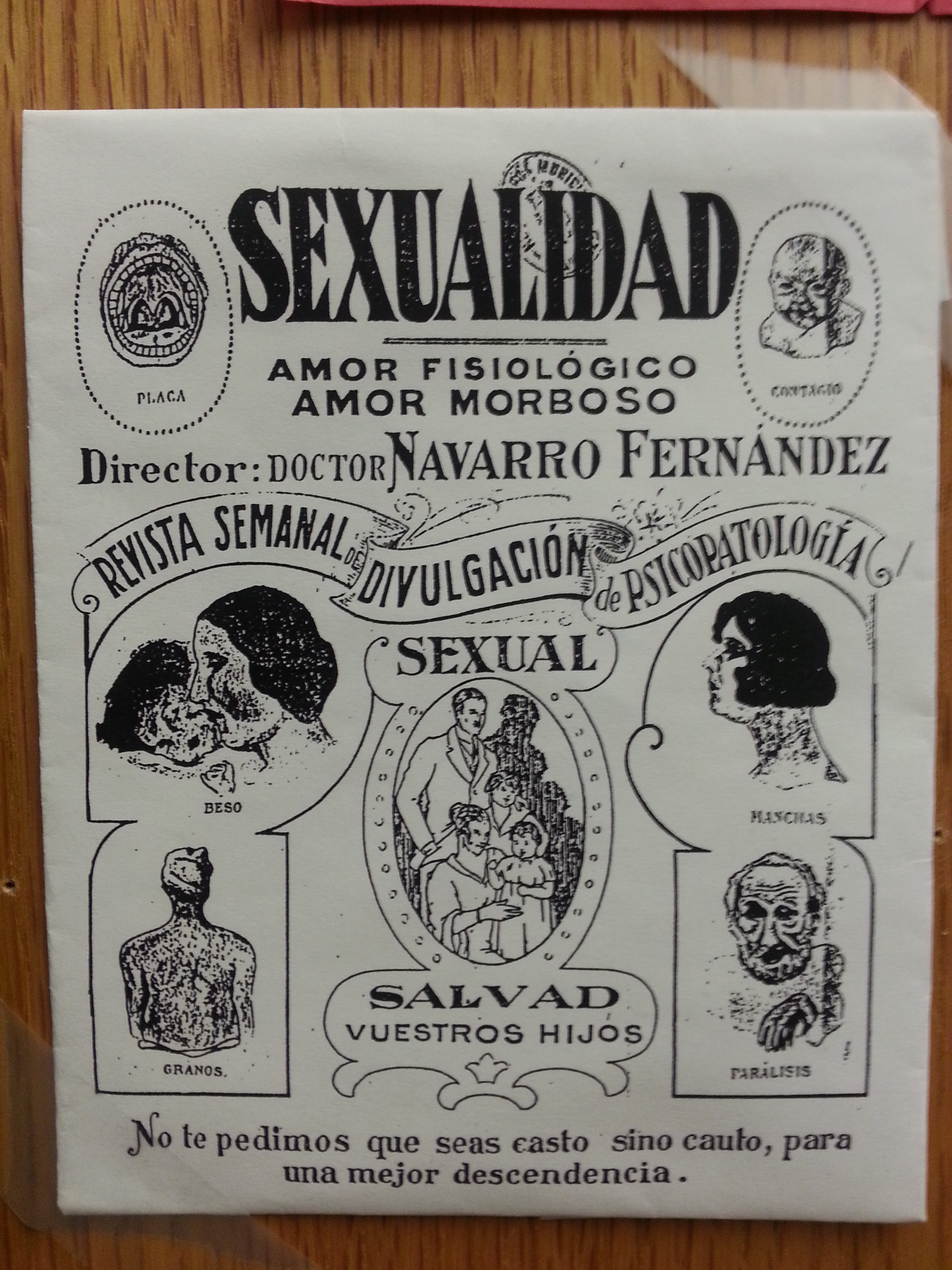
Salvad vuestros hijos

“We don’t ask that you be chaste/pure… but cautious/careful… for better offspring


I’m excited to incorporate The Red Virgin into my literature course next semester, since so far my students have seemed to enjoy analyzing film alongside literary texts. If you have time to watch it, let me know your thoughts!

Posted in Feminism, First-wave spanish feminism, Science and Medicine, Women | Tagged , , , , , , , , , , , , , | 5 Comments

Painting the Spanish Civil War

(For more information, see my more recent post with details on teaching Guernica in conjunction with Vicente Aleixandre’s poem “Oda a los niños de Madrid muertos por la metralla”, Dec. 2015).

In my (Spanish) Introduction to Textual Analysis course, my students are currently working with two texts in which the aftermath of the Spanish Civil War and the ensuing dictatorship of Francisco Franco form the historical and cultural background: the play Escuadra hacia la muerte (Alfonso Sastre, 1953) and the film El laberinto del fauno (dir. Guillermo del Toro, 2006).  As a way of discussing the different ways in which this historical context is relevant to both the play and the film, and to begin thinking about what dramatic and cinematographic effects help communicate this atmosphere to us as readers/viewers, I began our class last week with two paintings, created by Spanish artists during the years of the civil war (1936-39):

Picasso’s famous Guernica (1937):

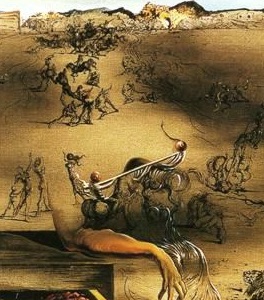
and Salvador Dalí’s lesser-known España (1938):

I intended to use the images for 10-15 minutes as a way of initiating discussion, so I had not prepared lengthy lectures of these particular pieces before class. My students proved to be not only enthusiastic about sharing their interpretations and thoughts on the paintings, but also far more inquisitive than I had anticipated. For Guernica they hit upon all the major themes and imagery that will prove relevant in our upcoming analytic discussions of Sastre’s play and del Toro’s film: lack of color (black and white, dark grays); the interplay of shadows and light; fragmented and mutilated human bodies; the lack of realism, or the abstract depiction of a historical event (the attack on the town of Guernica); agony; desperation; hopelessness; oppression; death; destruction; chaos. They even noted the “broken” bull – traditionally a symbol of Spain – that, despite the painting’s abstract depiction of war, nevertheless implicates the Spanish nation in particular.

However the class had a more difficult time – initially – comprehending Dalí’s portrayal. This was likely due to the fact that most of them had never seen it before, whereas Guernica, in general, had at least entered their field of vision in some way over the course of their Spanish studies (these students have studied Spanish for at least 4-5 years, on average). Once they were able to perceive the double-image that Dalí created – the ghost-like figure of “Mother Spain” looking down upon the destruction and chaos of a Spanish countryside polluted by the battles of war – they had more questions about the painting’s details. Below is a more detailed depiction of the woman’s face and bust that appear amidst the battlefield in this painting – it is often quite difficult to discern this female figure upon the first viewing of the painting:
Spain_Dali_details

In order to (try to) better answer their questions, this weekend I found myself shuffling through my nearly 25 books on Surrealism and Salvador Dalí – remembering why I had once been so passionate about these topics. I also realized that this is still one of my favorite books: Salvador Dalí. The Paintings. by Robert Descharnes and Gilles Néret (Köln: Taschen, 2002). Interestingly, Descharnes and Néret characterize Dalí’s position regarding the Spanish Civil War as apolitical: “True to his principle of taking no interest in politics, … [Dalí] observed [the war] as an entomologist might observe ants of grasshoppers. To him it was natural history; to Picasso, by contrast, it was a political reality. What Guernica was for Picasso, The Burning Giraffe and Soft Construction with Boiled Beans – Premonition of Civil War were for Dalí” (238).

The Burning Giraffe (Jirafa ardiendo) (1937)

Soft Construction with Boiled Beans – Premonition of Civil War (Construcción blanda con judías hervidas – Premonición de la Guerra Civil) (1936)

But for Dalí, the war was indeed a disturbing reality he could not ignore – his close friend, the poet and playwright Federico García Lorca, was murdered at the hands of the Nationalist militia in 1936. And while Dalí’s paintings may not appear to exhibit the same overt social commentary that is clearly visible in Picasso’s Guernica, I would disagree with Descharnes and Néret that the works themselves are apolitical. If we re-examine them, for example, in light of the aforementioned themes my class pointed out in Guernica, we find many – if not all – of the same techniques and representations. The surrealist style, bold colors, and unconventional imagery (and titles!) may mask the precise political and cultural realities, but we must not trivialize the way in which they nevertheless reveal the extent to which the death and destruction of this particular war affected even the most flippant, avant-garde, and typically irreverent of Spanish citizens.

I’ll end here by using this post as yet another platform from which I can share a few of my favorites of Dalí’s double-image paintings. After having read about and studied them for so many years, even traveling to remote Spanish villages to see the originals, I often forget how new and remarkable these paintings can be to others who are discovering them for the first time – especially when these “others” were all born after 1993…! I was amazed, for example, that many of my students had never seen what is arguably one of Dalí’s most popular double-image paintings, Swans Reflecting Elephants:

Swans Reflecting Elephants (Cisnes que se reflejan elefantes) (1937)

Ballerina in a Death's Head - Salvador Dali

Ballerina in a Death’s Head (Bailarina en una calavera) (1939)

Slave Market with the Disappearing Bust of Voltaire (Mercado de esclavos con la aparicion del busto invisible de Voltaire) (1940)

What have you recently taught or shared with your class that you were surprised to find out was entirely new to them?

Posted in Art, Pedagogy, Spanish Civil War, Surrealism | Tagged , , , , , , , , , | 20 Comments

Social History and Spanish Anarchism: Prostitution, Motherhood, and Free Love

During my dissertation research, I spent lots of time searching for several, quite obscure short novelas written throughout the 1920s by Spanish anarcho-feminist Federica Montseny. Somehow I came across the website for The International Institute for Social History, located in Amsterdam. The Institute has an impressive archival collection, including books and periodicals, documentation, and audio-visual materials “with a thematic emphasis on social and emancipatory movements.” Check out the collections via the IISH catalog. Or go right to their “highlights,” including virtual exhibitions, labor history resources, and “the item of the day.”

My research centers on women’s movements and strategies of social reform and resistance in 1920s Spain, and the IISH houses collections of two of the most influential Anarchist journals published in Barcelona during this time: La novela libre and La novela ideal. Federica Montseny was one of the few women writers who frequently contributed to these publications. In her autobiography, Montseny confirms that the apparently frivolous, folletín-esque narratives appearing in these journals were in fact powerful ideological vehicles directed at Spanish youth, and at women in particular. The themes were neither traditional nor uncompromised, and boasted elements of libertarian propaganda, anti-clerical sentiments, free love advocacy, and emphasis on social reforms. Here is a sample of a few Spanish titles from this series that caught my attention. What’s not intriguing about prostitutes, desperate desires to flee, and of course women’s constant, all-powerful maternal instinct?

Tres Prostitutas Decentes. by Mariano Gallardo
Barcelona: La Revista Blanca, n.d.

Ansias de volar. by Ángela Graupera.
Barcelona : La Revista Blanca, s.a. – 63 p.
La novela libre; 40

La infinita sed. by Federica Montseny.
Barcelona : La Revista Blanca, s.a. – 32 p. La novela ideal ; 181

Numerous authors penned short fictional novelas for these journals, and many were men; Montseny was not only one of a small group of female authors, but also one of the most prolific contributors. For the goals of my book project, I focus on two of Montseny’s short novelas, “Maternidad” (1925) and “El derecho al hijo” (1928), as part of a larger effort to position her anarcho-feminist understanding of motherhood within the broader context of first-wave feminist activity in Spain. Quite revolutionary for their time, these texts reveal a complex, often philosophical conception of motherhood as a female art form, an individual right, and a powerful vital force that ensures the futures of both the nation, and humanity.

In any case, with the scope of my current research and my teaching responsibilities, I unfortunately do not have the time or resources to obtain and read Tres prostitutas decentes. Bummer! I will have to put it on my list of future academic beach-reads. In the meantime, if any readers are lucky enough to have an electronic copy of this random text, feel free to contact me and share the wealth! 

What fascinating texts or archives have you come across recently that temporarily derailed or redirected your research?

Posted in First-wave spanish feminism, Literature, Spain, Women | Tagged , , , , , , , , , , , , , , , , , , | 5 Comments

The Silent Woman: Use Birth Control, Stay Attractive

UPDATE: April 2014 – I expanded upon this post and the historical background of the Disney film for my guest post over at Nursing Clio. Check out the lengthier version here.

I recently came across this amazing vintage video on “Family Planning,” produced by Disney in 1968, via Open Culture. Do yourself a favor and take 10 minutes to watch it. In addition to the frivolous use of Donald Duck and the caricature of a “simple,” heterosexual couple who appear clueless as to how babies are made, this short film provides us with a wealth of information regarding attitudes towards reproduction in this particular cultural milieu (USA, late 1960s).

Of course there are a number of things that we can critique, (over)analyze, and comment on in this video – the racialized representations of “man” and the underlying positive-eugenics discourse suggesting population control, for example. However for the purposes of this post I want to limit my discussion to “the silent woman.” In this video she has two functions that caught my attention. First, she is the accessory that allows the “everyday man” to maintain power within both the private (family home) and public spheres. She does not voice an opinion, she stays at/within the home to take care of all their children, and she certainly does not talk about sex or reproduction. This is perhaps her most obvious, and most historically and culturally recognized role.  But her second function in this video is what sparked my interest, given that it connects with my research on feminism and motherhood in 1920s Spain. I also see her as a silent embodiment of scare tactics that encourage women viewers to voluntarily embrace this passive, silent role within their families — all for their own “good.”

Specifically, the subtext of this video shares many similarities with the ideology that informed the research and writing of the well-respected Spanish endocrinologist, Dr. Gregorio Marañón, in the 1920s.  Marañón’s controversial theories regarding intersexuality, masculinity, and femininity, were quite popular with the Spanish readership, and historian Thomas F. Glick has described Marañón as “Spain’s authoritative voice on sexual matters” in the 1920s (see Glick’s informative article, “Sexual Reform, Psychoanalysis, and the Politics of Divorce in Spain in the 1920s and 1930s”). In 1926, Marañón published a collection of essays entitled Tres ensayos sobre la vida sexual (Three essays on sexual life), and the longest of the three was “Maternidad y feminismo”. While not explicitly advocating birth control, the doctor does argue in favor of “maternidad consciente,” a position that made him popular with some feminist-inclined women of the era (including novelist and journalist Carmen de Burgos). Yet much like this Disney video from the 1960s, the motives driving his arguments in favor of limiting reproduction are clearly tinted by patriarchal-glasses(!).

In the Disney video, the male narrator suggests that one of the benefits of limiting births with Family Planning is that the woman will work less and be healthier. At 6:05, we see a blue-gray image of a haggard, exhausted woman taking care of many children while performing all household duties. The narrator explains: “The woman will have too much to do. She will become tired and cross. Her health will suffer.” Appearing benevolent on the surface, this rhetoric harks back to 1920s Spain, in which “conscious maternity” was lauded for its potential to prevent adultery. ADULTERY!?!? Yes, adultery. You know, because if a woman is “tired,” “cross,” or appears older than her age due to birthing and raising many children, she certainly won’t be interested in sex, her husband will not be attracted to her, and thus he will “naturally” be forced to satisfy his sexual needs elsewhere. And what 1960s housewife would want to look like the depressing portrayal of the woman in the video?

Dr. Marañón employs this same tactic in his 1926 essays. The “poetic” lines he used to describe a woman with many children actually made me laugh the first time I read them:
“la madre, envejecida prematuramente, malhumorada, cuando no enferma y tererosa del tálamo […] pierda todo el encanto sexual para el esposo”  / “the mother, prematurely aged, grumpy, when not sick or fearful of the marriage bed […] loses all sexual appeal to her husband”  (“Maternidad y feminismo” 96)

But this is no laughing matter! If we examine the 1960s Family Planning video, Marañón’s seemingly antiquated words clearly find new life. Even though the woman remains silent throughout the video, it is she who bears the brunt of the Family Planning responsibilities in order to make her husband happy. It is the silent woman who visits the doctor, the health service worker, and the Family Planning clinic (8:00). It is she who will ultimately “take pills” (7:52). In the end, it appears as though the silent (ok… whispering like a chipmunk) woman convinces her husband to try Family Planning; he embraces her and  casts a loving gaze upon both her and their children (9:00-35).

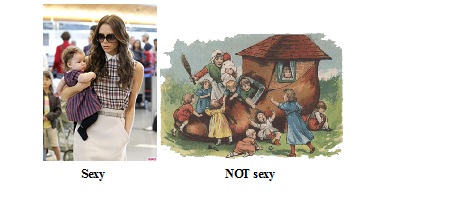
Considering the ways in which Family Planning and birth control have been discussed in different historical and cultural moments (in both “conservative” and “liberal” spaces), it’s important to recognize that public discussions of birth control are often less about a woman’s right to freely control her body, health, and sexual activity, and more about ways in which others might benefit from female self-discipline. The Disney short – which does not include one female name in the opening credits – is a perfect example. And while this is clearly a “vintage” film, that doesn’t necessarily mean that our current society has moved beyond these critiques. In fact, we might even classify our modern-day media’s obsession with women’s post-pregnancy bodies as a further means of pressuring women to control their reproductive potential, not for their own benefit, but for the benefit of those around them (husbands, public, modeling contracts, etc.).

Remember, ladies:

%name %title

Posted in Feminism, First-wave spanish feminism, Language, Science and Medicine, Women | Tagged , , , , , , , , , , , , | 2 Comments